
Sleep Environment Setup: Complete Bedroom Guide
Sleep environment setup means configuring your bedroom’s temperature (60–67°F / 15–19°C), light (complete darkness), noise (below 40 dB or masked), air quality (40–60% humidity, ventilated), and bedding to match your biology — not just your comfort preference.
In short: Your bedroom may feel fine and still be quietly wrecking your sleep. This guide shows you exactly what to fix first.
Your Bedroom May Be the Problem — Not You
You’ve tried everything. Earlier bedtimes, no caffeine after noon, even melatonin. And still — you lie there at 11pm, staring at the ceiling, wondering what’s wrong with you. Or you fall asleep fine and then jolt awake at 3am for no obvious reason. Is this normal? For millions of people, yes — and the cause is sitting four walls around them right now.
A sleep environment setup that feels comfortable and one that’s actually optimized for sleep are two different things. Your bedroom might feel cozy at 72°F — but that temperature is actively suppressing your deep sleep. You might not notice the amber standby light on your TV, but your brain does, all night long. Many people have silently built a bedroom that works against them, one small detail at a time, and they blame themselves for the result.
This isn’t about willpower or a sleep disorder. It’s an engineering problem. And engineering problems have solutions. Our Sleep Environment pillar covers every variable in detail — but this guide gives you the complete, prioritized system in one place. If you’ve said “my room feels fine but I sleep terribly,” keep reading: the data suggests your room is the reason, not a coincidence.
Is Your Bedroom Quietly Ruining Your Sleep?
Most sleep problems don’t start in the brain — they start in the bedroom. Check which of these situations describes your sleep environment tonight:
- My bedroom often feels warmer than I’d like when I’m trying to fall asleep
- I can see light sources in my room when my eyes are closed (streetlights, standby lights, hallway glow)
- Outside noise — traffic, neighbors, or a partner — regularly interrupts my sleep
- I wake up with a stuffy nose, dry throat, or itchy eyes in the morning
- My mattress or pillow is more than 7 years old
- I use my phone, TV, or laptop in bed within an hour of trying to sleep
If you checked 2 or more, your sleep environment has at least one fixable disruptor. This guide will show you how to find and fix it — starting with the highest-impact change.
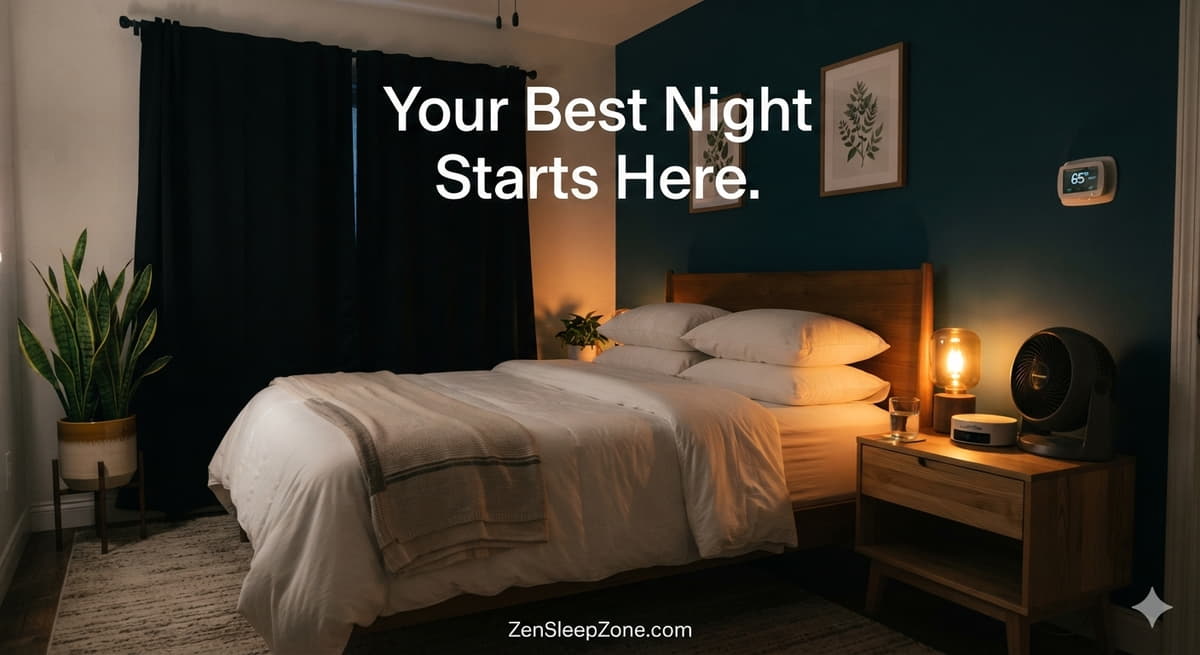
What if the one thing making you tired every morning costs nothing to fix tonight?
This guide is for educational purposes only and does not constitute medical advice — if you suspect a sleep disorder, please consult a qualified healthcare professional.
Temperature — The Most Powerful Lever in Your Bedroom 🌡️
Now that you know the problem is almost certainly environmental — not personal — the next question is: why does something as simple as room temperature affect something as complex as sleep? Understanding the mechanism is what turns a vague recommendation into something you’ll actually act on.
Your body doesn’t fall asleep on a schedule — it falls asleep in response to a drop in core body temperature. When you get tired in the evening, your body is actively shunting heat outward through your hands and feet, trying to lower your internal temperature by 1–2°F. Why is this happening? Because your thermoregulatory system uses that temperature drop as the trigger for sleep onset. A bedroom that’s too warm — even slightly — fights that process, delays sleep onset, and fragments your deeper sleep stages throughout the night.
What Is the Best Bedroom Temperature for Sleep?
The Cleveland Clinic recommends 60–67°F (15–19°C) for adult sleep, while the Sleep Foundation cites 65–68°F as the sweet spot for most people. [Cleveland Clinic, 2021] These aren’t arbitrary numbers: they reflect the ambient temperature at which your body’s thermoregulatory system can complete its core temperature drop without obstruction.
Bedroom above 67°F (19°C) → body cannot drop core temperature to trigger deep sleep
Reduced sleep efficiency, lighter sleep stages, more frequent night waking
Set thermostat to 65°F (18°C) or use a cooling mattress pad tonight — no cost beyond existing controls
That chain — warm room, blocked thermoregulation, fragmented sleep — is the entire mechanism. Once you see it, a slightly cool bedroom stops feeling like a sacrifice and starts feeling like medicine.
The research is specific about consequences: a 2023 longitudinal study using wearables and environmental sensors found that sleep efficiency was highest when nighttime ambient temperature ranged from 20–25°C (68–77°F), and dropped measurably — by 5–10% — when temperatures crept above 25°C. [Baniassadi et al., 2023] A 5–10% drop in sleep efficiency is not a subtle statistical artefact — it’s the difference between waking rested and waking groggy.
That gap between “feels comfortable” and “optimized for sleep” is one of the most important distinctions in sleep science. If your bedroom feels cozy at 72°F, it still isn’t serving your deep sleep — and your body knows it, even when you don’t.
Does Room Temperature Affect Deep Sleep Specifically?
Yes — and the effect is stage-specific. Slow-wave (deep) sleep and REM sleep are both thermosensitive. Deep sleep is most suppressed by overheating, while REM sleep — the stage associated with memory consolidation and emotional processing — is disrupted by both extremes. Cold below 55°F (13°C) increases arousals; heat above 77°F (25°C) reduces REM duration. The 60–67°F window isn’t a guess — it’s where both stages can run unimpeded. For a deeper look at what happens during each stage, see our guide to sleep stages and cycles.
Practical implication: if you’re the type who wakes between 2–4am — when body temperature naturally begins to rise — and can’t get back to sleep, a too-warm room is one of the most common culprits. Cooling the room by 2–3°F is often the fix that nothing else has been.
A slightly cool bedroom is not a discomfort. It’s a signal your biology has been waiting for.
Temperature Reference by Life Stage
| Life Stage | Recommended Range | Key Consideration |
|---|---|---|
| Adults (18–64) | 60–67°F / 15–19°C | Core temperature drop is the primary sleep-onset trigger; cooler is safer than warmer |
| Seniors (65+) | 66–70°F / 19–21°C | Thermoregulatory efficiency declines with age; slightly warmer is tolerated and often safer |
| Infants (0–12 months) | 68–72°F / 20–22°C | Infants cannot self-regulate temperature; overheating is a SIDS risk factor — no loose bedding |
| Children (1–12) | 65–70°F / 18–21°C | Closer to adult range; lighter sleepwear helps avoid overheating as metabolism runs warm |
| Pregnant adults | 60–65°F / 15–18°C | Basal body temperature is elevated during pregnancy; erring cooler supports comfort and sleep onset |
🔗 Your life stage changes your target — but temperature is always the first variable to audit.
Light and Darkness — How Your Bedroom Controls Your Biological Clock 💡
If temperature is the most controllable sleep variable, light is the most powerful circadian one. Your brain contains a master clock — the suprachiasmatic nucleus — that runs your 24-hour sleep-wake cycle. And that clock takes almost all of its time-setting information from one source: light. Every photon that reaches your retina after dark is a signal telling that clock to delay sleep.
That finding — that darkness is a biological requirement, not a comfort preference — changes how you should think about every light source in your bedroom. This includes the obvious ones (streetlights through thin curtains) and the invisible ones (the standby LED on your TV, the charging indicator on your laptop, the clock display on your router).
How Dark Does a Bedroom Need to Be for Good Sleep?
The research target is functional darkness — meaning no visible light sources detectable with fully dark-adapted eyes. In practice, that means you shouldn’t be able to see your hand in front of your face when the room is fully set up for sleep. Even low-intensity light (5–10 lux — roughly the level of a dim nightlight) has been shown to reduce melatonin production during the night. The AASM’s 2023 Sleep Prioritization Survey identified light as one of the two most commonly reported environmental sleep disruptors among American adults. [AASM, 2023]
For understanding the full mechanism behind light’s role in circadian biology, our guide to circadian rhythms covers the phototransduction pathway in detail.
How to Make a Bedroom Darker for Sleep — Blackout Options Compared
| Solution | Darkness Level | Rental-Friendly | Cost Tier | Best For |
|---|---|---|---|---|
| Blackout curtains (lined) | 90–99% light block | Yes (curtain rod) | $25–$80 | Primary window coverage — most households |
| Blackout roller blinds | 95–100% light block | Partial (command strip versions available) | $30–$120 | Precise fit, urban streetlight environments |
| Blackout liner clips | 85–95% light block | Yes — no drilling | Under $15 | Renters, temporary setups, gap-sealing |
| Sleep mask | 100% for eyes | Yes | $10–$30 | Shift workers, travel, light-sensitive sleepers |
| Black electrical tape over standby lights | 100% for point sources | Yes — removable | Free | Electronics, router LEDs, TV standby indicators |
🔗 Start with the free options tonight — tape over standby lights — before investing in curtains or blinds.
Blue Light from Screens — What the Evidence Actually Says
Evening screen use suppresses melatonin, delays circadian phase, and prolongs the time it takes you to fall asleep. A 2025 systematic review and meta-analysis in Frontiers in Neurology confirmed that blue light exposure in the hours before bed delays sleep onset latency — meaning screens genuinely push back the time your biology is ready to sleep. [Frontiers in Neurology, 2025]
Blue-light blocking glasses neutralise the sleep-disrupting effects of evening screen use.
The same 2025 meta-analysis found that blue-light blocking glasses produced non-significant effects on sleep onset latency and total sleep time in randomised controlled trials. Dimming screen brightness, enabling night mode, or stopping screen use 60 minutes before bed remains the evidence-supported approach.
This distinction matters practically: if you’re relying on blue-light glasses to offset evening screen time, the RCT evidence suggests they’re not sufficient protection. The more effective intervention is reducing screen luminance overall — not filtering a specific wavelength.
To explore how light and evening habits connect to sleep onset speed, our how to fall asleep fast guide covers the full pre-sleep routine framework.
Have you checked how many standby lights are currently visible in your bedroom right now?
Noise Control — Why Silence Isn’t Always the Answer 🔇
Most people understand that loud noise disrupts sleep. What’s less understood — and far more useful — is that noise doesn’t need to wake you to damage your sleep. Sounds that stay well below the threshold of conscious waking still register in your nervous system, pull you out of deep and REM stages, and leave you with fragmented sleep architecture even when you have no memory of being disturbed.
The AASM identified noise as one of the two most commonly reported bedroom sleep disruptors alongside light — and that finding reflects a pattern most sleep-disrupted adults will recognise immediately. Traffic, a partner’s breathing, upstairs neighbours, or even the ambient hum of a building all qualify. [AASM, 2023]
How Does Noise Affect Sleep Quality Even Without Waking You Up?
Your brain maintains environmental monitoring even during sleep — an evolutionary protection mechanism. When sound triggers this system, the brain briefly shifts from a deeper sleep stage to a lighter one, sometimes all the way to a micro-arousal. These events often last only seconds and leave no conscious memory, but they accumulate over a night and measurably reduce the proportion of slow-wave and REM sleep you obtain. The result is waking feeling unrested despite seemingly sleeping through the night.
For most renters and apartment dwellers, acoustic masking is the realistic and immediate solution — soundproofing requires structural changes that tenants cannot make. But for homeowners or those building a sleep sanctuary from scratch, a combination of both produces the best results.
White Noise vs. Pink Noise vs. Brown Noise — What the Evidence Shows
| Noise Type | Frequency Profile | Evidence for Sleep | Best For | Notes |
|---|---|---|---|---|
| White noise | Equal energy across all frequencies — sounds like a fan or static | Good — multiple RCTs in high-noise environments show improved sleep onset and efficiency | Urban noise masking, newborns, light sleepers | Can feel harsh to some listeners at higher volumes; keep below 50 dB |
| Pink noise | More energy in lower frequencies — sounds deeper, like steady rain | Emerging — small studies suggest enhancement of slow-wave sleep in adults | Adults seeking deeper sleep stages, not just noise masking | More pleasant to most listeners; promising but less replicated than white noise |
| Brown noise | Even more bass-heavy — sounds like distant thunder or strong wind | Limited — mostly anecdotal and self-report; no peer-reviewed sleep RCTs | Personal preference; anxiety reduction before sleep | Popular online but the weakest evidence base of the three |
| Nature sounds | Variable spectrum — birdsong, rainfall, ocean | Moderate — some studies show psychological relaxation benefit; masking is inconsistent | Pre-sleep relaxation; paired with sleep music therapy | Best for wind-down rituals rather than all-night masking |
🔗 If noise is your primary disruptor, start with white noise tonight — it has the strongest evidence base — and test pink noise over the following week.
Noise Level Reference — What Actually Disrupts Sleep
| Noise Source | Approximate dB | Sleep Impact | Recommended Response |
|---|---|---|---|
| Quiet bedroom (ideal) | 30–35 dB | None | Maintain — this is the target |
| Whispered conversation | 30 dB | Minimal | Usually tolerable; monitor for pattern disruption |
| Suburban ambient / AC unit | 40–45 dB | Mild fragmentation in light sleepers | White noise machine set at 45–50 dB to mask peaks |
| Street traffic / urban ambient | 50–60 dB | Measurable reduction in REM and deep sleep | Acoustic masking + door seal + heavy curtains to absorb |
| Snoring partner | 55–70 dB | Significant fragmentation; micro-arousals frequent | Partner evaluation for sleep apnea + masking + separate sleep consideration |
| Truck / construction / alarm | 70+ dB | Arousal-producing; consistent waking | Earplugs (NRR 30+) + masking; structural solutions needed long-term |
🔗 Knowing your approximate noise floor helps you choose the right tool — masking, physical barriers, or both.
Air Quality, Humidity, and Ventilation — The Overlooked Sleep Layer 🌬️
You’re actively weighing what changes are actually worth making — and this section covers the one area that almost no sleep advice mentions, despite having meaningful evidence. Can you actually improve your sleep by addressing the air in your bedroom? Yes — and for the roughly one in five adults with airborne allergen sensitivity, it may be the most impactful single change they haven’t yet considered.
Indoor air quality is almost never framed as a sleep concern. Most people think of air quality as a daytime health issue — relevant to asthma or outdoor pollution, but not to what happens in their bedroom at night. The reality is that a sealed bedroom with poor ventilation accumulates CO₂ as you breathe, drops in humidity during winter or rises above comfort in summer, and cycles allergens from mattresses and bedding through the air you inhale for seven or eight hours straight.
Does Humidity Affect Sleep Quality?
The evidence-supported bedroom humidity range for sleep is 40–60% relative humidity (RH). Below 30% RH — common in centrally heated winter bedrooms — the air dries out the mucous membranes of the nose and throat, increasing snoring, worsening sleep-disordered breathing, and producing the dry-mouth and scratchy-throat mornings that many people attribute to illness or dehydration. Above 65% RH, the environment becomes hospitable to mould growth and dust mite proliferation — both of which exacerbate allergic rhinitis and disrupt sleep through nasal congestion and inflammation.
The ideal bedroom humidity for sleep quality is 40–60% RH. Both extremes — below 30% and above 65% — are independently associated with sleep disruption through airway irritation, allergen proliferation, and thermal discomfort.
Environmental health and sleep science consensusMost people don’t own a hygrometer and have never measured their bedroom humidity — which means they’re flying blind on a variable that has a direct line to how they breathe all night. A basic digital hygrometer costs under $15 and gives you an immediate, objective reading.
Humidifier vs. Dehumidifier — When to Use Each
| Device | When to Use | Season / Context | Signs You Need It | Caution |
|---|---|---|---|---|
| Humidifier | RH below 40% | Winter, dry climates, centrally heated homes | Dry nose, scratchy throat, cracked lips in the morning | Clean weekly — stagnant water breeds bacteria and mould; use distilled water |
| Dehumidifier | RH above 60% | Summer, humid climates, basement bedrooms | Condensation on windows, musty smell, worsening allergy symptoms at night | Empty reservoir daily; place 12 inches from wall for airflow |
| Neither / ventilation only | RH 40–60% | Temperate climates, well-ventilated rooms | No morning airway symptoms; comfortable breathing through the night | Still measure seasonally — indoor humidity shifts with weather without notice |
🔗 Measure first with a $15 hygrometer — then decide which device, if any, your bedroom actually needs.
How to Reduce Allergens in the Bedroom for Better Sleep
Dust mites are microscopic arachnids that live in mattresses, pillows, and bedding — feeding on shed skin cells. For the estimated 20 million or more allergy sufferers in the United States, elevated dust mite allergen in bedroom textiles is a clinically recognised sleep disruptor: it triggers nasal congestion, post-nasal drip, and itching that fragments sleep without producing an obvious allergy symptom the sleeper can identify. Many people with dust mite sensitivity simply believe they’re a light sleeper or have “always slept badly.”
The dust mite reduction protocol involves five layers: encasing the mattress and pillows in allergen-proof covers, washing bedding weekly at 60°C (140°F) or higher, maintaining humidity below 50% (dust mites cannot survive at low humidity), replacing pillows every 1–2 years, and vacuuming the mattress surface every 2–3 months. No single step eliminates the allergen load — the combination does. For a broader look at how environmental factors relate to conditions like restless legs syndrome and sleep fragmentation, our disorders section provides deeper context.
What About CO₂ and Bedroom Ventilation?
This is the sleep environment factor that zero of the top sleep environment guides cover in any depth — and it’s genuinely consequential. When you sleep in a sealed room, you exhale CO₂ continuously. In a small, tightly insulated bedroom with windows and doors closed, CO₂ levels can rise from the outdoor baseline of roughly 400 parts per million to 1,000–2,000+ ppm by morning. Research in indoor environmental quality has linked elevated CO₂ levels — even in the 800–1,200 ppm range — to increased restlessness, reduced sleep quality ratings, and impaired morning alertness.
The simplest intervention: leave a window open by 1–2 inches (fitted with a security lock if needed), or open the bedroom door. If outdoor noise or pollution prevents this, a mechanical ventilation unit or a CO₂-aware air purifier is the next step. Measuring CO₂ is easy with a basic indoor air quality monitor — many double as hygrometers.
If your bedroom has no outdoor-facing window or only a sealed unit, run a HEPA air purifier set on its lowest setting overnight — it won’t ventilate CO₂ but will reduce particulate allergen load significantly, which is the more immediately disruptive factor for most sleepers.
Air quality improvements compound with other changes — fixing humidity, allergen load, and ventilation together produces a noticeably different breathing environment than any one fix alone.
Mattress, Pillow, and Bedding — Your Tactile Sleep Environment 🛏️
Here’s where many people land after fixing temperature, light, and noise: the sleep improves, but not completely. If you’ve cleaned up the environmental factors and still wake with back pain, overheat in the night, or find yourself shifting position every hour, your tactile environment — the surfaces you actually sleep on — is the remaining variable. Can improving your mattress, pillow, and bedding combination actually make a measurable difference? For most people who’ve been sleeping on a 10-year-old mattress or the wrong pillow loft for their sleep position: yes, and sometimes dramatically so.
How to Choose a Mattress for Better Sleep — A Decision Framework
The mattress market is enormous and its marketing is aggressively misleading. Price is not a reliable predictor of sleep quality — what matters is the match between the mattress’s characteristics and your sleep position, body weight, temperature preference, and any musculoskeletal needs. A $2,000 memory foam mattress can perform worse for a hot-sleeping side sleeper than a $600 latex hybrid — if the foam traps body heat and the hybrid allows airflow.
| Sleep Position | Recommended Firmness | Best Material | Temperature Profile | Key Need |
|---|---|---|---|---|
| Side sleeper | Soft to medium (3–5/10) | Latex, hybrid, or gel-infused foam | Neutral to cool | Hip and shoulder pressure relief; lateral spinal alignment |
| Back sleeper | Medium to medium-firm (5–7/10) | Hybrid, latex, or high-density foam | Neutral | Lumbar support; even pressure distribution across the back |
| Stomach sleeper | Firm (7–9/10) | Firm innerspring or firm latex | Cooler — stomach-down tends to trap heat | Prevents hip sinkage and cervical hyperextension |
| Combination sleeper | Medium (5–6/10) | Hybrid or responsive latex | Neutral to cool | Responsiveness — mattress adjusts quickly with position changes |
| Hot sleeper (any position) | Position-appropriate | Latex or hybrid with open-cell foam/airflow channels | Cool — avoid traditional dense memory foam | Heat dissipation; pair with cooling mattress pad if needed |
🔗 Your sleep position defines the firmness floor — temperature preference defines the material choice.
On mattress longevity: the average mattress life before measurable sleep quality decline is 7–10 years. Beyond that point, foam loses its pressure-relieving properties and springs lose their support profile. If your mattress is older than a decade, it’s not performing the way it was when purchased — regardless of how comfortable it still feels. Our full mattress buying guide walks through every category in clinical detail, including trial period strategy and return policy evaluation.
Pillow Selection by Position and Fill Type
| Sleep Position | Ideal Loft (Height) | Fill Type | Avoid |
|---|---|---|---|
| Side sleeper | High (4–6 inches) | Memory foam, latex, or firm down alternative | Soft down (collapses; leaves neck unsupported) |
| Back sleeper | Medium (3–4 inches) | Medium-density foam, latex, or adjustable fill | Very high loft (forces neck into flexion) |
| Stomach sleeper | Low (1–3 inches) or no pillow | Soft down, very soft foam, or buckwheat at low fill | High loft (causes cervical hyperextension) |
| Hot sleeper | Position-appropriate | Shredded latex, buckwheat, or cooling gel fill | Solid memory foam (traps heat) |
🔗 A mismatched pillow undermines spinal alignment all night — the right loft is as important as mattress firmness.
What Bedding Materials Are Best for Temperature Regulation?
Bedding material directly affects how much heat builds up between your body and the mattress surface during the night — one of the most common causes of 2–4am waking that people attribute to stress or a restless mind. Natural fibres with high moisture-wicking capacity — particularly percale cotton, bamboo, and linen — outperform synthetic fabrics for most sleepers, especially those who sleep warm. Our guide to bedding fabric types provides a full comparison across 12 material categories including thread count, weave structure, and allergen resistance.
Sleep Environment Visual Hub
See every environmental factor mapped visually — temperature zones, light levels, noise thresholds, and more.
See the Visual Guide →Sleep Environment Questions Answered
Every common bedroom setup question answered clearly — with direct evidence-based responses.
Read the Q&A →Sleep Environment Mind Map
Explore every environmental pillar and how they connect in one interactive visual overview.
Explore the Mind Map →Sleep Environment Statistics
The data behind temperature, light, noise, and air quality — all the key sleep environment research in one place.
Research the Stats →🔗 The visual guide is the fastest way to identify which pillar to tackle first in your specific bedroom.
Bedroom Layout, Electronics, Color, and Scent — The Psychological Layer 🎨
The physical environment of your bedroom — temperature, light, noise, air — operates on your biology directly. The psychological layer operates differently: it works through association, arousal, and the unconscious signals your brain reads when it walks into the room. If your bedroom is the place where you work, scroll, argue on the phone, or lie awake worrying — your brain has learned to associate it with wakefulness, not rest. This is conditioned arousal, and it’s real.
Is It Bad to Have Electronics in the Bedroom?
Electronics in the bedroom create two separate problems. The first is the light emission covered earlier — screens, standby LEDs, and device indicators all contribute to melatonin suppression. The second is associative: when you regularly use your phone or laptop in bed, your brain begins wiring the bedroom environment to alertness and engagement rather than sleep. Over time, climbing into bed starts triggering wakefulness rather than drowsiness — the opposite of what sleep requires.
The evidence-based recommendation is to remove all screens from the bedroom entirely where possible, and to stop using any screen within 60 minutes of target sleep time. For those for whom this is unrealistic, the minimum viable intervention is: keep screens out of bed (use a chair if you must watch something), enable maximum night mode, and cover or remove all standby indicators.
Common Mistake: Relying on Phone Night Mode as a Complete Solution
Night mode shifts screen colour temperature toward amber and reduces blue wavelength output — but it does not reduce overall screen brightness or the arousal effect of engaging content. A 2025 meta-analysis confirmed that blue-light filtering alone produces non-significant sleep improvements. Brightness reduction and content disengagement are the effective levers; colour temperature is secondary.
That said, if removing your phone entirely from the bedroom feels impossible tonight, start smaller: charge it across the room rather than beside your pillow. That single change reduces both light exposure and the temptation to check it during night wakings.
What Bedroom Colors Promote Sleep?
Environmental psychology research supports the principle that lower-arousal colour environments — muted, cool-toned, and low-saturation — are more conducive to pre-sleep relaxation than bright, warm, or highly saturated palettes. Specifically, soft blues, greens, and neutral greys have the strongest association with reported calm and drowsiness in bedroom settings. Highly saturated reds, oranges, and bright yellows are associated with increased alertness and energy — the opposite of what a sleep environment requires.
This doesn’t require repainting. Bedding, lampshades, and soft furnishings in cooler tones achieve the same psychological shift. The mechanism is not mysterious: your visual system reads chromatic saturation and warm-cool balance as signals about the environment’s level of stimulation, and your arousal level adjusts accordingly.
Does Aromatherapy — Specifically Lavender — Have Real Evidence for Sleep?
Lavender is the most-studied scent in sleep science, and the evidence is modest but real. Multiple peer-reviewed studies have found that inhaled lavender essential oil — via diffuser or applied to a pillow — is associated with reduced sleep onset latency and improved subjective sleep quality in adults. The effect size is small-to-moderate: lavender is not a cure for insomnia, but for people in a generally healthy but mildly disrupted sleep state, it may contribute to the pre-sleep relaxation cascade. It works best as a consistent environmental cue — your brain associates the scent with sleep over repeated exposures, making it a form of classical conditioning rather than pharmacology. Pair it with stress and sleep management strategies for best results.
What Is the Best Bedroom Layout for Sleep Quality?
Bedroom layout affects sleep primarily through two mechanisms: visual complexity and proximity to sleep disruptors. Cluttered, visually busy bedrooms produce a low-grade cognitive arousal effect — your brain processes the visual scene and maintains a background level of alertness that interferes with wind-down. The evidence base for this comes from environmental psychology rather than sleep polysomnography, but the effect is consistent across multiple studies.
The practical guidance: keep surfaces clear, limit the bedroom to sleep-associated objects only, and face the bed away from doors and windows where possible (both noise and light intrude from those directions most). Feng Shui’s directional bed placement (north-south orientation, etc.) has no sleep science evidence — but its emphasis on clutter removal and simplified visual environments aligns with genuine psychological arousal research.
When Is Poor Sleep an Environmental Problem vs. a Medical One?
This is a question worth answering directly: environmental optimisation addresses environmental causes. If you’ve made all five environmental adjustments — temperature, light, noise, air quality, and bedding — and sleep quality remains severely disrupted after two to three weeks, the cause is likely not your bedroom. Persistent insomnia (difficulty initiating or maintaining sleep at least three nights per week, for three months or longer) meets clinical criteria for an insomnia disorder and warrants evaluation by a healthcare provider. Similarly, symptoms including loud snoring, observed breathing pauses during sleep, or excessive daytime sleepiness despite adequate time in bed suggest possible sleep apnea — a condition that requires medical diagnosis and is not resolved by environmental changes alone. Our insomnia guide covers the distinction between insomnia disorder and environmental sleep disruption in detail.
Your Bedroom Disruptor Audit — Find Your Worst Offender First ✅
You’re ready to act — you’ve understood the mechanisms, you’ve compared the options, and now the question is simply: what do I fix first? That’s exactly the right question. The research is clear that fixing your single worst environmental disruptor produces the fastest, most measurable improvement. Trying to fix everything simultaneously leads to overwhelm, inconsistency, and the mistaken conclusion that none of it works.
The audit below is designed to answer that question systematically. It ranks each environmental factor by the strength of evidence for its impact, how easy it is to change, and what it costs — so you can triage your bedroom like an engineer, not guess like everyone else.
Bedroom Disruptor Priority Matrix
| Factor | Circadian / Sleep Impact | Evidence Strength | Ease of Fix | Cost Tier | Fix Tonight? |
|---|---|---|---|---|---|
| Temperature (too warm) | Suppresses deep sleep, delays onset, fragments night | Very high — multiple RCTs + longitudinal wearable data | High — thermostat adjustment is immediate | Free (thermostat) to $30 (fan) | ✅ Yes |
| Light (ambient, screens, standby) | Disrupts circadian phase, suppresses melatonin, fragments architecture | Very high — circadian biology consensus | High — tape over lights is free and immediate | Free to $80 (blackout curtains) | ✅ Yes |
| Noise (intrusive or variable) | Fragments deep and REM; increases micro-arousals even without waking | High — AASM + multiple acoustic sleep studies | High — free noise app or fan tonight | Free (app) to $50 (dedicated machine) | ✅ Yes |
| Electronics in bedroom | Light + conditioned arousal — undermines sleep association | High — screen/melatonin studies + behavioural evidence | High — remove or cover tonight | Free | ✅ Yes |
| Humidity (too dry or too humid) | Airway irritation, snoring, allergy symptoms — disrupts breathing quality | Moderate — environmental health consensus | Medium — requires measurement first ($15 hygrometer) | $15 (hygrometer) to $60 (humidifier) | ⚠️ Measure first |
| Allergens (dust mites, pet dander) | Nasal congestion, nocturnal rhinitis, fragmented breathing | Moderate-high — clinical allergy and sleep literature | Medium — encasements and washing needed | $20–$60 (mattress + pillow encasements) | ⚠️ Wash bedding tonight; encasements this week |
| Mattress/pillow age and fit | Pressure pain, poor alignment, heat trapping — reduces sleep continuity | Moderate — mattress age/quality and sleep outcome research | Low — replacement is a process not immediate | $200–$1,500+ | ❌ Plan for it — not tonight |
| CO₂ / ventilation | Rising CO₂ correlates with restlessness and impaired morning alertness | Moderate — indoor environmental quality research | High — open window 1–2 inches tonight | Free | ✅ Yes |
| Bedroom clutter / layout | Psychological arousal, conditioned wakefulness | Moderate — environmental psychology literature | Medium — 15-minute declutter session | Free | ⚠️ Partial fix tonight |
🔗 If you scored 3 or more fixable disruptors in the top four rows, your environment is doing most of the damage — and most of it costs nothing to address tonight.
Sleep Environment Setup Checklist — Your First 24 Hours
Tonight: Your First Environmental Changes (Free or Under $30)
- Lower your thermostat to 65–67°F (18–19°C) — or point a fan across your sleeping surface to create convective cooling. If you share a bed, consider a thin cooling mattress topper on your side only.
- Cover or unplug every light source in the room — black electrical tape over standby LEDs, router indicators, and charging lights. Move the TV’s standby LED out of your line of sight or tape over it.
- Stop all screen use 60 minutes before your target sleep time — or dim screens to minimum brightness if you cannot stop completely. Do not use devices in bed.
- Open a window by 1–2 inches — or open the bedroom door to allow CO₂ to exchange. If security or noise prevents this, note it for tomorrow’s planning step.
- Remove your phone from beside your pillow — charge it across the room. If you use it as an alarm, use a $10 dedicated alarm clock instead.
- Note your room temperature when you wake — if it has risen above 70°F by morning, you have a ventilation or insulation issue that needs a next-step solution (fan, AC, or window management).
🔗 This is the first-night minimum — you may notice a difference by night two or three, especially if temperature was your primary disruptor.
Budget-Tiered Action Plan
| Improvement | Free | Under $30 | Premium ($30+) |
|---|---|---|---|
| Temperature control | Lower thermostat; use existing fan; wear lighter sleepwear | Box fan ($20–$25); cooling gel pillow cover ($15–$25) | Cooling mattress pad ($80–$200); dual-zone bed temperature system ($400+) |
| Light blocking | Tape over LEDs; tuck a dark towel over curtain gaps; wear a sleep mask (if owned) | Blackout liner clips ($10–$15); sleep mask ($10–$20) | Lined blackout curtains ($40–$120); blackout roller blind ($60–$150) |
| Noise masking | Free white noise app on phone (screen off, volume low); position a fan | Basic white noise machine ($20–$30); foam earplugs ($5–$10) | Dedicated pink/white noise machine ($50–$150); acoustic door seal ($30–$60) |
| Humidity regulation | Open a window; bring indoor plants (minor humidity increase) | Digital hygrometer ($10–$15) | Cool-mist humidifier or dehumidifier ($40–$120) |
| Allergen reduction | Wash bedding at 60°C; remove bedroom rugs temporarily | Allergen-proof pillow encasement ($10–$20) | Full mattress encasement ($30–$80); HEPA air purifier ($80–$200) |
| Tactile environment | Flip your pillow; use lightest available bedding for current season | Percale cotton pillowcase ($15–$25) | New pillow matched to sleep position ($30–$100); mattress topper ($80–$300) |
🔗 Most of the fastest wins are free — the premium tier extends and refines those wins, not replaces them.
The Five-Pillar Framework — Your System Overview
The ZSZ Five-Pillar Framework
A Complete Sleep Environment Optimisation System
- Thermal Pillar — Set and maintain bedroom temperature between 60–67°F (15–19°C). Measure with a thermometer, not by feel. Use thermostat, fan, or cooling pad as the tool. Revisit seasonally — summer and winter require different approaches.
- Luminance Pillar — Eliminate all visible light sources during sleep hours. Prioritise window coverage first (highest lux), then electronics standby lights. Add a 90-minute evening wind-down with dimmed, warm-toned lighting to signal the circadian clock before blackout.
- Acoustic Pillar — Identify your noise floor (approximate dB) and choose between acoustic masking (white or pink noise) and physical barriers (door seals, heavy curtains, earplugs). Use both when noise is severe. Keep masking audio below 50 dB.
- Atmospheric Pillar — Measure and maintain humidity between 40–60% RH. Ventilate with at least a cracked window nightly. Replace bedding and clean mattress surfaces on a schedule to control allergen load. Consider a HEPA purifier in sealed or high-allergen environments.
- Tactile Pillar — Match your mattress firmness and pillow loft to your sleep position. Select bedding materials for breathability rather than thread count. Replace mattress after 7–10 years; pillows every 1–2 years. Add a cooling topper if your mattress is otherwise appropriate but runs warm.
🔗 Each pillar has a free version — start there, measure your sleep response, then invest in upgrades only where you see incomplete results.
Why Environment Fixes Sometimes Don’t Work — And What’s Actually Going On
Environmental optimisation addresses environmental causes. If you’ve made all five changes and sleep quality remains severely impaired after two to three consistent weeks, the problem is likely not your bedroom. Persistent difficulty falling or staying asleep three or more nights per week for three months or more meets clinical criteria for insomnia disorder — which requires cognitive behavioural therapy for insomnia (CBT-I), not environmental adjustment. Similarly, if you’re doing everything right but still feel exhausted during the day, excessive daytime sleepiness may indicate a sleep-disordered breathing condition. In both cases, the right next step is a healthcare consultation, not another bedroom purchase. Environmental changes are necessary but not always sufficient — and knowing when to escalate is part of the framework.
Signs This Is Working (Even Before Sleep Improves)
- You fall asleep more quickly than usual — within 20 minutes of lights out, even if you still wake later
- Morning nose or throat symptoms (dryness, congestion) reduce within 2–3 days of humidity or allergen changes
- You feel cooler and more physically comfortable in bed within the first night of a temperature adjustment
Sleep architecture improvements take 7–14 consistent nights to become measurable — don’t assess the intervention in the first 48 hours.
Setups for Every Sleeper Type — Demographic-Specific Guidance 👥
You’ve made your initial changes and your bedroom is better — but staying consistent and adapting the system to your specific situation is where most generic sleep advice falls apart. What works for a single adult in a controlled apartment is not the same as what works for a shift worker trying to sleep at 9am, or a couple with a 5°F temperature preference gap, or a new parent managing an infant’s sleep environment alongside their own.
This section is for the “what if it doesn’t work the same way for me?” moment — because demographic differences in environmental needs are real, evidence-documented, and almost entirely absent from competitor guides.
How to Set Up a Sleep Environment for Shift Workers
Shift workers sleeping during daylight hours face the most challenging environmental setup problem: fighting a circadian system wired to be awake when the body needs to sleep. The primary battleground is light — outdoor daylight during morning and midday hours is 10,000+ lux, which is the most powerful circadian signal available. Blackout solutions that achieve 99–100% light block are essential, not optional, for this group. Blackout roller blinds with gap-sealing tape, combined with a sleep mask as redundancy, is the gold standard.
Noise control is the second challenge — daytime ambient sound (traffic, construction, neighbours, deliveries) averages 55–65 dB in suburban environments and is higher in urban ones. A white noise machine at 50 dB provides the most consistent masking for unpredictable daytime noise patterns. Temperature management also differs: most homes are warmer during the day without active cooling. A dedicated fan, blackout curtains (which also reduce radiant heat from windows), and lightweight cooling bedding are essential. For jet lag management during rotating shift patterns, our jet lag recovery guide covers circadian realignment strategies.
Sleep Environment Setup for Couples with Different Temperature Preferences
Partner temperature incompatibility is one of the most commonly cited sleep environment complaints — and one of the most solvable without conflict. The core options, in order of escalating investment: separate top-layer bedding (each partner uses their own duvet on a shared base sheet — eliminates tug-of-war and allows each to regulate their own microclimate); a dual-zone cooling mattress pad (separate temperature controls for each side of the mattress — costs $200–$400+ but is the most effective solution); and different sleepwear choices (the partner who runs warm wears minimal layers; the partner who runs cold uses thermal pyjamas — free and effective as a first step).
A 5°F preference gap (e.g., one partner prefers 64°F and the other 69°F) is solved more easily than it sounds: setting the room to 66°F with a fan blowing across the warmer sleeper’s side of the bed typically satisfies both thresholds without conflict. For stress-related sleep incompatibility in shared sleeping arrangements, the stress and sleep guide addresses the psychological layer.
How to Set Up a Sleep Environment for Seniors
Thermoregulatory efficiency declines with age, which means seniors are both more vulnerable to temperature-related sleep disruption and more at risk from aggressive cooling. The target range for adults 65 and older shifts up to 66–70°F (19–21°C) — still cooler than most heated homes in winter, but warmer than the ideal range for younger adults. Seniors also tend to experience more frequent night waking from noise (sleep architecture lightens with age, reducing arousal thresholds), making acoustic masking more valuable in this group. Allergen control is particularly important for seniors with respiratory conditions: HEPA air purifiers and allergen-proof encasements provide the clearest risk-reduction benefit.
Safe Sleep Environment for Infants and Babies
Infant sleep environment setup is governed by safety evidence more than comfort optimisation. The American Academy of Pediatrics’ safe sleep guidelines specify: a firm, flat sleep surface; no loose bedding, pillows, bumpers, or toys in the sleep space; room temperature between 68–72°F (20–22°C); and the infant always placed on their back to sleep. Overheating is a documented SIDS risk factor — a single layer of light sleep clothing is typically sufficient without additional blankets. Room-sharing (but not bed-sharing) is recommended for the first 6 months. Our baby sleep training guide covers the full infant sleep environment framework including safe surface options, white noise use, and feeding-sleep associations.
Rental-Friendly Sleep Environment Improvements
Renters face structural limitations — no drilling, no permanent window treatments, no thermostat authority in some properties. But at least 80% of the highest-impact environmental improvements are either free or require no permanent alteration. The rental-specific toolkit: blackout liner clips (tension-mounted over existing curtain rods, no holes), command strip-mounted blackout panels, a portable white noise machine or fan, a hygrometer and portable humidifier for humidity control, a sleep mask for light gaps that curtains can’t solve, and allergen-proof encasements on mattress and pillows (protects against the landlord’s mattress, not just your own). The only significant limitation renters face is temperature — if the thermostat is building-controlled, a fan plus cooling bedding is the only viable tool.
Seasonal Adjustments and Maintenance Schedule 📅
A sleep environment that’s well-optimised in October can be actively disruptive by July — and many people experience this seasonal drift without connecting it to their bedroom. The room that was at 66°F with the window cracked is now hitting 74°F on summer nights. The humidity that was comfortable at 50% has dropped to 28% under winter heating. The blackout curtains that blocked dawn at 7:30am now let in light by 5:15am in midsummer. Sleep environment optimisation is not a one-time setup — it’s a system that needs seasonal calibration.
| Season | Temperature Action | Humidity Action | Light Action | Bedding Action |
|---|---|---|---|---|
| Spring | Switch from electric blanket / heavy bedding to fan and lighter layers; check thermostat setpoint | Phase out humidifier as outdoor humidity rises; monitor hygrometer weekly | Extend blackout coverage as sunrise advances; check curtain gaps as days lengthen | Transition from flannel or heavy duvet to percale cotton or bamboo |
| Summer | Run AC or fan to maintain 65–67°F; use blackout curtains to reduce radiant window heat; switch to cooling mattress pad | Monitor for humidity above 60% in humid climates; deploy dehumidifier or AC as needed | Maximum blackout priority — early sunrise is the biggest summer light disruptor; add blackout liner if existing curtains are insufficient | Lightest bedding tolerable — moisture-wicking percale or linen; remove duvet entirely if needed |
| Autumn | Reduce reliance on cooling; watch for evening ambient heat rising as heating activates; recalibrate thermostat | Begin monitoring for humidity drop below 40% as heating season starts; connect humidifier | Later sunrise means less pressure on blackout; use transition to check for curtain gap sealing ahead of winter | Add a light duvet layer; transition bedding from summer linens; wash before storage |
| Winter | Heating systems push rooms toward 70–75°F — the most common winter sleep disruptor; lower thermostat to 65°F at bedtime; use lightweight blankets not heavy heating | Central heating dries air significantly — humidifier is typically needed; target 45–55% RH | Shortest days reduce dawn light pressure; use transition to clean blackout curtains and check for wear | Add warmth through heavier duvet or electric blanket (remove before sleeping, not during); ensure bedding is allergen-washed after storage |
🔗 Most people experience their worst sleep in summer and don’t connect it to the room — temperature and early dawn light are almost always the culprits.
Bedroom Maintenance Schedule
Long-Term Maintenance: Keeping Your Sleep Environment Optimised
- Weekly — Wash pillowcases and sheets at 60°C or above (kills dust mites); empty and clean humidifier reservoir; check hygrometer reading and adjust humidity management if needed.
- Monthly — Vacuum mattress surface (especially along seams and edges where mite populations concentrate); wipe down white noise machine; clean air purifier pre-filter.
- Every 3 months (seasonal) — Audit all five pillars against your current season (use the seasonal table above); check blackout curtain seams for light gaps; replace HEPA filter in air purifier per manufacturer guidance; measure bedroom CO₂ if you have a monitor.
- Annually — Assess pillow condition (fold test: if a foam pillow stays folded, replace it; if a down pillow doesn’t spring back, replace it); evaluate mattress for sagging or pressure issues; check mattress and pillow encasement integrity.
- Every 7–10 years — Plan mattress replacement; assess whether sleep position has changed (common after injury, pregnancy, or significant weight change) and whether firmness profile still matches your needs.
🔗 The maintenance schedule is what separates a one-time bedroom project from a sustained sleep system — consistency here compounds over months and years.
For the complete statistical picture of how environmental factors interact with sleep quality across populations, the REM vs deep sleep guide explains how each stage responds differently to environmental disruption — which helps you interpret your own sleep quality changes as you make adjustments. And for the broader context of how circadian biology interacts with your sleep environment, our circadian rhythms guide is the natural next read.
A bedroom that works in January may not work in July. The system needs you to check in — not obsess, just check.
- Temperature is the most fixable high-impact variable — the evidence-supported range is 60–67°F (15–19°C); exceeding 77°F produces a clinically measurable 5–10% drop in sleep efficiency. Lower your thermostat tonight.
- Light, not noise, is the most powerful circadian disruptor — even standby LEDs and ambient glow suppress melatonin and fragment sleep architecture. Full darkness is a biological requirement, not a comfort preference.
- “Comfortable” and “sleep-optimised” are measurably different — your bedroom can feel cosy and still actively suppress your deep sleep. The gap between how a room feels and how it performs is the core insight of this guide.
- Air quality, CO₂, and humidity are the overlooked layer — almost zero competitor guides address this, yet it’s the primary disruptor for many readers with morning congestion, dry throats, or unexplained night restlessness. Measure humidity first; crack a window tonight.
- Your first environmental change should be free — thermostat, tape over LEDs, a cracked window, and a free noise app address the four highest-priority disruptors at zero cost. Premium solutions extend these wins; they don’t replace them.
- Demographics change the targets — seniors, infants, shift workers, couples, and renters each have specific environmental needs that generic “dark, quiet, cool” advice doesn’t address. Your situation may need a tailored framework, not a universal one.
- The environment is a system, not a one-time setup — seasonal recalibration (especially summer temperature and dawn light, winter humidity and heating) is what converts a good bedroom into a consistently performing sleep system.
- If environmental optimisation doesn’t resolve severe sleep difficulty, escalate — persistent insomnia and excessive daytime sleepiness are medical questions, not bedroom engineering problems.
🔗 You now have both the system and the science — what follows is the practical next step to take it further.
Quick Overview
- The free fix most people miss → Tape standby LEDs and lower the thermostat to 65°F — costs nothing, works tonight.
- Temperature has a hard evidence threshold → Above 77°F (25°C), sleep efficiency drops 5–10% measurably — “feeling fine” isn’t a reliable guide.
- Blue-light glasses don’t solve the screen problem → 2025 RCT meta-analysis: non-significant effect on sleep onset. Stop using screens in bed instead.
- CO₂ buildup in sealed bedrooms disrupts sleep → A cracked window changes the atmospheric composition of your sleep space — free and often overlooked.
- Mattress age predicts decline regardless of comfort feel → Beyond 7–10 years, pressure relief and support degrade even when the mattress still feels acceptable.
Your Bedroom Can Be a Biological Performance System — Not Just a Room
Explore our complete Sleep Environment resource library for every variable covered in depth — from mattress science to circadian lighting automation.
See the Visual Guide →Sources
- Baniassadi A et al. — Science of the Total Environment / PubMed Central — Nighttime ambient temperature and sleep efficiency in community-dwelling older adults; 5–10% efficiency drop at 25–30°C (2023)
- Sleep Foundation — Best Temperature for Sleep — Evidence-based optimal sleep temperature range 65–68°F; core body temperature drop mechanism (2024)
- Sleep Foundation — How to Design the Ideal Bedroom for Sleep — Light as primary circadian cue; low colour-temperature lighting and melatonin (2023)
- Cleveland Clinic — Ideal Sleeping Temperature — Optimal adult sleep temperature 60–67°F; REM sleep stability relationship (2021)
- American Academy of Sleep Medicine — Sleep Prioritization Survey 2023 — Light and noise identified as primary environmental sleep disruptors by US adults (2023)
- Frontiers in Neurology — Systematic Review and Meta-Analysis (2025) — Evening blue light exposure delays sleep onset; blue-light blocking glasses show non-significant effects on sleep outcomes in RCTs (2025)
What is the ideal room temperature for sleeping?
The ideal bedroom temperature for sleep is 60–67°F (15–19°C) for most adults, with 65°F often cited as the practical sweet spot. This range supports the core body temperature drop that triggers and maintains deep sleep. Temperatures above 77°F (25°C) produce a measurable 5–10% drop in sleep efficiency. Seniors may sleep better at 66–70°F due to reduced thermoregulatory efficiency. For the full mechanism and demographic-specific targets, see our Sleep Environment pillar.
Does a dark room help you sleep better?
Yes — and darkness matters more than most people realise. Light is the primary signal for the human circadian clock. Even low-level ambient light (5–10 lux — the level of a dim nightlight) suppresses melatonin production during sleep. Complete functional darkness during sleep hours is a biological requirement, not a comfort preference. Standby LED lights, charging indicators, and streetlight glow through thin curtains all qualify as disruptors. Start with black tape over LED sources — it’s free and works immediately. Learn more at our sleep environment questions answered hub.
What noise level is best for sleeping?
The target bedroom noise floor for sleep is 30–35 dB — roughly the level of a quiet library. Sounds above 40 dB begin to produce micro-arousals in lighter sleepers even without causing conscious waking. When environmental noise cannot be reduced below 50 dB, acoustic masking with white or pink noise at a consistent 45–50 dB raises the baseline and reduces disruptive contrast. The AASM identifies noise as one of the two most commonly reported bedroom sleep disruptors. Explore the full comparison of masking options in our sleep environment visual guide.
Does humidity affect sleep quality?
Yes, significantly. The evidence-supported humidity range for bedroom sleep quality is 40–60% relative humidity. Below 30% RH — common in winter-heated homes — the air dries mucous membranes, worsens snoring, and produces morning throat and nasal symptoms. Above 65% RH, mould and dust mite populations increase, aggravating allergic rhinitis and disrupting breathing quality during sleep. A basic digital hygrometer (under $15) gives you an immediate reading. Then add a humidifier for dry conditions or a dehumidifier for excess humidity. Find the full data breakdown at our sleep environment statistics page.
Is it bad to have electronics in the bedroom?
Yes — for two distinct reasons. First, screens and standby LEDs emit light that suppresses melatonin and delays circadian phase. A 2025 meta-analysis confirmed that evening blue light exposure prolongs sleep onset latency. Second, using devices in bed creates conditioned arousal: your brain learns to associate the bedroom with wakefulness and engagement rather than rest, making it harder to fall asleep over time. The most effective change is removing screens from the bedroom entirely and stopping use 60 minutes before target sleep time. Blue-light blocking glasses alone are not sufficient — RCT evidence shows non-significant effects on sleep outcomes. More detail in our sleep environment questions answered hub.
How do I reduce allergens in my bedroom for better sleep?
Dust mite allergen in mattresses and pillows is a clinically recognised sleep disruptor for allergy sufferers — producing nasal congestion and inflammation that fragments breathing quality throughout the night. The five-step reduction protocol: encase mattress and pillows in allergen-proof covers; wash all bedding weekly at 60°C or above; maintain bedroom humidity below 50% RH (dust mites die at low humidity); replace pillows every 1–2 years; and vacuum the mattress surface every two months. No single step is sufficient — the combination reduces allergen load significantly. See the Bedding Fabric Finder & Visual Hub for allergen-resistant material options.
What colors help you sleep?
Environmental psychology research supports muted, cool-toned, and low-saturation colours as most conducive to pre-sleep relaxation. Soft blues, sage greens, and neutral greys are consistently associated with calm and reduced arousal in bedroom environments. Highly saturated reds, bright oranges, and vivid yellows are associated with increased alertness — the opposite of what sleep onset requires. Repainting is not necessary: bedding, lampshades, and soft furnishings in cooler tones achieve a similar psychological effect. Pair colour changes with the Circadian Rhythms Q&A for full context on how lighting colour temperature interacts with melatonin production.
How do I make my bedroom better for sleeping — where do I start?
Start with the highest-evidence, lowest-cost change: lower your bedroom temperature to 65°F (18°C) tonight. If your room runs warm, add a fan. Then cover or remove all standby light sources — tape over LEDs, move your phone charger outside the bedroom. These two changes — temperature and light — address the two most powerful and most commonly active sleep disruptors, and both cost nothing if you already own the tools. From there, use the bedroom disruptor priority matrix in this guide to identify your third most active disruptor and address it next. For a structured next step, explore the Mattress Selector & Visual Hub if your tactile environment is the remaining gap.