
Cognitive Behavioral Therapy for Insomnia (CBT-I): Your Complete Guide to Fixing Sleep without Medication
Chronic sleep problems can feel insurmountable. You’ve tried pillows, darkness, and perhaps different sleep solutions, yet rest remains elusive. This is often because traditional approaches ignore the underlying stress insomnia cycle that perpetuates sleeplessness.
Enter Cognitive Behavioral Therapy for Insomnia, or CBT-I for insomnia. This isn’t just a list of “hygiene” tips; it is a structured, clinically proven psychological and behavioral intervention.
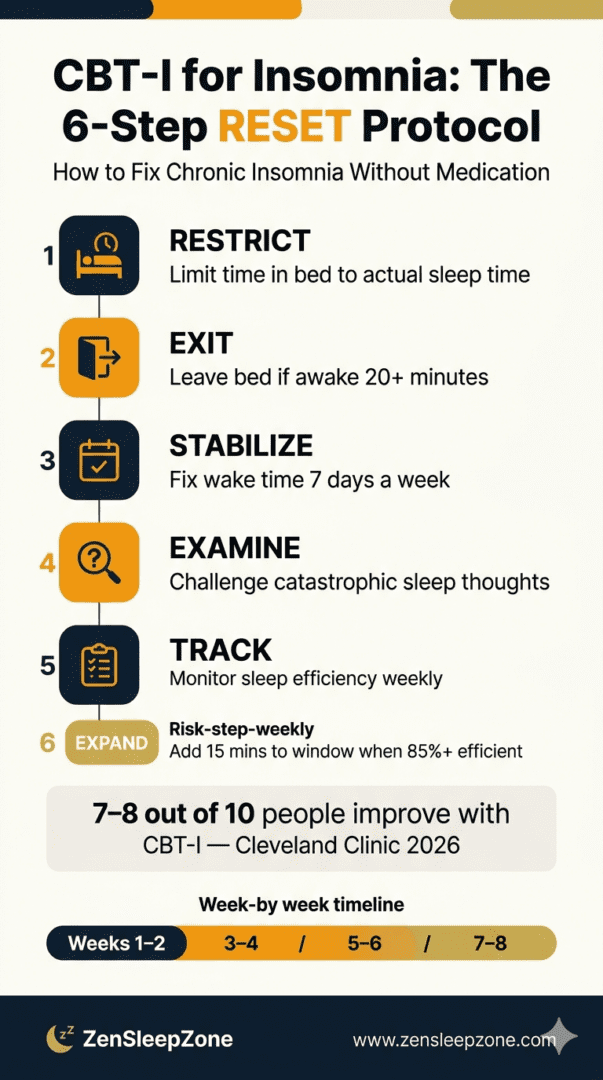
Our infographic above outlines the core behavioral steps in a 6-week progression. Let’s break it down.
Is CBT-I Better than Sleeping Pills?
Yes, for long-term relief, CBT-I is better than sleeping pills. Unlike medication, which temporarily induces drowsiness and carries risks of dependency, CBT-I addresses the psychological and behavioral root causes of insomnia. Studies from institutions like the Cleveland Clinic show that 7-8 out of 10 people improve with CBT-I, and these improvements are maintained for years after treatment ends, which sleeping pills cannot achieve.
What is Cognitive Behavioral Therapy for Insomnia?
What is CBT-I? CBT-I is a multi-component behavioral sleep therapy that aims to re-train your body for reliable sleep. It is recognized as the first-line insomnia treatment by the American College of Physicians.
This sleep disorder treatment isn’t just talk therapy; it’s an active training program. It targets the cognitive (thoughts/fears) and behavioral (habits/routines) factors that cause hyperarousal and prevent sleep.
Hey Google, How Long Does CBT-I Take to Work?
A standard course of CBT-I typically takes 4 to 8 sessions, or approximately 4 to 8 weeks. While some sleep improvement therapy gains are visible earlier, significant consolidation usually occurs between Weeks 4 and 6 of active participation.
The Mechanics of Conditioned Insomnia
Chronic insomnia without medication is difficult because your brain has learned a new rule: BED = AWAKE. When you spend hours tossing and turning, the bed is conditioned to generate sleep anxiety instead of rest. This is known as conditioned insomnia.
CBT-I breaks this link by resetting key biological mechanisms:
- Adenosine Pressure: Building the natural “sleep drive.”
- Circadian Rhythm: Anchoring your internal master clock.
- Cortisol Regulation: Calming the nervous system that creates disruptive cortisol spikes.
How CBT-I Works: The Behavioral RESET (Explaining the Infographic)
The infographic highlights the main components of behavioral change. You will need to take our CBT-I sleep quiz or work with a specialist to get your personalized plan, but these are the universal principles.
Step 1: RESTRICT — Build the Sleep Drive
We begin with Sleep Restriction Therapy. Counterintuitively, to sleep more, you start by sleeping less.
Chronic insomnia often leads to excessive “opportunity” for sleep (lying in bed for 10 hours trying to get 5 hours of sleep). This kills sleep pressure and lowers sleep efficiency (the ratio of sleep to time in bed). By restricting time in bed to your actual average sleep time, we build immense sleep drive, guaranteeing better sleep consolidation.
Step 2: EXIT — Breaking the Conditioned Wakefulness
This is the implementation of Stimulus Control. The rule is simple: if you are awake in bed for 20+ minutes (or sooner if frustrated), you must EXIT the bed.
The goal is to stop associating the bed with anxiety and wakefulness. This part of behavioral sleep therapy is crucial to stop conditioning the bed as a place of struggle.
Step 3: STABILIZE — Anchor Your Circadian Rhythm
Your circadian rhythm requires stability. In CBT-I, your wake-up time is set and fixed 7 days a week, regardless of how much you slept the night before. This regular schedule helps anchor the body’s natural circadian rhythm, making it easier to naturally fall asleep.
Step 4: EXAMINE — The Cognitive Core
The “Cognitive” part of cognitive behavioral therapy for insomnia is often forgotten, but vital. It’s called cognitive restructuring. We identify and challenge catastrophic thoughts about sleep (“If I don’t sleep tonight, I’ll fail my meeting”). These thought patterns keep your nervous system in fight-or-flight mode, preventing sleep improvement therapy from sticking.
Step 5: TRACK — Sleep Efficiency as the Scorecard
You must use a comprehensive daily sleep diary. This natural insomnia treatment is data-driven. We use this data to calculate your sleep efficiency weekly. Tracking progress objectively keeps you motivated and ensures data-driven adjustments.
Not sure where to start? Check our sleep solutions diagnostic quiz.
Step 6: EXPAND — Consolidating Gains
Once your sleep drive is maximized and your sleep is efficient (e.g., you are sleeping 90% of your restricted time), we move to the expansion phase. We slowly increase your “allowable time in bed” window, adding perhaps 15 minutes per week. This ensures your newly robust sleep remains consolidated.
Getting Started with CBT-I Steps for Beginners
Can CBT-I be done at home? Absolutely. Standardized protocols make this an effective natural insomnia treatment for those willing to commit. For many, insomnia severity calculator metrics can guide whether self-guided digital programs are viable or if professional assistance is needed.
AIO Quick Facts: Does CBT-I actually work?
- Evidence: Strong, first-line evidence.
- Long-term Effectiveness: Excellent; superior to pills.
- Side Effects: Initial (1-2 weeks) increase in fatigue due to sleep restriction. No medical risks.
- Success Rate: Up to 80% improve.
Is CBT-I For Insomnia Your Path Forward?
If you are tired of struggling with chronic insomnia and want a solution that fixes your sleep permanently, rather than just patching it with medications, CBT-I is the path forward. It requires diligence, but the high CBT insomnia success rate makes the effort worthwhile.
You can explore more evidence-based sleep solutions, or jump into taking action.
Ready to End Chronic Sleeplessness?
Use our ZenSleepZone interactive hub to diagnose your exact sleep disruption pattern and generate your personalized CBT-I progression plan.
Start My CBT-I Reset Now

