
Mindfulness for Sleep Infographic Guide
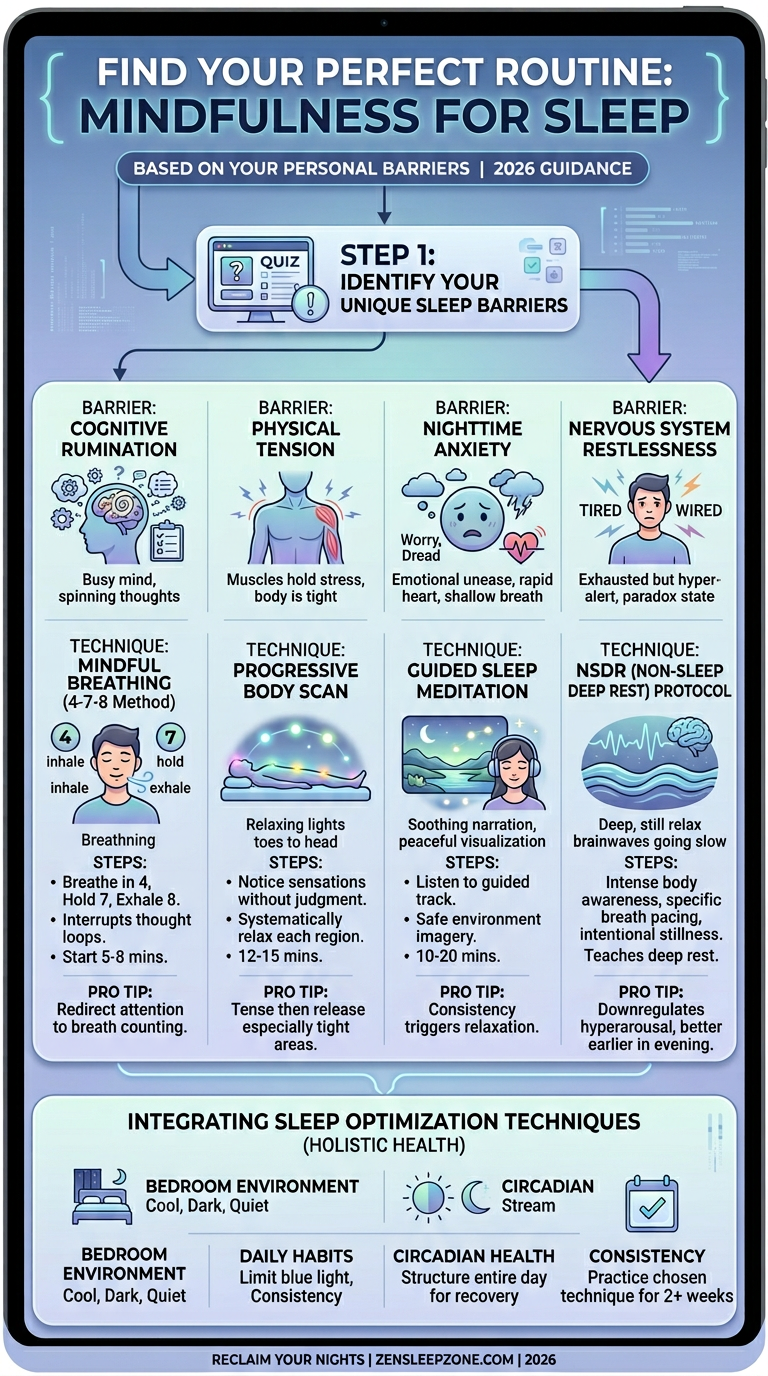
The attached infographic, titled “Find Your Perfect Routine: Mindfulness for Sleep”, is built around a simple but smart idea: stop treating every bad night the same. Instead, the graphic asks you to identify your personal barrier first, then match it to the right practice. That makes this more useful than a generic bedtime checklist. Whether your issue is cognitive rumination at night, physical tension before bed, nighttime anxiety and sleep disruption, or plain nervous system restlessness, the goal is to build a personalized mindfulness sleep routine that fits the real reason you are not settling.
What the infographic covers at a glance
The visual opens with Step 1: Identify Your Unique Sleep Barriers, then groups readers into four common patterns: cognitive rumination, physical tension, nighttime anxiety, and a “tired but wired” state of nervous system restlessness. Each barrier is paired with a matching technique: mindful breathing for sleep, progressive body scan for sleep, guided sleep meditation, or NSDR for sleep. The bottom panel then adds four support layers: a cool, dark, quiet bedroom, healthier daily habits, stronger circadian structure, and at least two weeks of consistent practice.
How the mindfulness for sleep infographic works
The most useful part of this graphic is its sequence. It does not start with “try meditation.” It starts with self-identification. That is why it fits naturally within spiritual sleep practices that support better nightly rest. The top section uses a quiz-style visual and the phrase “based on your personal barriers,” which signals user intent clearly: this is not one-size-fits-all advice. It is a sorting tool disguised as an infographic.
That approach matters because different sleep blockers need different responses. Someone with looping thoughts is not experiencing the same problem as someone whose shoulders, jaw, and chest stay tight at bedtime. Mindfulness for sleep works best when it becomes specific.
Research insight: A 2019 systematic review and meta-analysis in Annals of the New York Academy of Sciences found that mindfulness-based interventions produced meaningful improvements in self-reported sleep quality, especially where stress and pre-sleep arousal were present.
The 4 sleep barriers shown in the infographic
The graphic does a good job of translating vague sleep struggles into four understandable patterns. This connects well with the broader spirituality and sleep framework for nightly recovery, because it recognizes that rest is mental, emotional, and physical at the same time.
| Barrier | What the infographic says | Best first technique |
|---|---|---|
| Cognitive rumination at night | Busy mind, spinning thoughts, mental loops that keep attention locked on problems. | Mindful breathing for sleep using the 4-7-8 pattern. |
| Physical tension before bed | Muscles holding stress, body still tight even when you feel tired. | Progressive body scan for sleep. |
| Nighttime anxiety and sleep | Worry, dread, emotional unease, faster heart rate, shallow breathing. | Guided sleep meditation. |
| Nervous system restlessness | “Tired but wired” state, exhausted yet hyper-alert, paradoxically unable to drop into rest. | NSDR for sleep, ideally earlier in the evening. |
Research insight: Insomnia research often separates cognitive arousal from somatic arousal. In plain language, that means some people are kept awake by thought intensity, while others are kept awake by body activation. This infographic mirrors that distinction well.
Why each technique fits its barrier
The middle panel is where the infographic becomes practical. Rather than throwing ten tools at the reader, it gives one starting technique per barrier. If you want more depth on these methods, pair this visual with guided sleep meditation techniques for a calmer pre-bed transition.
1) Mindful breathing for sleep for cognitive rumination
The infographic recommends the 4-7-8 method: inhale for 4, hold for 7, exhale for 8, and start with 5 to 8 minutes. The logic is sound. When attention keeps feeding thought loops, structured breathing gives the mind a job. The pro tip on the graphic—redirect attention to breath counting—is especially useful because counting competes with rumination instead of arguing with it.
2) Progressive body scan for sleep for physical tension
Here the graphic tells the reader to notice sensations without judgment, then systematically relax each region from toes to head for 12 to 15 minutes. That is classic body-scan logic: awareness first, release second. Its added pro tip—tense then release especially tight areas—can help people who do not notice how much stress they are still holding.
3) Guided sleep meditation for nighttime anxiety and sleep disruption
For readers whose barrier is emotional unease, the infographic recommends a guided track, safe imagery, and 10 to 20 minutes of listening. This is a strong match because anxious states usually benefit from external guidance. Instead of generating more internal dialogue, the mind follows a soothing structure and begins to associate bedtime with safety rather than dread.
4) NSDR for sleep for nervous system restlessness
The most modern entry on the graphic is NSDR, or Non-Sleep Deep Rest. The infographic describes it as intense body awareness, specific breath pacing, and intentional stillness that teaches deep rest. Its pro tip—use it earlier in the evening to downregulate hyperarousal—is thoughtful. People in a “tired but wired” state often need a buffer before bed, not just a last-minute fix. If this section resonates, related yoga nidra benefits for deep rest and nervous system downshifting may also be relevant because NSDR methods often overlap with yoga nidra-style guided rest.
Research insight: Evidence is strongest for mindfulness, slow breathing, and relaxation practices broadly. For example, a 2018 review in Frontiers in Human Neuroscience linked slow breathing with beneficial shifts in autonomic regulation. The specific “NSDR” label is newer, but its underlying methods overlap with established relaxation approaches.
Why the bottom panel on sleep optimization techniques matters
Many readers will focus only on the top half of the infographic, but the bottom panel may be what makes the routine actually work. It reminds you to integrate your practice with a stronger sleep environment setup for a cool, dark, quiet bedroom. That matters because even the best mindfulness technique struggles when the room is bright, noisy, too warm, or full of stimulation.
The graphic also highlights daily habits, blue-light limits, circadian structure, and consistency. That is not filler. It is foundational. If your sleep timing is irregular, your brain receives mixed signals about when to be alert and when to wind down. This is where how circadian rhythms guide sleep timing and recovery becomes essential reading. In other words, sleep optimization techniques make your chosen mindfulness tool easier to absorb.
The infographic’s last line in this section—practice your chosen technique for 2+ weeks—is realistic. A mindfulness sleep routine is not a one-night trick. It is conditioning.
Research insight: A 2015 PNAS study by Chang and colleagues found that evening use of light-emitting eReaders delayed circadian timing and reduced next-morning alertness. That supports the graphic’s advice to limit blue light and protect circadian health for sleep.
How to use this infographic as a 2-week plan
The best way to use this infographic is not to sample all four techniques at once. Pick the barrier that feels most dominant, then stay with the matching method consistently. If you want a more guided self-check first, the mindfulness for sleep assessment to identify your biggest barrier is the natural next step.
- Choose one barrier: rumination, tension, anxiety, or restlessness.
- Use one technique nightly: 4-7-8 breathing, body scan, guided sleep meditation, or NSDR.
- Support it with basics: a darker room, less blue light, and steadier sleep timing.
- Review after 2 weeks: if the fit feels wrong, reassess rather than quitting.
If your nights are more complex than one barrier, the spirituality and sleep health assessment for wider pattern awareness can help you see whether the issue is bedtime-specific or part of a broader stress-and-recovery pattern.
Research insight: Repetition is part of the mechanism. Mindfulness-based sleep tools usually become more effective as the brain starts associating a repeated cue with safety, slowing, and rest.
When mindfulness helps most — and when you may need more support
This infographic is strongest for people whose sleep trouble is stress-linked, emotionally loaded, or fueled by overstimulation. It is an excellent fit for readers who want a practical, non-pharmacological starting point. For a wider visual context, the spirituality and sleep infographic for a broader visual overview complements this piece well.
But if you have chronic insomnia, loud snoring, breathing pauses, severe panic, trauma symptoms, or disabling daytime sleepiness, mindfulness alone may not be enough. It can support recovery, but it should not replace proper assessment when symptoms are persistent or severe.
Research insight: The American College of Physicians recommends CBT-I as first-line treatment for chronic insomnia in adults. That does not diminish mindfulness for sleep; it simply clarifies where mindfulness is supportive and where formal insomnia treatment may be needed.
Ready to turn this infographic into an actual nightly practice? Start with our complete mindfulness for sleep guide with step-by-step routines to build a bedtime approach around your real barrier, not guesswork.
FAQ
What is the main idea of the mindfulness for sleep infographic?
It helps you identify your biggest sleep barrier first, then match that barrier to the most suitable practice. That is why the infographic feels more personalized than a general sleep-tip list.
Is mindfulness for sleep enough for chronic insomnia?
Sometimes it helps a lot, especially with stress and overthinking, but persistent insomnia may still need clinical care and structured treatment such as CBT-I.
How long should I practice one technique before switching?
The graphic suggests at least two weeks, which is sensible. Consistency is part of the treatment effect, especially when you are retraining your response to bedtime.
Sources
- Black DS, O’Reilly GA, Olmstead R, Breen EC, Irwin MR. Mindfulness Meditation and Improvement in Sleep Quality and Daytime Impairment Among Older Adults With Sleep Disturbances. JAMA Internal Medicine. 2015.
- Rusch HL, Rosario M, Levison LM, et al. The effect of mindfulness meditation on sleep quality: a systematic review and meta-analysis of randomized controlled trials. Annals of the New York Academy of Sciences. 2019.
- Zaccaro A, Piarulli A, Laurino M, et al. How Breath-Control Can Change Your Life: A Systematic Review on Psycho-Physiological Correlates of Slow Breathing. Frontiers in Human Neuroscience. 2018.
- Chang AM, Aeschbach D, Duffy JF, Czeisler CA. Evening use of light-emitting eReaders negatively affects sleep, circadian timing, and next-morning alertness. Proceedings of the National Academy of Sciences. 2015.
- Qaseem A, Kansagara D, Forciea MA, Cooke M, Denberg TD. Management of Chronic Insomnia Disorder in Adults. Annals of Internal Medicine. 2016.
This article explains the attached infographic for educational purposes and should not replace medical advice or diagnosis.


