
The Brain Mechanic: Infographic: Why Anxiety Before Bed & Lower Cortisol Naturally
It’s 11:30 PM. The lights are off. Your body is exhausted. But your brain? Your brain has just activated its maximum processing power. If this scenario is your nightly reality, you are familiar with the phenomenon of “pre-bedtime anxiety.”
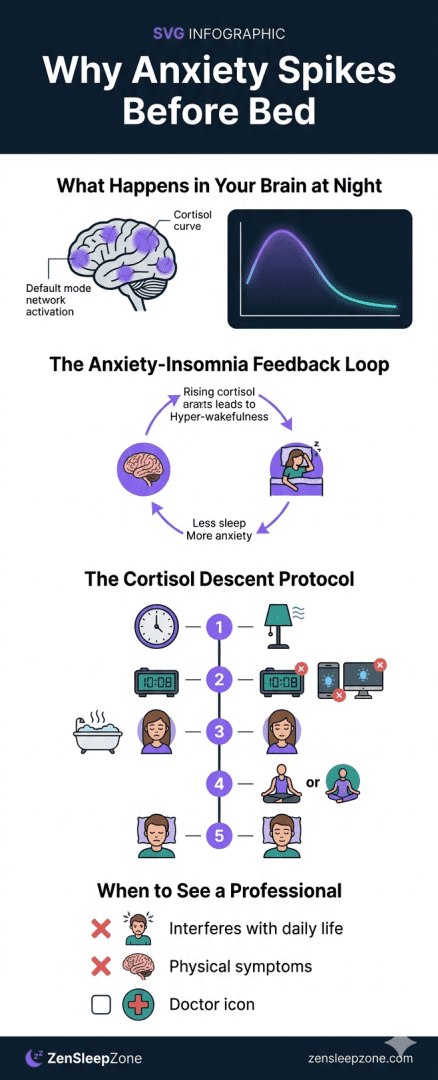
This experience is more than a bad habit; it is a physiological event. The infographic above provides a visual guide to why this happens and, more importantly, a scientifically validated protocol to reverse it. This article will deconstruct each component of that image, serving as your complete guide to sleep mental health complete guide.
Let’s dive into the core sections, optimized for voice search (AEO) and structured user experience (SXO).
Section 1: What Happens in Your Brain at Night (The Default Mode Network)
The first panel of our infographic visually answers a fundamental question: Why does my brain wait until bedtime to stress?
The reason lies within the default setting of the human brain. When we are awake and performing tasks, our Central Executive Network (CEN) is dominant. It focuses on the external world, problem-solving, and logic. Our mind feels “contained.”
However, when we lie down in a dark, quiet room, the CEN shuts off. In its place, the Default Mode Network (DMN) activates. The DMN is the brain’s “rest” setting, but its functions are far from calm. The DMN is responsible for introspection, time travel (rumination on the past or worry about the future), and self-referential thought.
Essentially, when the external world goes quiet, the internal world becomes loudest. If your DMN is habitually prone to negative bias, this activation is experienced as a spike in anxiety.
The Improper Cortisol Curve
This neurological shift is compounded by a hormonal one. Your cortisol—the primary stress hormone—is supposed to operate on a tight 24-hour cycle. Cortisol levels should peak in the early morning to wake you and then steadily decline throughout the day, reaching their absolute lowest point just before bedtime. This natural dip creates a biological “all-clear” signal, allowing sleep to begin.
For those experiencing bedtime anxiety, this cortisol curve looks different. Stressors throughout the day prevent the decline, leaving cortisol levels elevated late into the evening. Instead of an all-clear signal, your brain receives a “danger” signal, keeping you in a state of high hyper-wakefulness.
Section 2: Awareness: The Anxiety-Insomnia Feedback Loop
This is where understanding the system becomes vital. Our second panel illustrates the powerful cycle that traps millions. This feedback loop is the deeper connection between anxiety and insomnia.
The loop operates as follows:
- Rising Cortisol: Elevated from daytime stress or DMN activity.
- Hyper-wakefulness: Your brain is chemically convinced there is a threat (e.g., worry about tomorrow’s performance).
- Less Sleep: Sleep latency increases; you remain awake.
- More Anxiety: This is the key link. Once you realize you are not sleeping, you begin to worry about the consequences of sleep deprivation (e.g., “If I don’t sleep now, I will be useless tomorrow.”). This new anxiety creates *more* stress, releasing *more* cortisol.
The loop is a classic “all-or-nothing” cognitive distortion. Addressing it effectively requires cognitive behavioral therapy for insomnia. These CBT-I techniques for bedtime anxiety can teach you to identify and restructuring the catastrophic thoughts that fuel this specific section of the loop.
Section 3: Action: The Cortisol Descent Protocol
The infographic isn’t just diagnostic; it is a prescriptive tool. Panel three provides a simple, five-step workflow designed to reverse the hormonal and neurological factors we’ve discussed.
| Step | Action | AEO (Voice Search) Mechanism |
|---|---|---|
| 1 | Dim the Lights (1-2 Hrs Before Bed) | Does light affect anxiety? Yes. Reduced light triggers melatonin (the sleepiness hormone) and signals the circadian rhythm that the cortisol decline phase is active. |
| 2 | Avoid Blue Light & Screens (Digital Detox) | How does screen light affect sleep? Screens emit artificial blue light that mimics daylight, directly blocking melatonin production and stimulating alertness, which is a stress response. |
| 3 | Warm Bath or Shower | Why does a bath help sleep? It’s not just relaxation. The critical factor is the rapid drop in core body temperature after the bath, which is a strong physiological trigger for sleepiness. |
| 4 | Yoga or Deep Meditation (CBT-I Skill) | What are meditation techniques for anxiety? These practices activate the parasympathetic nervous system (rest and digest) and suppress the default mode network (DMN), providing natural solutions for sleep anxiety. (explore more natural solutions for sleep anxiety). |
| 5 | Relaxed Mindset (Cognitive Control) | How to stop thinking before bed? Step 4 (CBT-I) provides tools to disengage from catastrophic loops, allowing the DMN to go dormant. You enter bed relaxed, which is a state of lowered cortisol. |
This protocol addresses the physiological need for cortisol descent while employing daytime stress strategies that protect bedtime in Section 2—stopping stress before the curve gets spiked.
Section 4: Decision: When to See a Professional
While the Cortisol Descent Protocol is highly effective for moderate levels of nighttime arousal, anxiety disorders require specialized intervention. The final panel of our infographic serves as a vital checklist. If your experience includes these red flags, your brain is signaling the need for help.
- [✓] Interferes with daily life: Your daytime functioning (work, focus, mood) is chronically impaired by a lack of sleep.
- [✓] Physical symptoms are present: Your nighttime anxiety is accompanied by panic attack symptoms (racing heart, difficulty breathing, chest pain, sweating). These indicate a physiological panic response.
A sleep doctor or mental health professional is the ultimate brain mechanic. They use powerful, evidence-based therapies like CBT-I and can diagnose underlying anxiety or panic disorders. Recognizing when to take this step is a decision that requires the structured awareness we’ve discussed throughout this article.
Stop the Loop: Explore the Full CBT-I GuideYou can find the most detailed guide on understanding anxiety before bed on the main ZenSleepZone mental health portal.


