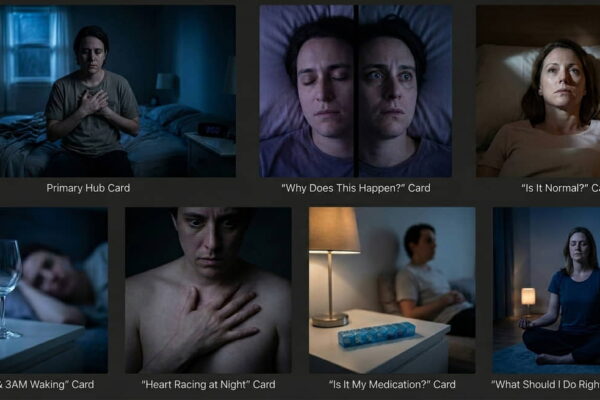

Anxiety before bed can be met with one small, comfortable step tonight. Write down one worry and its next action, or breathe gently without forcing it. Go to bed when sleepy. If anxiety or poor sleep starts disrupting daily life, seek professional help.
Based on the NHS and the National Heart, Lung, and Blood Institute · choose your first step for tonight
The light goes off and your mind switches on. Many people describe the worrying starting the moment their head hits the pillow, or a dread of not falling asleep.
That loop is understood. Cleveland Clinic describes sleep anxiety as fear or stress about falling or staying asleep, and notes that one problem usually makes the other worse.
Here you’ll find one manageable step for tonight, a way to sort worries you can act on, and routes to care. It’s part of our mental health and sleep guides.
Not sure which part applies to you? The anxiety before bed Sleep Compass points you to your starting point in about a minute.
Is this you? Find the line that sounds most like tonight.
- My head hits the pillow and the worrying starts. → turn a worry into a plan.
- I dread not falling asleep. → see why worries get louder.
- Breathing helps for a minute, then the thoughts return. → compare coping and treatment.
- I have almost no energy and need something easy. → pick one low-effort step.
- I worry about what my body feels as I drift off. → check when to get help.
These are patterns to recognize, not a diagnosis.
This guide explains anxiety before bed for general education. It can’t diagnose you or replace care from a clinician who knows your health.
What can you try for anxiety before bed tonight?
For anxiety before bed tonight, pick one comfortable step instead of a full routine. You can write down a worry and its next action, or breathe gently without forcing it. Go to bed when you feel sleepy. These are ways to cope, not a guaranteed sleep fix.
You might have almost no energy left at that hour. That’s fine, because none of these options needs focus or willpower. Pick whichever asks the least of you.
Four low-effort options (pick one)
- Write one worry down. Putting it on paper can make it easier to work through concerns one at a time.
- Breathe gently. Breathe in through your nose and out through your mouth if that feels natural. Let the breath go as deep into your belly as is comfortable, without forcing it.
- Go to bed when you’re sleepy. NHS insomnia advice is to go to bed only when you feel sleepy.
- Wind down your way. A book, soothing music or a hot bath are examples, not a required routine.
That’s the whole menu. You don’t need to do all four, or do them in order.
Breathing deserves one honest note. The NHS says breathing exercises give the most benefit when you practice them regularly as part of your day (NHS, 2026). So treat tonight as a trial, not a test.
If breathing helps for a moment but the thoughts come back, a practical worry may need a plan instead. The worry plan below shows how.
If reading feels like too much effort, this short Every Mind Matters video walks through a mindful breathing exercise.
Mindful Breathing Exercise — Every Mind Matters
Prefer to notice your thoughts and let them go? The NHS describes meditation that way. If meditation apps feel like effort, skip them. Our guide to practicing mindfulness for sleep covers it as an optional extra.
One safety note comes before any tip. Chest pain with sweating, sickness, light-headedness or shortness of breath needs emergency help. So does any moment when you can’t keep yourself or someone else safe. The help section lists urgent options by country.
What does bedtime anxiety feel like?
Bedtime anxiety can feel like fear about not sleeping, racing thoughts, trouble relaxing or tight muscles. Different people notice different things. Symptoms like these can’t tell you the cause. Still, describing them clearly is a useful first step toward the right kind of help.
Here are ways people describe it. See which ones sound like you.
- Fear about sleep itself. You worry about falling or staying asleep.
- Trouble relaxing. Your body feels wound up when you want it to settle.
- Muscle tension. You notice aches or tightness as you lie down.
- Racing thoughts at night. Thoughts keep coming or jump from topic to topic.
Notes like these are also easy to share with a clinician later.
Sleep anxiety: fear about falling or staying asleep
Sleep anxiety is a plain name for fear or stress about falling or staying asleep (Cleveland Clinic, 2024). It describes an experience, not a new diagnosis. Generalized anxiety disorder is different: it involves persistent anxiety or dread that interferes with life (National Institute of Mental Health, 2025). Bedtime anxiety alone doesn’t establish it.
Waking up in a panic is a different pattern. Nocturnal panic attacks can wake you from sleep (Cleveland Clinic, 2024). Our guide to waking with a panic attack covers that, while this page stays with worry as you prepare for sleep.
Don’t assume a physical symptom is only anxiety. The help section says which ones need urgent care.
Why do worries get louder when you go to bed?
Worries get louder at bedtime partly because few distractions are left once you lie down. The bed itself can also become linked with worry. And anxiety and sleep problems usually make each other worse. Together, those three can feel like a trap with no obvious door.
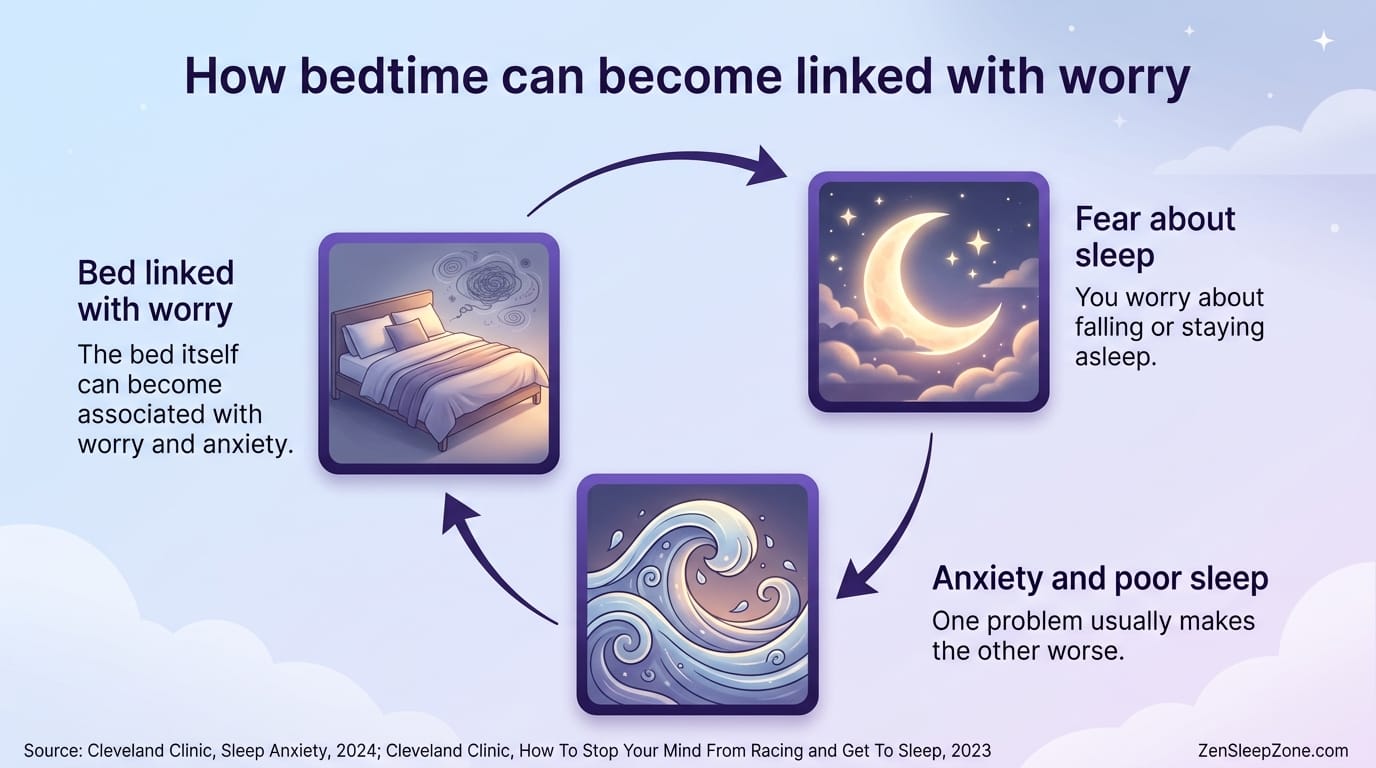
The picture shows how each part feeds the next. Here they are one at a time.
Racing thoughts at night: why the quiet makes them louder
Racing thoughts at night can feel louder because nothing else is competing for your attention. Cleveland Clinic notes that environmental distractions are generally low when people lie in bed (Cleveland Clinic, 2023). That’s one explanation, not the only one.
The second piece is learned. The bed can become associated with worry and anxiety, so lying down starts the alarm (Cleveland Clinic, 2023). Not every hard night means this has happened.
The third is fear of sleep itself. Anxiety and sleep problems usually make each other worse, so each can feed the other (Cleveland Clinic, 2024). That’s the dread of not falling asleep that people describe.
You don’t have to clear every worry before you rest. The NHS says worries can’t be eliminated completely and that we can’t control everything (NHS, n.d.). A quieter goal is to give each worry a place, which the next sections show.
Want the whole pattern at a glance? The anxiety before bed mind map shows how thoughts about tomorrow, fear of sleep, body tension and habits connect.
The wider loop between stress and sleeplessness has its own guide: the stress and sleeplessness cycle.
Did you know?
Part of CBT-I is cognitive therapy, which helps you feel less nervous about not being able to sleep (National Heart, Lung, and Blood Institute, 2022). See what treatment studies measure
Once you can see the pattern, you can match the response: a plan for a worry, ease for the body, or care for a pattern that keeps returning.
At a glance
- Sleep anxiety — It means fear or stress about falling or staying asleep.
- Plan or calm — A worry plan handles a worry you can act on, while breathing is a different tool.
- CBT-I — The VA/DOD recommends it for chronic insomnia disorder.
- Help — Seek it when anxiety starts causing problems in everyday life.
How can you turn a bedtime worry into a practical plan?
To turn a bedtime worry into a plan, write it down and ask one question: can I do something about this? If yes, note a specific action and when you’ll do it. If not right now, schedule a time to deal with it.
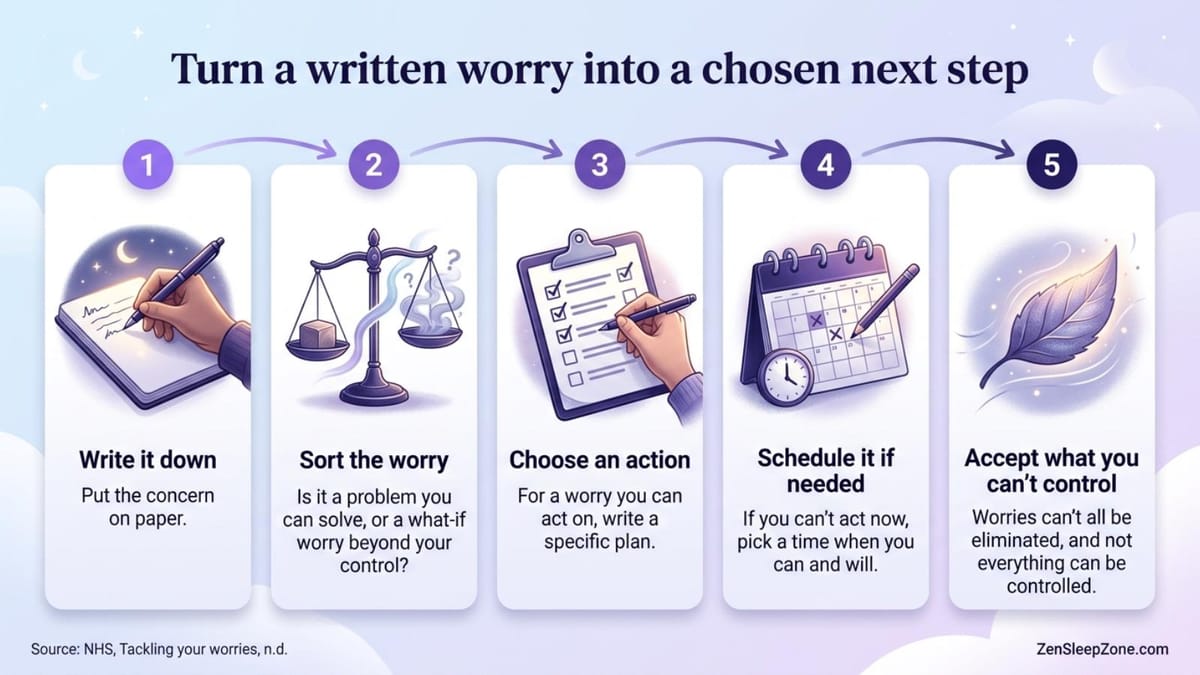
The NHS calls this a worry tree. It splits worries into problems you can solve and what-if worries beyond your control (NHS, n.d.). Writing a worry down first can make it easier to work through concerns one at a time.
A worked example: tomorrow’s meeting
Here’s a made-up example. Someone lies down worried about a morning meeting.
- The worry: “I’m worried about my meeting tomorrow.”
- Can I act on it? Yes. Preparing my notes is something I can do.
- The plan: Go over my notes at a time I choose, such as tomorrow morning.
- The second worry: “What if everyone dislikes me?” No task tonight can settle that, so I mark it as outside my control.
Now the page holds both worries, and the plan covers the one you can act on.
If you can’t act on a worry yet, schedule a time when you can and will. The NHS gives 10 or 15 minutes as an example length for worry time. It’s an example, not a rule.
If you notice yourself trying not to think and getting more anxious, drop that goal. A place for each worry is a gentler aim than silence.
When a worry keeps coming back, the Worry-to-Action Planner organizes concerns and chosen next steps.
Open the Worry-to-Action PlannerOrganize a concern and the next step you choose.What should you do if you are still awake?
If you’re still awake and anxious, the usual advice is to get out of bed. Stimulus control, a part of CBT-I, means going to bed only when you’re sleepy and getting out of bed if you can’t sleep. Do something quiet until you feel sleepy again.
This approach is called stimulus control (National Heart, Lung, and Blood Institute, 2022). It rebuilds the link between bed and sleep, instead of bed and worry.
- Go to bed when you feel sleepy. Sleepiness is the signal.
- If you can’t sleep, get out of bed. This page doesn’t set a waiting time.
- Do something quiet. A book or soothing music are examples.
- Go back to bed when you’re sleepy again.
That’s a general principle, not a treatment plan. Don’t try to shrink your time in bed on your own, because that belongs inside structured treatment. The guide to what a full CBT-I program involves explains how trained providers use it.
Mobility matters here. The VA/DOD guideline lists nighttime fall risk, or trouble getting in and out of bed, as a reason to adapt CBT-I, including bed-leaving instructions (VA/DOD, 2025). If that’s you, ask a clinician how to adapt this advice.
If your anxiety starts after you wake in the night, our guide to anxiety after waking picks up from there.
Which daytime and evening habits are worth changing?
A few habits can support sleep: getting up at the same time each day, being active during the day, and winding down comfortably. Alcohol, caffeine, nicotine and some medicines can add to sleep problems. Pick one habit that fits your life, not a rulebook.
- Get up at the same time. The NHS advises waking and getting out of bed at the same time every day (NHS, 2024). Shift work may need a different plan.
- Move during the day. NHS advice includes regular exercise during the day. This page sets no exact amount.
- Wind down your way. Reading, soothing music or a hot bath are examples, not a required sequence.
- Look at caffeine, alcohol and nicotine. The NHS lists all three among causes of insomnia. Our caffeine timing guide covers timing without a universal cutoff.
- Ask about medicines. Many medicines can cause insomnia. Talk to the prescriber about timing and alternatives, and don’t stop one on your own.
A good bedtime routine is enough for long-term insomnia.
The VA/DOD suggests against sleep hygiene education as a stand-alone treatment for chronic insomnia disorder. Habits still play a supporting role.
A drink helps me sleep.
Alcohol can make sleep lighter and waking more likely. Feeling drowsy at first doesn’t mean the whole night improves.
Our guide to alcohol and the rest of the night explains why that first drowsiness can mislead. You don’t need a perfect routine. One habit that helps is enough.
When do coping tips need to become treatment?
Coping tips can ease a single night. Treatment is worth discussing when anxiety causes problems in daily life, or when habit changes haven’t helped your sleep. Anxiety-focused CBT and insomnia-focused CBT-I do different jobs, so ask a trained provider which one fits.
CBT is therapy that works with thoughts and behavior. CBT-I is a structured form built for insomnia. The table shows what each option does and how much evidence sits behind it.
| Option | Purpose | What taking part involves | Evidence scope | Next step |
|---|---|---|---|---|
| Worry planning | Sorts worries you can act on from ones you can’t. | Write the worry, then choose an action or a later time. | NHS self-help guidance, not a trial result. | Try it tonight. |
| Comfortable breathing | Helps you feel less wound up. | Breathe gently, ideally as a regular habit. | NHS technique guidance. | Try it as part of your day. |
| Muscle relaxation | Helps you notice tension versus relaxation. | Tense and release muscle groups. | NHS technique guidance. | Try it if body tension is your main trouble. |
| Meditation | Helps you notice anxious thoughts and let them go. | Noticing thoughts without acting on them. | The NHS describes a coping benefit. The VA/DOD found insufficient evidence for or against it in chronic insomnia. | Optional. It doesn’t replace CBT-I. |
| CBT for anxiety | Questions automatic thoughts that are inaccurate or harmful. | Therapy that works with thoughts and behavior. | The National Institute of Mental Health describes it for generalized anxiety disorder. | Ask about it if anxiety affects daily life. |
| CBT-I | Treats insomnia, including a busy mind and beliefs about sleep. | Trained professionals deliver it. | VA/DOD: strong recommendation for chronic insomnia disorder, with moderate evidence quality. | Ask a doctor whether it fits. |
| CBT-I plus medication | Combined insomnia care. | You and a clinician decide together. | AASM: conditional, low-certainty suggestions (Buysse et al., 2026). | Discuss it with a clinician. |
In short, coping practices help you settle. CBT-I is the structured option the VA/DOD recommends for chronic insomnia disorder, not for every anxious night (VA/DOD, 2025).
CBT for generalized anxiety disorder helps you spot automatic thoughts that are inaccurate or harmful, and question them (National Institute of Mental Health, 2025). CBT-I also addresses a busy or racing mind and unhelpful beliefs about sleep. Trained professionals must deliver it.
Meditation and CBT-I aren’t the same thing. Meditation can help you notice anxious thoughts. The VA/DOD found insufficient evidence to recommend for or against mindfulness meditation as a treatment for chronic insomnia. So it’s a settling option, not a stand-in.
Treatment for generalized anxiety disorder can involve therapy, medication or both. For insomnia, the AASM conditionally suggests CBT-I plus medication over medication alone. It also conditionally suggests against combining them as the default over CBT-I alone. Both suggestions are low certainty, so you and a clinician decide. This page can’t tell you whether you need medication.
Studies of digital CBT-I show how averages work. A 2023 review pooled 18 trials that measured anxiety. On average, anxiety scores fell by a small amount. Sleep measures from 22 trials improved by a larger average amount (Lee et al., 2023). These are group averages in study units, not percentages, and they don’t predict your nights. Every figure, with who it applies to, is on the statistics page.
Who may need an adapted CBT-I?
The VA/DOD guideline lists nine situations where a clinician should adapt or delay CBT-I. Check the full list with your provider.
- Medically unstable. A clinician should delay CBT-I.
- Active alcohol or drug use disorder. A clinician should delay it.
- Excessive daytime sleepiness. A clinician should adapt or delay it.
- Nighttime fall risk or trouble getting in or out of bed. A clinician should adapt it.
- Exposure-based PTSD treatment in progress. Treatment needs coordinating, and CBT-I may be delayed.
- Uncontrolled seizure disorder. A clinician should delay it.
- Bipolar disorder. A clinician should adapt it.
- Current acute mental health symptoms. A clinician should delay it and assess your current needs.
- Pregnancy or postpartum insomnia. You need individual clinical guidance.
For the bigger picture, see understanding persistent insomnia, and what a full CBT-I program involves. You can now ask a provider which target, anxiety or insomnia, the treatment is aimed at.
When should you get medical or urgent help?
Get urgent help for chest pain with sweating, sickness, light-headedness or shortness of breath, or if you can’t keep yourself or someone else safe. For anxiety that affects daily life, or sleep habits that haven’t helped, book a routine appointment with a doctor.
Get urgent help now if
- You have chest pain with sweating, sickness, light-headedness or shortness of breath. Get emergency medical help. In the UK, call 999. Don’t decide it’s anxiety from this page.
- You can’t keep yourself or someone else safe. Get emergency help now. In the UK, call 999 or go to A&E.
- You’re suicidal or in emotional distress (US). Call or text 988. In life-threatening situations, call 911.
- Elsewhere, use your local emergency number.
That box is for the moment. In England, the NHS lists where to get urgent mental health help (NHS, n.d.).
Book a routine appointment when:
- Sleep habit changes haven’t helped. The NHS advises a GP or primary care appointment, also if insomnia makes it hard to cope.
- Anxiety causes problems in everyday life. The National Institute of Mental Health says that’s the time to seek professional help.
- You feel sleepy when driving. Don’t drive while you feel sleepy.
Snoring or interrupted breathing can also interfere with a good night’s sleep (NHS, 2024). Symptoms of another sleep disorder, such as sleep apnea, may lead to a sleep clinic referral. Our guide to snoring and interrupted breathing covers what to look for.
You can now tell which situations are urgent and which can wait for an appointment.
How can you find treatment in your country?
Start with your country’s route, then ask about experience, fees and coverage. In the US, begin with primary care or a treatment locator. In England, you can refer yourself to NHS talking therapies. In Canada, a family doctor is often the first stop. In Australia, a doctor can create a plan if you have a diagnosed disorder.
CBT-I can be provided by a doctor, nurse or therapist (National Heart, Lung, and Blood Institute, 2022). Funding rules differ by country, so check the local details below.
| Country | First step | Cost and coverage | Worth knowing |
|---|---|---|---|
| United States | A primary care provider can do an initial mental health screening and refer you. You can also use the federal locator, FindTreatment.gov (National Institute of Mental Health, 2026). | Ask your insurer which local providers your plan covers. | Coverage depends on your plan and the provider. |
| England | Refer yourself through the NHS talking therapies finder. You don’t need a diagnosed condition. The finder asks for your GP surgery name (NHS, 2025). | NHS mental health services are free. | This row covers England only. Scotland, Wales and Northern Ireland need local checking. |
| Canada | A family doctor is often the first professional people talk to. | Treatment by a GP or psychiatrist can be covered by public health insurance. Private psychotherapy is charged a fee (Centre for Addiction and Mental Health, n.d.). | Check your province, the provider and any private benefits. |
| Australia | If you have a diagnosed mental health disorder, your doctor can create a treatment plan (Services Australia, 2026). Medicare Mental Health Centres give free support with no appointment or referral. | A plan can cover up to 10 individual and 10 group sessions each calendar year. Professionals set their own fees, so Medicare may cover only part. | Eligibility and referral rules apply. The free centres aren’t a guaranteed course of specialist CBT-I. |
Whatever your route, bring a few questions to the first visit:
- Experience. What experience do you have treating someone with my issue?
- Cost. How much will treatment cost?
- Length. How long do you expect treatment to take?
- Coverage. What does my insurance or public plan cover?
Still have a specific follow-up question, such as breathing that stops helping, medication, or what to do if treatment isn’t working? The anxiety before bed questions page goes deeper. You now have a starting route and the questions to ask about cost.
How can you review progress without demanding a perfect night?
Review progress by looking at patterns over time, not one night. Note when the anxiety began, how long it lasts, how often it happens and how it affects your day. Bring those notes, and any treatment concerns, to your provider. Managing anxiety can involve setbacks.
- When it began. A rough date is enough.
- How long it has lasted. Weeks, months or years.
- How often it happens. Most nights, or only some.
- How it affects your life. Work, mood, relationships or energy.
A clinician may ask these same questions when assessing anxiety (National Institute of Mental Health, 2025). Notes in your own words are enough.
A rough night after a better stretch
One hard night doesn’t by itself mean the plan has failed. Write down what happened and what you tried. Bring it to your next visit. If treatment seems unhelpful or worries you, talk with your provider before stopping it. Don’t stop treatment without that conversation.
If stress through the day is part of the picture, our guide to managing daytime stress connects it to your evenings. You can now prepare a useful follow-up conversation.
Key takeaways
- Remember — A worry you can act on, a tense body and a recurring problem each call for a different step.
- Do — Pick one comfortable step tonight: write a worry and its next action, or breathe gently.
- If it continues — Get help when anxiety causes problems in daily life or sleep habit changes haven’t helped.
You can now choose a starting point
Not sure which step fits? The anxiety before bed Sleep Compass points you to one in about a minute. More in mental health and sleep.
Find your starting point →Common questions about anxiety before bed
Can I have sleep anxiety without GAD?
Sleep anxiety and generalized anxiety disorder (GAD) describe different things. Sleep anxiety means fear or stress about falling or staying asleep. GAD involves a persistent feeling of anxiety or dread that interferes with life. Bedtime fear alone doesn’t establish that diagnosis, and only a clinician can assess it.
If anxiety starts to cause problems in everyday life, professional help is the next step. A clinician can also check whether sleep trouble needs its own treatment, as the treatment section explains.
How long does CBT-I take?
The National Heart, Lung, and Blood Institute describes CBT-I as a 6- to 8-week treatment plan. That’s the usual course, and programs differ. Your needs and the provider’s approach can change the length. The course length isn’t a deadline for feeling better, so don’t judge your progress by the calendar.
Ask a provider how many sessions they expect, how they’re delivered and what each one involves. If a program seems to run long or isn’t helping, discuss it with the provider before stopping. The treatment section compares your options.
Can I get CBT-I online?
Yes. CBT-I can be delivered in person, by telephone or online. Online delivery doesn’t remove the need for trained delivery. The VA/DOD guideline says CBT-I must be delivered by professionals trained specifically in it. Ask who provides your treatment and what professional support comes with it.
Trials of fully automated digital CBT-I show average gains in sleep outcomes, but those are group averages, not promises for you. The statistics page explains what those studies measure and what they can’t tell you.
Will melatonin or magnesium treat my sleep anxiety?
These sources don’t establish melatonin or magnesium as a treatment for bedtime anxiety. The National Heart, Lung, and Blood Institute says research hasn’t proven melatonin is an effective insomnia treatment. The VA/DOD guideline finds insufficient evidence to recommend for or against magnesium for chronic insomnia disorder. Insufficient evidence means no recommendation either way.
If you’re thinking about a supplement, tell a clinician what you take, because many medicines can also cause insomnia. Don’t stop a prescribed medicine on your own. For medication questions, the anxiety before bed questions page goes further.
Is therapy covered by insurance or public healthcare?
Coverage depends on your country and the service. In the US, ask your insurer which local providers your plan covers. NHS mental health services in England are free. In Canada, private psychotherapy is charged a fee. In Australia, Medicare may cover only part of the cost.
Australian treatment plans can claim up to 10 individual and 10 group sessions each calendar year, subject to eligibility and referral rules. A rebate isn’t a promise that the full fee is covered. The country table above shows where to start.
Can someone close to me help?
Yes, in one way. The National Institute of Mental Health advises people with anxiety symptoms to have an honest conversation about how they feel with someone they trust. You can tell them what bedtime is like for you. That conversation sits alongside professional help, not in place of it.
Seek professional help as well once anxiety starts causing problems in everyday life. If you’re unsure where to start, the access table shows routes in four countries.
Sources
- Department of Veterans Affairs and Department of Defense — VA/DOD Clinical Practice Guideline for the Management of Chronic Insomnia Disorder and Obstructive Sleep Apnea (2025). Supports: the recommendation for CBT-I, the position on sleep hygiene alone, mindfulness, magnesium, who needs CBT-I adapted or delayed, and who should deliver it.
- Journal of Clinical Sleep Medicine — Combination treatment for chronic insomnia disorder in adults: an American Academy of Sleep Medicine clinical practice guideline (2026). Supports: the suggestions on CBT-I with or without medication.
- National Institute of Mental Health — Generalized Anxiety Disorder: What You Need to Know (2025). Supports: what generalized anxiety disorder is, CBT and medication options, when to seek help, setbacks, talking to someone you trust, and what an assessment asks.
- NHS — Tackling your worries (n.d.). Supports: writing worries down, the worry tree, action plans, scheduled worry time and accepting uncertainty.
- NHS — Breathing exercises for stress (2026). Supports: gentle breathing and regular practice.
- NHS — Insomnia (2024). Supports: going to bed when sleepy, a regular getting-up time, daytime exercise, substances and medicines, driving when sleepy, snoring, and when to see a doctor.
- National Heart, Lung, and Blood Institute — Insomnia Treatment (2022). Supports: stimulus control, wind-down examples, alcohol and sleep, the thinking part of CBT-I, who provides it, how it is delivered, its usual length and melatonin.
- NHS — How can meditation help with sleep? (n.d.). Supports: meditation and muscle relaxation as coping practices.
- npj Digital Medicine — Digital cognitive behavioral therapy for insomnia on depression and anxiety: a systematic review and meta-analysis (2023). Supports: average effects of digital CBT-I on anxiety and sleep measures.
- npj Digital Medicine — Systematic review and meta-analysis on fully automated digital cognitive behavioral therapy for insomnia (2025). Supports: average sleep gains from fully automated digital CBT-I.
- National Institute of Mental Health — Help for Mental Illnesses (2026). Supports: US care routes, urgent help by phone or text, questions to ask, and talking to a provider before stopping treatment.
- NHS — Find NHS talking therapies for anxiety and depression (2025). Supports: self-referral in England.
- Services Australia — Mental health care and Medicare (2026). Supports: Australian treatment plans, session limits, fees and free centres.
- NHS — Chest pain (2023). Supports: chest pain with sweating, sickness, light-headedness or shortness of breath as an emergency.
- NHS — Where to get urgent help for mental health (n.d.). Supports: urgent help in England.
- NHS — How you can access NHS mental health services (2026). Supports: NHS mental health services being free.
- Cleveland Clinic — Sleep Anxiety (2024). Supports: what sleep anxiety means, how anxiety and sleep problems affect each other, and nighttime panic.
- Cleveland Clinic — How To Stop Your Mind From Racing and Get To Sleep (2023). Supports: fewer distractions at bedtime and the bed becoming linked with worry.
- Centre for Addiction and Mental Health — Looking for Mental Health Services (n.d.). Supports: Canadian first steps and public versus private coverage.
Sources checked · Next review
How we made this guide: researched from the sources above, drafted with AI assistance and edited by Aamir Bashir, Founder & Editor. Read our editorial policy.