
Anxiety before bed statistics: the key numbers
Anxiety before bed statistics are thin, because we found no study that counted this exact experience. The closest numbers come from insomnia research. A 2019 Korean survey found 40.3% of adults at high risk for insomnia also screened positive for anxiety, against 6.1% of others. Sleep treatments lowered anxiety scores by small to moderate amounts in trials.
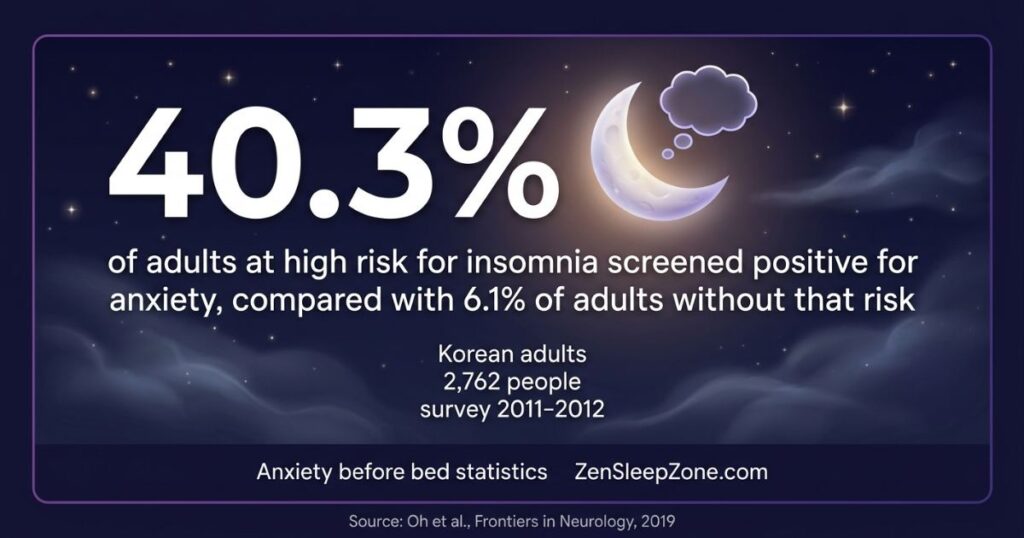
- 40.3% of adults at high risk for insomnia screened positive for anxiety in a 2011–2012 Korean survey (Oh et al., Frontiers in Neurology, 2019).
- 12.4% of adults had insomnia disorder in interview-based general-population studies (van Straten et al., Journal of Sleep Research, 2025).
- −0.38 was the average change in anxiety symptoms after non-drug sleep treatments in 43 trials (Staines et al., Journal of Sleep Research, 2022).
- −0.29 was the average change in anxiety symptoms after digital CBT-I across 18 trials (Lee et al., npj Digital Medicine, 2023 (doi:10.1038/s41746-023-00800-3)).
- 6 to 8 weeks is the usual length of a CBT-I treatment plan (National Heart, Lung, and Blood Institute, Insomnia Treatment, 2022).
22 figures from 10 sources, data years 2011–2026, mostly international trial reviews. The full explanation is in our article on anxiety before bed.
These figures describe groups of people, not you personally. They’re for information, not medical advice.
How common is anxiety before bed?
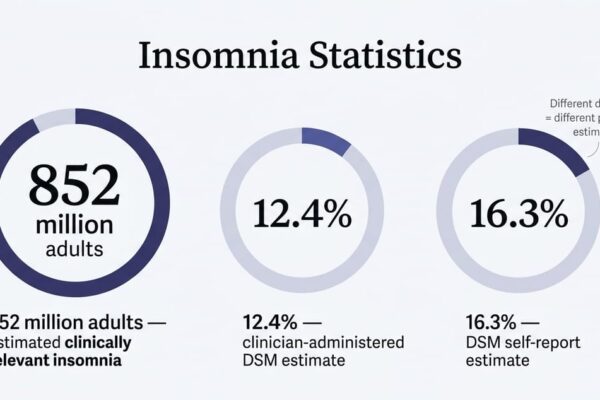
No study we found counted anxiety before bed on its own. The nearest measured problem is insomnia, which overlaps with anxiety. A 2025 review of 47 general-population studies pooled insomnia disorder at 12.4% of adults in interview-based studies. Questionnaires gave a much wider spread of results.
12.4% of adults in general-population studies had insomnia disorder when interviews checked the diagnostic criteria.
16.3% of adults had insomnia disorder when people answered questions about the diagnostic criteria themselves.
7.5% to 32.3% of adults had insomnia, depending on which questionnaire and cut-off each study used.
What this means for you: About 1 in 8 adults meets the criteria for insomnia disorder in the best-checked studies. Bedtime anxiety has no count of its own yet. Our article on why worries get louder in bed explains the pattern behind the numbers.
How often do anxiety and insomnia go together?
40.3% of adults at high risk for insomnia screened positive for anxiety in a Korean survey published in 2019. Among adults without that risk, the figure was 6.1%. The survey covered 2,762 adults. It shows that the two problems often overlap in groups of people. It cannot show which one comes first.
40.3% of adults at high risk for insomnia screened positive for anxiety, compared with 6.1% of adults without that risk.
9.8 times the odds of screening positive for anxiety were found in adults at high risk for insomnia, after adjusting for age, sex, education and area.
21.7% of adults at high risk for insomnia had anxiety alone, without depression.
18.6% of adults at high risk for insomnia had both anxiety and depression.
What this means for you: In groups, anxiety and poor sleep often show up together. That is a pattern across many people, not a verdict on any one night. Our guide to how insomnia is assessed shows how a symptom becomes a diagnosis.
Do sleep treatments of any kind change anxiety?
43 trials with 5,945 people were pooled in a 2022 review of non-drug sleep treatments. Anxiety fell by a moderate amount on average, with an effect size of −0.38. Two other reviews found moderate effects too. Each uses a different measure, so the numbers are not interchangeable.
−0.38 is the average change in anxiety symptoms after non-drug sleep treatments, a moderate drop compared with control groups.
−0.43 was the average change in anxiety symptoms for people who started with high anxiety.
−0.92 was the average change in sleep-related thinking, a large drop compared with control groups.
0.406 was the average effect of CBT-I on anxiety that came with insomnia, a small to moderate change.
−0.51 was the average change in anxiety after treatments that improved sleep quality, a medium-sized drop.
−0.49 was the average change in rumination, meaning repeated worry thoughts, in the same trials.
What this means for you: Across three reviews, treating sleep problems went along with less anxiety and fewer sleep-related worries on average. Averages describe groups. Our section on when coping tips need to become treatment shows how the options compare.
How well does digital CBT-I work?
−0.76 is the pooled effect of digital CBT-I on sleep outcomes in a 2023 review of 22 trials. Anxiety symptoms fell by a smaller average amount, at −0.29. A 2025 review of fully automated programs found small to moderate effects on falling asleep and sleep efficiency. Each outcome has its own estimate.
−0.29 was the average change in anxiety symptoms after digital CBT-I, a small drop.
−0.76 was the average change in pooled sleep outcome scores after digital CBT-I.
−0.39 was the average change in time to fall asleep after fully automated digital CBT-I, a small to moderate drop.
0.19 was the average gain in total sleep time after fully automated digital CBT-I, a small gain.
What this means for you: Digital programs showed average gains in sleep outcomes and a smaller average drop in anxiety. These trials enrolled people with insomnia, not people chosen for bedtime anxiety. Our Answers page replies to practical questions about online treatment.
Does a 0.45 effect mean a 45% improvement?
A 0.45 effect is not a 45% improvement. It is a standardized mean difference, measured in study-scale units rather than percentage points. In 25 comparisons of fully automated digital CBT-I, sleep efficiency gained 0.45 on average. That shows the direction and rough size of a group change. It does not give minutes slept.
0.45 was the average gain in sleep efficiency, the share of time in bed spent asleep, after fully automated digital CBT-I.
What this means for you: Think of the number as a ruler for comparing outcomes, not a score for your own sleep. A higher efficiency score means more of the time in bed was spent asleep. Our article on what a full CBT-I program involves explains the treatment behind these trials.
How long does treatment take, and what does it cover?
6 to 8 weeks is the usual length of a CBT-I plan, according to the US National Heart, Lung, and Blood Institute. NHS guidance suggests 10 or 15 minutes for scheduled worry time. In Australia, eligible people can claim up to 10 individual and 10 group sessions a year. These are guidance and rules, not trial results.
6 to 8 weeks is the usual length of a CBT-I treatment plan, though programs and needs vary.
10 to 15 minutes is the example NHS guidance gives for a short period of scheduled worry time.
Up to 10 individual sessions a year can be claimed under an Australian mental health treatment plan, for eligible people.
Up to 10 group sessions a year can be claimed as well, separate from the individual sessions.
What this means for you: These figures describe guidance and rules, not promises about how long recovery takes. Fees and referral rules differ by country. Our section on finding treatment in your country covers the US, England, Canada and Australia.
Anxiety before bed statistics table
| What it measures | Figure | Who / based on | Compared with · when | Source |
|---|---|---|---|---|
| Insomnia disorder, interview-based | 12.4% pooled, 95% CI 9.0–16.8% | Adults in general-population studies · interview-based studies inside a 47-study review | — · data searched to April 2024 | van Straten et al., Journal of Sleep Research, 2025 |
| Insomnia disorder, self-report of criteria | 16.3% pooled, 95% CI 11.3–23.0% | Adults in general-population studies · self-report studies inside a 47-study review | — · data searched to April 2024 | van Straten et al., Journal of Sleep Research, 2025 |
| Insomnia, questionnaire-based | 7.5% to 32.3% range | Adults · 27 studies with different questionnaires | — · data searched to April 2024 | van Straten et al., Journal of Sleep Research, 2025 |
| Positive anxiety screen at high insomnia risk | 40.3% observed | Korean adults · 117 of 290 at high insomnia risk | 6.1% of 2,472 adults without that risk · survey 2011–2012 | Oh et al., Frontiers in Neurology, 2019 |
| Odds of a positive anxiety screen | Adjusted OR 9.8, 95% CI 7.3–13.1 | Korean adults · 2,762 people | Adults not at high insomnia risk · survey 2011–2012 | Oh et al., Frontiers in Neurology, 2019 |
| Anxiety alone at high insomnia risk | 21.7% observed | Korean adults · 63 of 290 at high insomnia risk | — · survey 2011–2012 | Oh et al., Frontiers in Neurology, 2019 |
| Anxiety and depression at high insomnia risk | 18.6% observed | Korean adults · 54 of 290 at high insomnia risk | — · survey 2011–2012 | Oh et al., Frontiers in Neurology, 2019 |
| Anxiety symptoms after non-drug sleep treatment | Hedges g −0.38 | 43 trials · 5,945 people | Control groups · right after treatment · published 2022 | Staines et al., Journal of Sleep Research, 2022 |
| Anxiety symptoms in people starting with high anxiety | Hedges g −0.43 | Subgroup of the 43 trials | Control groups · right after treatment · published 2022 | Staines et al., Journal of Sleep Research, 2022 |
| Sleep-related thought processes | Hedges g −0.92 | Trials that measured these thoughts | Control groups · right after treatment · published 2022 | Staines et al., Journal of Sleep Research, 2022 |
| Anxiety that comes with insomnia, after CBT-I | Effect size 0.406, 95% CI 0.318–0.493 | People with insomnia, with or without an anxiety disorder | — · published 2011 | Belleville et al., Clinical Psychology Review, 2011 |
| Anxiety after sleep-quality treatments | g+ −0.51 | 65 trials · 8,608 people in the whole review | Control groups · published 2021 | Scott et al., Sleep Medicine Reviews, 2021 |
| Rumination after sleep-quality treatments | g+ −0.49 | 65 trials · 8,608 people in the whole review | Control groups · published 2021 | Scott et al., Sleep Medicine Reviews, 2021 |
| Anxiety symptoms after digital CBT-I | SMD −0.29, 95% CI −0.40 to −0.19 | Adults with insomnia · 18 trials | After treatment · published 2023 | Lee et al., npj Digital Medicine, 2023 (doi:10.1038/s41746-023-00800-3) |
| Pooled sleep outcomes after digital CBT-I | SMD −0.76, 95% CI −0.95 to −0.57 | Adults with insomnia · 22 trials | After treatment · published 2023 | Lee et al., npj Digital Medicine, 2023 (doi:10.1038/s41746-023-00800-3) |
| Time to fall asleep after automated digital CBT-I | SMD −0.39 | Trial participants · 23 comparisons | Pooled controls · after treatment · searched to March 2024 | Hwang et al., npj Digital Medicine, 2025 (doi:10.1038/s41746-025-01514-4) |
| Total sleep time after automated digital CBT-I | SMD 0.19 | Trial participants · 24 comparisons | Pooled controls · after treatment · searched to March 2024 | Hwang et al., npj Digital Medicine, 2025 (doi:10.1038/s41746-025-01514-4) |
| Sleep efficiency after automated digital CBT-I | SMD 0.45 | Trial participants · 25 comparisons | Pooled controls · after treatment · searched to March 2024 | Hwang et al., npj Digital Medicine, 2025 (doi:10.1038/s41746-025-01514-4) |
| Usual CBT-I plan length | 6 to 8 weeks | People receiving CBT-I · guidance, not a trial | — · guidance updated 2022 | National Heart, Lung, and Blood Institute, Insomnia Treatment, 2022 |
| Example scheduled worry time | 10 to 15 minutes | People managing worries · suggested practice | — · page undated | NHS, Tackling your worries, n.d. |
| Australian individual session limit | Up to 10 a year | Eligible people using Medicare-supported care | Each calendar year · page updated October 2026 | Services Australia, Mental health care and Medicare, 2026 |
| Australian group session limit | Up to 10 a year | Eligible people using Medicare-supported care | Each calendar year · page updated October 2026 | Services Australia, Mental health care and Medicare, 2026 |
Why the numbers differ
Insomnia counts differ by method. The 2025 review by van Straten and colleagues pooled 12.4% from interview studies and 16.3% from self-report questions about the diagnostic criteria. Questionnaire studies ranged from 7.5% to 32.3%. Higher-quality studies gave lower rates, and the authors call 12.4% their most accurate estimate.
Anxiety effect sizes differ too. Belleville and colleagues reported 0.406 for CBT-I in 2011. Staines and colleagues found −0.38 across non-drug sleep treatments in 2022. Scott and colleagues found −0.51 in 2021, and Lee and colleagues found −0.29 for digital programs in 2023. The reviews pooled different trials, treatments and anxiety measures. The sign only shows how each team coded direction. All four describe lower anxiety on average.
One survey can show a gap in two ways. The shares are 40.3% against 6.1%. The adjusted odds ratio is 9.8, which means 9.8 times the odds. Odds are not the same as risk, so 9.8 is a comparison of odds and not a rate.
What the numbers can’t tell you
Anxiety before bed statistics have four limits. First, we found no study that counted bedtime anxiety on its own, so none of these figures is its true rate. Second, the Korean survey used a screening scale, not a diagnosis, and it measured one point in time. Third, the trials enrolled people with insomnia, not people chosen for bedtime worry. Fourth, effect sizes are study-scale units, not minutes or percentages.
We found no reliable figure for daily-life impact, treatment drop-out or cost in dollars. Group numbers cannot predict one person’s night. To organize your own worries instead, the Worry-to-Action Planner turns a concern into a next step you choose.
How we compiled this page: we gathered figures from the published studies and official sources below, recorded each figure’s outcome, population, comparison, timepoint and year exactly as published, and ran no surveys of our own. The original figures belong to their publishers. Our compilation and wording may be reused with credit under CC BY 4.0.
See how the pieces connect before you pick a next step
Use the mind map to see how worries, sleep and treatment connect. Ready to act? The Compass picks a first step. More in mental health and sleep.
See how it all connects →Sources
- National Heart, Lung, and Blood Institute — Insomnia Treatment (2022) — official treatment guidance; used for: the usual length of a CBT-I plan
- NHS — Tackling your worries (n.d.) — official self-help guidance; used for: the example length of scheduled worry time
- Services Australia — Mental health care and Medicare (2026) — official funding guidance; used for: yearly session limits in Australia
- npj Digital Medicine — Digital cognitive behavioral therapy for insomnia on depression and anxiety: a systematic review and meta-analysis (2023) — review of randomized trials; used for: anxiety and sleep outcomes after digital CBT-I
- npj Digital Medicine — Systematic review and meta-analysis on fully automated digital cognitive behavioral therapy for insomnia (2025) — review of randomized trials; used for: time to fall asleep, total sleep time and sleep efficiency
- Journal of Sleep Research — The Prevalence of Insomnia Disorder in the General Population: A Meta-Analysis (2025) — review of general-population studies; used for: how common insomnia is
- Journal of Sleep Research — Do non-pharmacological sleep interventions affect anxiety symptoms? A meta-analysis (2022) — review of randomized trials; used for: anxiety and sleep-related thinking after sleep treatments
- Sleep Medicine Reviews — Improving sleep quality leads to better mental health: A meta-analysis of randomised controlled trials (2021) — review of randomized trials; used for: anxiety and rumination after better sleep
- Clinical Psychology Review — Meta-analytic review of the impact of cognitive-behavior therapy for insomnia on concomitant anxiety (2011) — review of clinical trials; used for: the effect of CBT-I on anxiety
- Frontiers in Neurology — The Effect of Anxiety and Depression on Sleep Quality of Individuals With High Risk for Insomnia: A Population-Based Study (2019) — national survey; used for: how often anxiety and insomnia occur together
Figures checked · 22 figures from 10 sources · Next review
How we made this page: figures gathered and checked from the sources above, written up with AI assistance and edited by Aamir Bashir, Founder & Editor. Read our editorial policy.