
Anxiety Before Bed Planner helps you organize bedtime worries without trying to solve everything tonight. This visual guide separates practical concerns from worries outside your control. Use the interactive planner to record one concern, choose your response, and keep a personal next-step plan.
This educational tool supports reflection and planning. It does not diagnose anxiety or prescribe treatment.
How to use the Anxiety Before Bed Planner
Turn one bedtime worry into a personal next step in about one minute.
- Write down one concern. Choose something currently occupying your mind.
- Choose its type. Decide whether you can act, cannot act now, or feel unsure.
- Record your response. Write what you might do, how you will do it, and when it suits you.
- Keep your plan. Generate your result and copy or print it for later.
You do not need to finish every concern tonight. If anxiety affects everyday life, consider speaking with a healthcare professional. If you have immediate safety concerns, use the urgent-help guidance in the main article.
Free interactive planner
Anxiety Before Bed Planner: Make Your Own Worry Plan
Organize one concern and choose a manageable response without creating another bedtime task.
The live planner needs JavaScript. The examples below show the possible results.
Your personal plan will appear here. Start by writing one concern and choosing its type.
Example: if an action is possible
Your result: Choose one practical action
Your concern has a possible next step. Your notes: Your concern
Keep the action small enough to manage. Choose how and when you want to address it. You do not need to solve everything tonight.
Example: if you cannot act at this moment
Your result: Choose a suitable later time
Your concern may need an action, but now may not be the right moment. Your notes: Your concern
Write when you would prefer to return to it. This is your own task reminder, not a prescribed sleep schedule.
Open next: See the worry-planning method
Example: if the concern is outside your control
Your result: Recognize what you cannot control
You have identified something you cannot settle through another task right now. Your notes: Your concern
You can acknowledge the concern without trying to force an answer. Choose a comfortable activity or leave the question unresolved for now.
Open next: Understand the bedtime worry cycle
Example: if you cannot tell what action is possible
Your result: Give yourself room to decide
You do not need to force an answer. Your concern: Your concern
Write down what you know and what remains unclear. You can revisit the question or discuss it with someone you trust.
Open next: Explore questions about anxiety before bed
Example: if you would like professional support
Your result: Consider speaking with someone
You have identified a need for support. Your concern: Your concern
You can write down when this started, how often it happens, and how it affects daily life. Bring those observations to a healthcare professional.
Open next: Find treatment and support options
What your Anxiety Before Bed Planner result means
Your result reflects the type of concern you selected. It does not decide what caused your anxiety or which treatment you need.
When you can take action
Choose one practical step and write down how you might complete it. The NHS worry method recommends a specific action plan for solvable concerns.
When you cannot act right now
Choose a suitable time to revisit the task if an action is possible later. You do not have to work through it while trying to sleep.
When something is outside your control
Recognize that another task may not resolve the concern. You can acknowledge uncertainty without demanding an immediate answer.
When you feel unsure or need help
It is fine to leave a question open. You can write down your observations and discuss recurring concerns with a professional.
A worked example
Imagine you are worried about a meeting tomorrow. You write down the concern and choose to prepare your notes. You decide when that task suits you.
Now imagine another thought: what if everyone dislikes me? You cannot settle that prediction through another task tonight. You can recognize it as a hypothetical worry.
These are different responses to different concerns. Neither requires you to force sleep or finish every worry.
For the full method, explore the article’s practical worry-planning section.
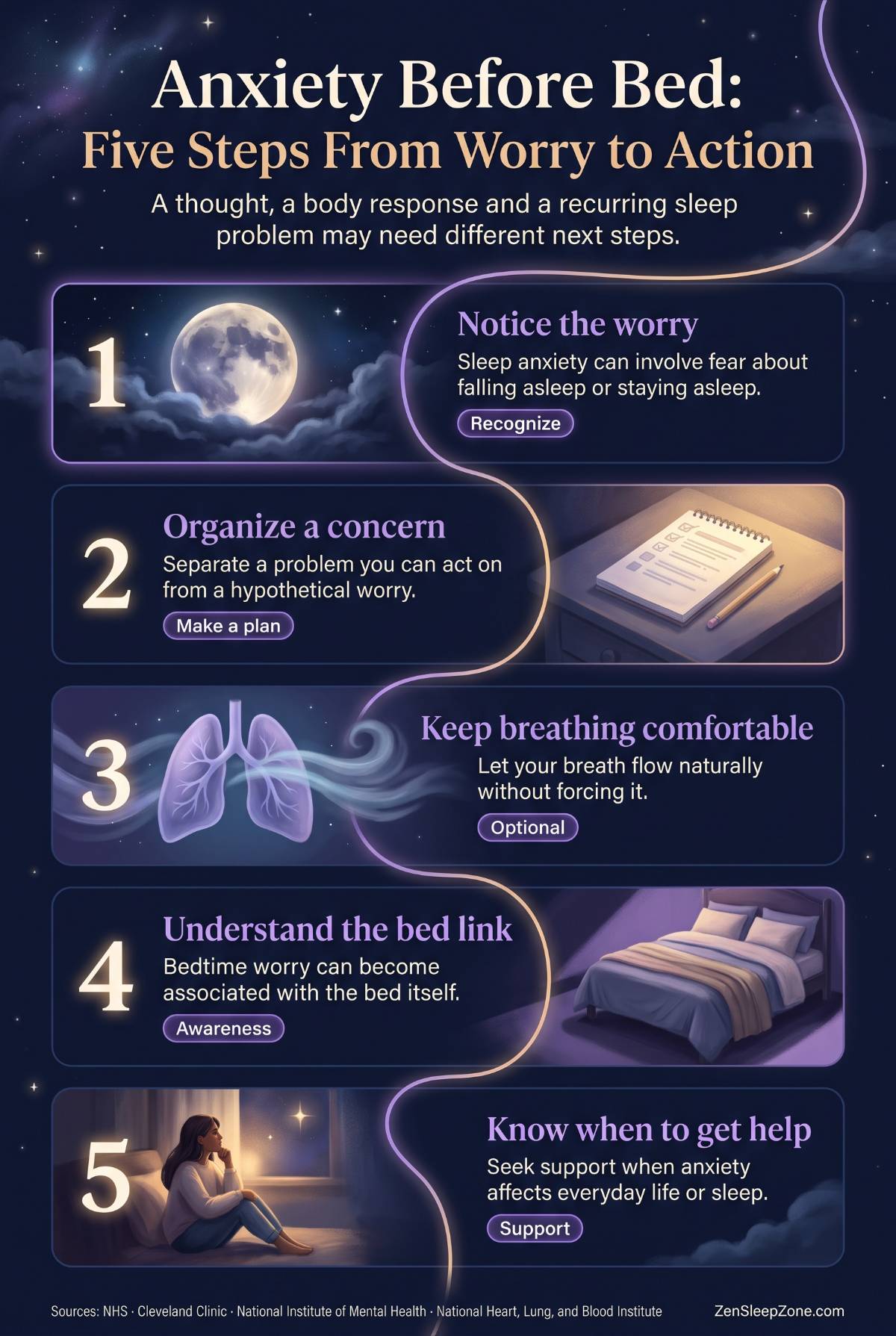
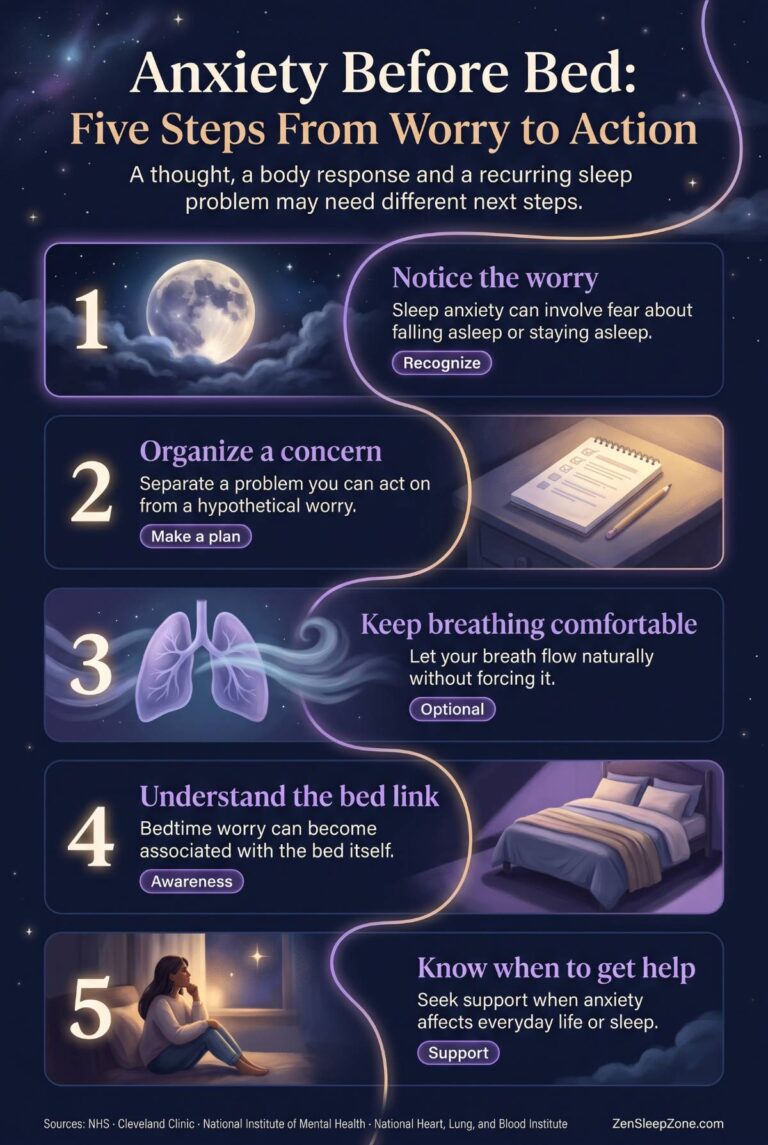
Anxiety Before Bed Planner: Five Steps From Worry to Action
Bedtime anxiety can involve thoughts, physical tension and recurring sleep concerns. Each may need a different response.
- Notice the worry — A concern about falling or staying asleep can be part of sleep anxiety.
- Organize a solvable concern — Separate a problem you can act on from a hypothetical worry.
- Keep breathing comfortable — Let your breath flow naturally without forcing it.
- Understand the bed-worry link — Bedtime worry can become associated with the bed itself.
- Know when to get help — Seek professional support when anxiety affects everyday life or sleep.
Explore why worries can become louder at bedtime or use the Anxiety Before Bed Mind Map to understand how the different parts connect.
The rules behind this interactive planner
The planner follows a simple worry-management method. It records your own choices rather than making clinical decisions.
| If you choose… | The planner shows… | The reason |
|---|---|---|
| I can take an action | Choose one practical action | Solvable problems can have a specific action plan. |
| Not possible to act now | Choose a suitable later time | An action can be scheduled for a time you choose. |
| Outside my control | Recognize what you cannot control | Not every worry can be eliminated or controlled. |
| I’m not sure | Give yourself room to decide | The method does not require a forced answer. |
| I need some help | Consider speaking with someone | Professional support may help when anxiety affects daily life. |
What the planner does not measure
It does not measure anxiety severity, diagnose a condition or predict how you will sleep. It does not recommend medication or calculate a sleep schedule.
Why breathing is optional
Comfortable breathing is one possible settling practice. The NHS advises allowing your breath to flow without forcing it. You can choose another comfortable response if breathing exercises do not suit you.
When to seek help
Consider a healthcare appointment if changing sleep habits has not helped or insomnia makes daily life difficult. Seek professional help when anxiety starts causing problems in everyday life.
Chest pain with sweating, sickness, light-headedness or shortness of breath needs emergency medical help. If you cannot keep yourself or someone else safe, seek emergency help now.
Take your next step without solving everything tonight
Explore the treatment figures and research behind digital sleep therapy on our Anxiety Before Bed Statistics page. More in Mental Health & Sleep.
Explore the research and statisticsSources
- NHS — Tackling your worries. Supports the solvable-versus-hypothetical worry distinction and action planning.
- NHS — Breathing exercises for stress (2026). Supports comfortable, unforced breathing.
- National Institute of Mental Health — Generalized Anxiety Disorder: What You Need to Know (2025). Supports professional help when anxiety affects everyday life.
- NHS — Insomnia (2024). Supports seeking help when sleep problems continue or affect coping.
Sources checked October 2026 · Next review April 2027
How we made this page: the infographic and planner rules were built from the sources above, drafted with AI assistance and edited by Aamir Bashir, Founder & Editor. Read our editorial policy.