
Sleep Diary Analyser
Enter your sleep details to see your estimated sleep efficiency — and what it means.
When to seek help → Learn more
—
—
| Bedtime | — |
| Rise time | — |
| Time in bed | — |
| Estimated time to fall asleep | — |
| Night wakings | — |
| Time awake during the night | — |
| Total estimated sleep time | — |
| Estimated sleep efficiency | — |
| Morning refresh score | — |
| Date recorded | — |
Estimates are self-reported and are not equivalent to clinical polysomnography. Use this summary as a conversation-starter with your GP or sleep specialist — not as a diagnosis. Source: ZenSleepZone Sleep Diary Analyser · zensleepzone.com/visual/insomnia-guide/
If you lie awake wondering whether your broken sleep is “bad enough” to worry about, the Sleep Diary Analyser below gives you a concrete answer. Enter last night’s details — bedtime, how long it took you to drift off, any time you spent awake during the night, and your rise time — and you’ll see your estimated sleep efficiency measured against the clinical benchmark, with a plain-language result and a printable summary you can take to a doctor.
This is an educational tool, not a clinical diagnosis — a healthcare provider is needed to evaluate your sleep and rule out other conditions.
How to use the Sleep Diary Analyser
Work through the six steps in order — each one asks for a single detail about last night’s sleep — and the tool calculates your estimated sleep efficiency as soon as you submit step six.
- Bedtime — Enter the time you got into bed, not the time you eventually fell asleep. This anchors your total sleep window.
- Time to fall asleep — Drag the slider to your best estimate of how many minutes passed before you drifted off. A rough guess is fine; clinical sleep diaries work the same way. If you’d like to understand why this matters for diagnosis, the insomnia diagnosis section of the full guide explains how clinicians use sleep onset latency.
- Number of wakings — Tap the stepper to count each time you fully woke during the night. Brief stirrings don’t count.
- Time awake during the night — Drag the slider to your best estimate of total minutes spent awake after first falling asleep. If you had no wakings, leave this at zero.
- Rise time — Enter the time you got out of bed for the day. Together with your bedtime, this gives your total time in bed.
- Morning refresh score — Tap a number from 1 (completely exhausted) to 10 (well-rested). This is a daytime impairment indicator only; it is not a health rating and does not change your efficiency figure.
Once you hit Calculate my sleep efficiency, your result appears instantly. Use the print button to save a summary for your doctor, or the save button to keep the data in your browser for next time. Your data never leaves your device.
What your result means
✓ Within the typical healthy range (≥85%)
Your estimated sleep efficiency is in the range clinicians generally consider healthy. This doesn’t mean every night will look like this — one difficult night can pull the number down, and that’s normal. The most useful thing you can do is keep tracking for a week or two to see whether this pattern holds. If you’re still curious about what insomnia actually is and how it differs from ordinary bad nights, the what is insomnia section of the full guide explains the distinction clearly.
⚠ Slightly below the typical benchmark
Your estimated sleep efficiency is in the 75–84% range — below the clinical benchmark of 85%, but not sharply so. A single night in this range isn’t cause for alarm. What matters is the pattern: if this is where your number sits most mornings, it’s worth tracking consistently for one to two weeks and then discussing the results with your GP. When to seek help in the full guide gives you a clear list of signals that make a GP visit the right call. This tool produces estimates from self-reported data, not a clinical sleep study, so treat the number as a useful prompt rather than a verdict.
↓ Below the typical benchmark
Your estimated sleep efficiency is below 75%. If this is consistent across several nights — rather than one bad night after a stressful day — it’s worth raising with a GP or sleep specialist. They can rule out other conditions that affect sleep and talk through treatment options. The most evidence-supported first-line treatment for chronic insomnia disorder is CBT-I (cognitive behavioural therapy for insomnia). When to seek help in the full guide explains what to expect at that appointment. This tool does not diagnose insomnia or any other condition. A clinician evaluation is needed to rule out contributing causes. Cullen et al., Journal of Sleep Research, 2025
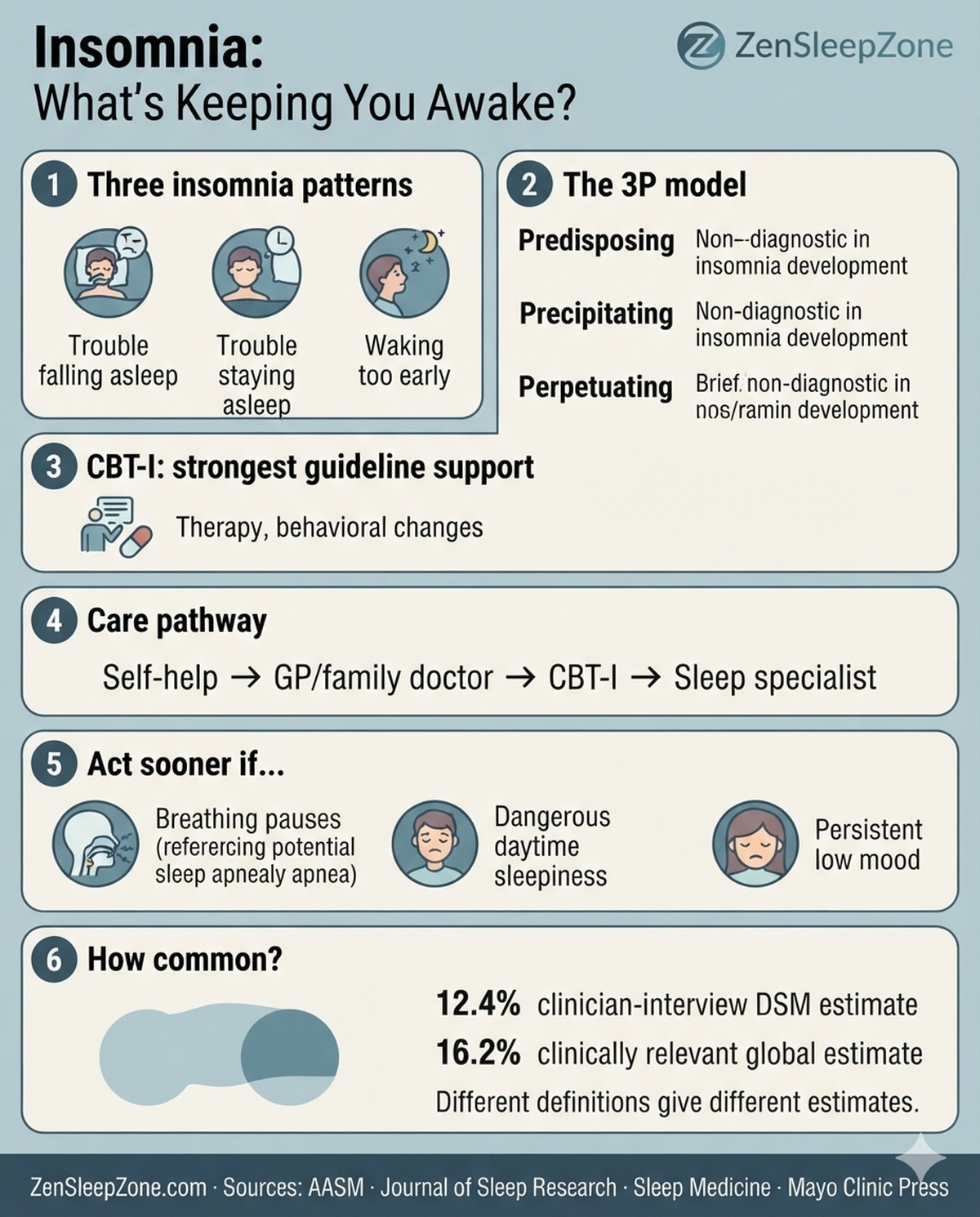
What the infographic shows
The infographic above maps the six-stage cycle that keeps insomnia going long after the original reason for poor sleep has passed.
- The trigger — Stress, illness, or a life event triggers initial sleep difficulty. This is the precipitating factor in the three-P model of insomnia: the thing that starts the problem. PMC / Klin Spec Psihol, 2022
- Coping behaviours — Extended bed time, late naps, and compensatory sleep begin. These feel logical — you’re exhausted, so you spend more time in bed — but they are the primary perpetuating factors that keep insomnia going. PMC / Klin Spec Psihol, 2022
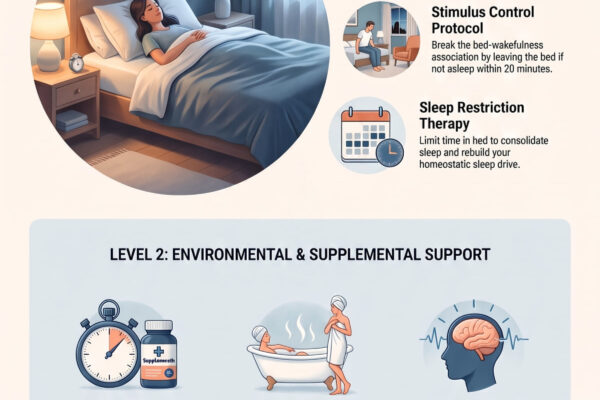
- Bed association — The bed becomes associated with wakefulness and arousal, not rest. The more hours you spend lying awake in bed, the more your brain learns that bed is a place to be alert, not to sleep — the mechanism that stimulus control therapy directly targets. PMC / Klin Spec Psihol, 2022
- Sleep worry — Worry about sleep itself becomes a primary driver of arousal. Once you start watching the clock, calculating how many hours remain, or dreading the next night, the anxiety becomes its own cause of wakefulness — independently of the original trigger. PMC / Klin Spec Psihol, 2022
- The cycle persists — The cycle continues even after the original trigger has resolved. This is why insomnia that began during a stressful period can last for months or years after the stress has passed: the coping behaviours and the bed association have taken over as the maintaining cause. PMC / Klin Spec Psihol, 2022
- Breaking the cycle — CBT-I targets each link directly to restore healthy sleep patterns. Rather than treating a symptom, CBT-I works on the coping behaviours, the bed associations and the anxious thinking that keep the cycle running. PMC / Klin Spec Psihol, 2022 · Cullen et al., Journal of Sleep Research, 2025
“Insomnia persists because of what we do to cope — and those coping behaviours are exactly what CBT-I is designed to change.”
Questions about the Sleep Diary Analyser
How is sleep efficiency calculated?
Total sleep time divided by total time in bed, multiplied by 100. The tool estimates total sleep time by subtracting your sleep onset time and mid-night wake time from your total time in bed.
For example: if you were in bed for 8 hours, took 30 minutes to fall asleep, and were awake for 30 minutes during the night, your estimated total sleep time is 7 hours and your sleep efficiency is 87.5%. The formula is the same one used in clinical sleep diaries recommended at assessment. Mayo Clinic, 2023
Is one bad night enough to lower my efficiency?
No — a single difficult night is normal and doesn’t indicate a problem on its own.
Sleep varies from night to night for everyone. Stress, temperature, noise, alcohol, or a late meal can all push your number down without meaning anything is wrong. This tool is most useful when you track your sleep consistently over one to two weeks, which is what clinicians recommend before drawing any conclusions. Mayo Clinic, 2023 For more on how patterns — rather than single nights — form the basis of a diagnosis, see insomnia questions answered.
Does this tool diagnose me with insomnia?
No. This tool is for informational purposes only and does not produce a clinical diagnosis.
A formal diagnosis of insomnia disorder requires a healthcare provider to evaluate your history, rule out other conditions — such as sleep apnea, restless legs syndrome, or a mood disorder — and apply clinical criteria. The sleep efficiency figure this tool produces is an estimate based on your self-reported entries; it is not equivalent to a clinical sleep study or a clinician’s assessment. This tool is for informational purposes and does not constitute a diagnosis. Insomnia shares features with other sleep disorders and medical conditions. A clinician evaluation is needed for diagnosis and to rule out contributing causes.
What should I do if my efficiency is consistently low?
Print your sleep diary summary from the tool and bring it to a GP or sleep specialist appointment.
A clinician can help rule out other conditions and discuss treatment options. The most evidence-supported first-line treatment for chronic insomnia disorder is CBT-I — cognitive behavioural therapy for insomnia — which targets the maintaining factors directly rather than suppressing symptoms. Cullen et al., Journal of Sleep Research, 2025 · PMC / Klin Spec Psihol, 2022
You have your number — here’s what to do with it
Print or save your sleep diary summary, track for a few more nights if this was your first time, and bring the results to your GP if your efficiency is consistently below 85% or your daytime functioning is significantly affected. The full guide is the full insomnia guide, with everything from diagnosis to CBT-I explained in plain language, and more resources in Sleep Disorders.
Find my starting point →Sources
- PMC / Klin Spec Psihol — “Cognitive Behavioral Therapy for Insomnia (CBT-I): A Primer” (2022) — supports: CBT-I addresses perpetuating factors per the 3P model; infographic panels 1–6 (precipitating factor, coping/perpetuating behaviours, stimulus control mechanism, cognitive arousal, cycle persistence, CBT-I as targeted treatment)
- Cullen et al., PMC / Journal of Sleep Research — “Effectiveness of CBT-I in Individuals With Neurodevelopmental Conditions” (2025) — supports: CBT-I is the recommended first-line treatment for chronic insomnia disorder in diverse populations with co-occurring conditions; infographic panel 6; below-benchmark result state
- Mayo Clinic — “Insomnia treatment: Cognitive behavioral therapy instead of sleeping pills” (2023) — supports: sleep diary tracking for 1–2 weeks recommended at assessment; sleep efficiency formula used in clinical practice
Sources checked · Next review due March 2027