
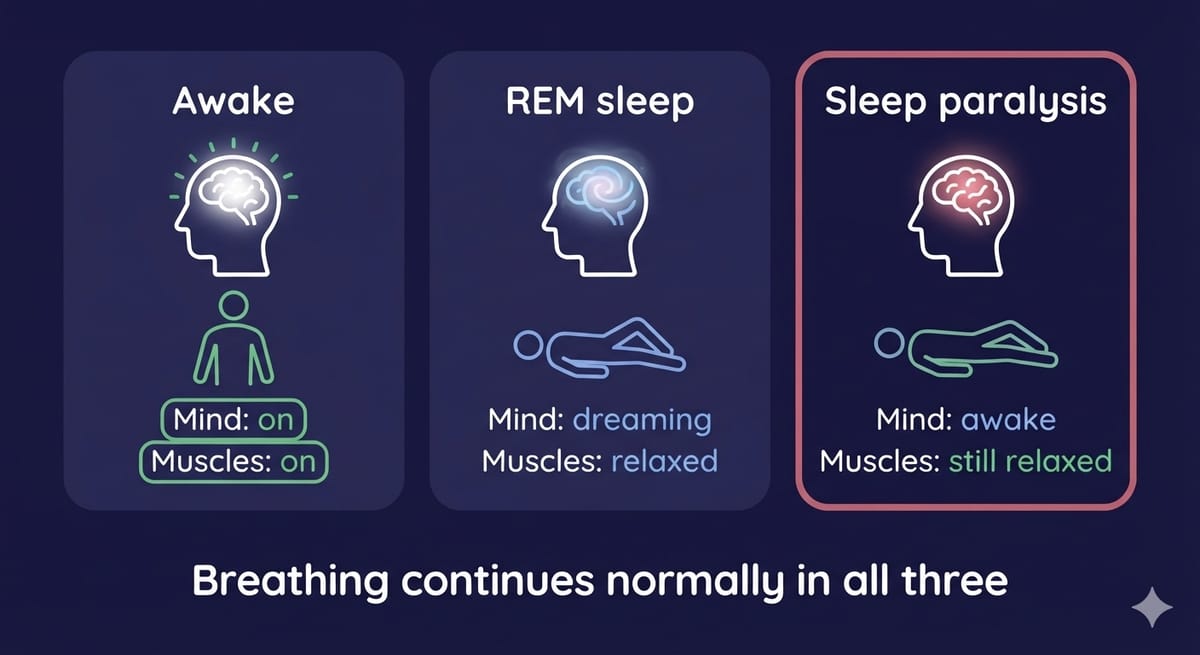
Sleep paralysis is a brief state where your mind wakes before your body. REM (dreaming) sleep’s muscle relaxation is still on, so you can’t move or speak for seconds to a few minutes. It’s frightening but not considered dangerous: you keep breathing normally, and it ends on its own (AASM, 2021).
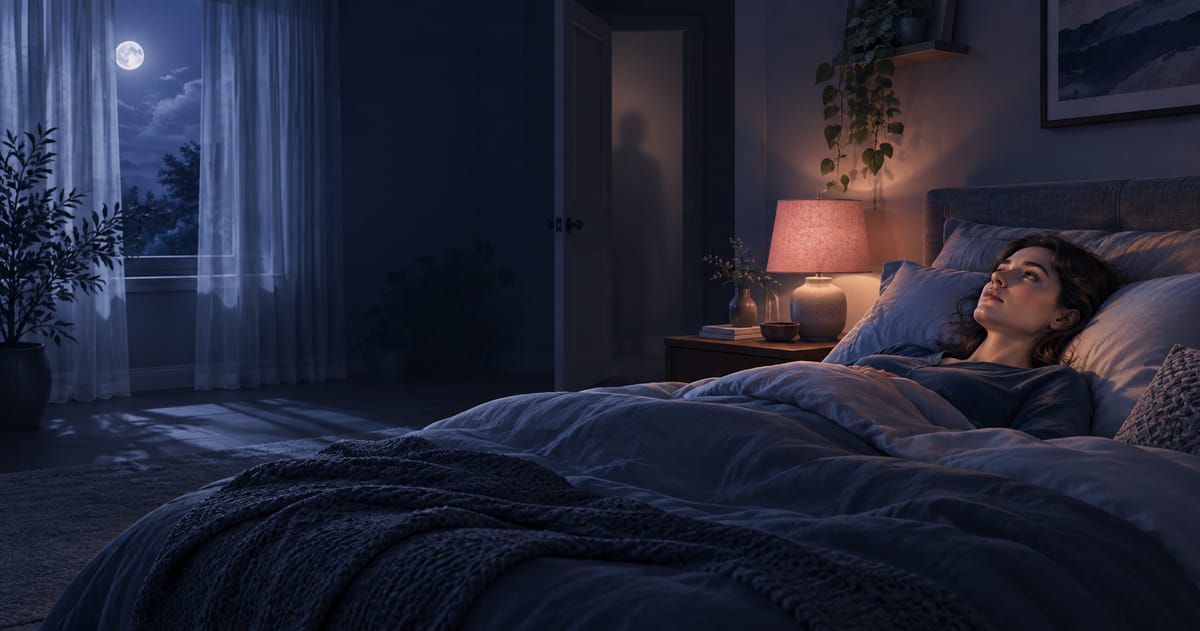
You wake up, but nothing moves. You try to shout and no sound comes out. Maybe you feel a weight on your chest, or you’re sure someone is standing in the room. Then, just as suddenly, it’s over, and you’re left wide awake with your heart pounding.
If that just happened to you, you’re not losing your mind, and sleep paralysis itself isn’t considered dangerous. This guide explains what was going on in your brain, what to do the next time it starts, which habits make episodes more likely, and the few signs that mean it’s worth talking to a doctor. It’s part of our wider coverage of sleep disorders and their symptoms.
At a glance
- It’s REM sleep overlapping with waking — the American Academy of Sleep Medicine classes sleep paralysis as a REM parasomnia.
- You keep breathing — awareness and breathing stay normal during an episode, even if your chest feels heavy.
- It’s short — most episodes last from a few seconds to 1 or 2 minutes (MedlinePlus, 2025).
- About 7.6% of people have it at least once — the pooled estimate from a systematic review, far below the 30–70% you may see quoted online (Denis, 2018).
- Most people need no treatment — episodes are usually too rare to need it, but see a doctor if they’re frequent, leave you afraid to sleep, or come with daytime sleepiness or sudden muscle weakness (NHS, 2026).
This guide explains sleep paralysis for general education. It can’t diagnose you or replace care from a clinician who knows your health.
Is sleep paralysis dangerous?
Sleep paralysis isn’t considered dangerous. Cleveland Clinic puts it plainly: it “isn’t dangerous, but it can cause emotional distress during an episode” (Cleveland Clinic, 2024). The distress is real. The physical threat isn’t.
The feeling that you can’t breathe is the part that scares most people. Here’s what’s actually happening: the muscles you control on purpose, like your arms and legs, are still relaxed from dream sleep, but your breathing keeps working on its own. The American Academy of Sleep Medicine describes episodes with “full awareness and normal breathing” (AASM, 2021). Your chest may feel heavy because you can’t take a big, deliberate breath, not because air isn’t getting in.
It also ends by itself. Most episodes last from a few seconds to one or two minutes, and the NHS says the feelings can last “up to several minutes” (NHS, 2026). Fear can make it feel far longer; as one person put it, “that 20 seconds feels like a lifetime.”
The one honest caveat: being harmless doesn’t mean being unimportant. If episodes keep coming back, make you afraid to go to bed, or show up alongside heavy daytime sleepiness, they’re worth a conversation with a doctor. You’ll find the specific signs in when to see a doctor.
What to do during an episode
The most useful thing you can do during sleep paralysis is name it and let it pass: remind yourself it’s sleep paralysis, that it’s harmless, and that it will end within moments. Fear makes the experience worse, so calming your mind matters more than fighting your body.
You’ll find two different pieces of advice online, and it helps to know where each comes from. Australia’s government health service suggests: “Try to move your fingers and toes. Focus on staying calm and breathing” (healthdirect, 2025). The only technique that has been tested in a study, meditation-relaxation (MR) therapy from the University of Cambridge, says the opposite about movement: relax your muscles and “under no circumstances” try to move (University of Cambridge via ScienceDaily, 2020).
Calm-and-reframe
A four-step plan for your next episode
- Name it — Tell yourself: “This is sleep paralysis. It’s common, it’s harmless, and it’s temporary. What I’m seeing is part of a dream.”
- Step back from the fear — Remind yourself there’s nothing to be afraid of, and that panic is what makes episodes feel worse and longer.
- Focus inward on something good — Hold your attention on a positive, emotionally meaningful image: a person you love, a happy memory, a prayer or a favorite song.
- Let your body go soft — Relax your muscles instead of straining against them, and let your breathing look after itself.
Those four steps follow the MR therapy protocol. In a small pilot study of 10 people with narcolepsy, the group using it had 50% fewer days with sleep paralysis and 54% fewer episodes in the final month, while the comparison group practiced deep breathing (Jalal et al., 2020). The researchers call the results “preliminary and exploratory given the small sample,” and it hasn’t yet been tested in people without narcolepsy.
So which should you do? There’s no proven answer for everyone. A sensible approach is to start with the calm-and-reframe steps, because reducing fear is what both pieces of advice are aiming for. If gently wiggling a finger or toe helps you feel back in control, that’s fine too. Straining your whole body against the paralysis is the one thing the tested technique specifically advises against. Behavioral techniques for sleep paralysis still lack systematic testing, so if your episodes are frequent or distressing, don’t rely on self-help alone.
Knowing how to get through an episode takes the edge off. Knowing why it happens takes away most of the fear.
What is sleep paralysis?
Sleep paralysis is a temporary inability to move or speak “right as you’re falling asleep or waking up” (MedlinePlus, 2025). Doctors classify it as a REM parasomnia, which means it’s an unusual event linked to the dreaming stage of sleep.
Sleep paralysis is a brief overlap between REM sleep and waking: your mind becomes aware, but the muscle relaxation that normally stops you acting out dreams hasn’t switched off yet.
During REM sleep, your brain sends signals that relax the muscles in your arms and legs so you don’t act out your dreams (Cleveland Clinic, 2024). That’s normal and happens every night. Sleep paralysis is what you notice when you become conscious while that relaxation is still on. If you’d like to understand this stage better, our guide to what REM sleep does compared with deep sleep explains the full cycle.
When it happens to someone who’s otherwise healthy, it’s called isolated sleep paralysis. It can also appear as one of the symptoms of narcolepsy, a separate sleep disorder covered further down. It usually first shows up in the teens, with an average starting age of 14 to 17, and it’s most frequent in people in their 20s and 30s (AASM, 2021).
Why you might see a figure or feel pressure
The shadowy figure, the presence in the room or the weight on your chest is dream imagery carrying over into waking. Dr. Katherine Green, medical director of the University of Colorado Sleep Center, calls it “a transitional hallucination that resolves along with the paralysis” (CU Anschutz, 2025). When the paralysis lifts, the figure goes with it.
Many people describe very similar scenes: “a dark silhouette comes right over my body,” or the NHS’s description of feeling “like something is pushing you down” (NHS, 2026). The similarity isn’t evidence of something outside you. It reflects how the same brain state produces the same kinds of images in different people.
People have been describing this for centuries. In 1664, a Dutch physician recorded a patient who believed “the devil lay upon her and held her down,” and Henry Fuseli’s 1781 painting The Nightmare shows a creature sitting on a sleeping woman’s chest, an image tied to the folklore of the “incubus”.
If your faith or culture gives the experience a spiritual meaning, that’s yours to hold. The medical explanation sits alongside it: the paralysis and the images come from REM sleep, and they pass. For a broader look at how belief and rest interact, see how faith and spirituality shape sleep.
What causes sleep paralysis?
Sleep paralysis is caused by REM sleep overlapping with waking, and that overlap becomes more likely when your sleep is short, irregular or disturbed. Researchers have found links rather than a single cause, so think of these as factors that load the dice.
REM sleep’s muscle relaxation is still active when your mind wakes up.
Short or irregular sleep, stress, anxiety, trauma, some conditions and medicines, and sleeping on your back.
Enough sleep, steady sleep times, side sleeping and treating any linked condition.
The NHS lists insomnia, disrupted sleep patterns such as shift work or jet lag, narcolepsy, PTSD, generalized anxiety disorder, panic disorder and a family history of sleep paralysis (NHS, 2026). MedlinePlus adds not getting enough sleep, mental stress, bipolar disorder and ADHD medicines, and Cleveland Clinic includes obstructive sleep apnea.
A 2018 review in Nature and Science of Sleep found that worse sleep quality is linked to higher odds of sleep paralysis across multiple studies, and that insomnia symptoms predict it too (Denis, 2018). So if you’re also dealing with long-running insomnia, improving that sleep is part of the picture. Travel matters too: the NHS lists jet lag among the disruptions linked to episodes, and our guide to resetting your body clock after travel can help. The same review links stress, exposure to threatening events, anxiety and poor mental health with sleep paralysis. If you tend to wake with a racing mind, our guide to waking at night with anxiety covers that pattern.
Sleeping position plays a part, though not the way people expect. Episodes happen most often while lying on your back, but the position you fall asleep in shows no clear link. In other words, you may drift onto your back later in the night, and that’s when episodes tend to happen.
Once the causes make sense, the next questions are how normal this is and whether it needs treating.
How common is sleep paralysis?
The strongest estimate is that about 7.6% of people in the general population have sleep paralysis at least once in their lives. That figure comes from a systematic review that pooled many studies, whose individual results ranged from 2% to 60% (Denis, 2018).
You’ll see much bigger numbers online, and the gap can be confusing. Here’s where each one comes from.
| Figure you may see | Who it describes | Where it comes from |
|---|---|---|
| 7.6% | General population, at least once in life | Pooled systematic review estimate, reported by Denis, 2018 |
| 5% to 40% | People in general | A broad range given by the AASM, 2021 |
| About 20% | People in general | Background statement in a 2020 study (Jalal et al.) |
| About 30% | People worldwide, at least once | Patient page with no study shown (Cleveland Clinic, 2024) |
| Up to 70% | People at some point | A clinician’s interview estimate, no study cited (CU Anschutz, 2025) |
| Higher than average | Students and psychiatric patients, especially PTSD and panic disorder | Pattern across studies (Denis, 2018) |
For you, that means two things. First, you’re far from alone: even the most cautious estimate means a large share of people have been through what you experienced. Second, it isn’t something almost everyone goes through, so it’s fair to take frequent episodes seriously rather than shrug them off. The spread in numbers mostly comes from who was surveyed and how the question was asked. Studies of students or people with PTSD or panic disorder find higher rates than studies of the general public.
Does sleep paralysis need treatment?
Most people don’t need treatment for sleep paralysis. MedlinePlus notes that “in most cases, sleep paralysis occurs so rarely that treatment is not needed,” and that dealing with causes such as lack of sleep helps (MedlinePlus, 2025).
When episodes are frequent or distressing, a doctor usually starts by looking for anything that’s feeding them, such as a mental health condition or another sleep disorder. The NHS says a specialist may prescribe a low dose of an antidepressant, a type of medicine that suppresses REM sleep, or suggest cognitive behavioral therapy (NHS, 2026). Those are decisions for you and your doctor, not something to start on your own. If insomnia sits underneath your episodes, CBT for insomnia is the first-line treatment for that problem.
The research on sleep paralysis treatment itself is thin. A review concluded that several behavioral approaches have been proposed but “systematic testing is lacking,” and that people with sleep paralysis rated changes to their sleep patterns as the most successful way to prevent it (Denis, 2018). Meditation-relaxation therapy is promising but has only been tested in a small group of people with narcolepsy.
“Sleep paralysis can stop your breathing.”
Breathing continues normally during an episode; only the muscles you move on purpose are relaxed.
“The figure in the room is something attacking me.”
It’s a transitional hallucination from REM sleep that ends with the paralysis.
“Fighting as hard as you can to move is the way out.”
The only tested technique asks you to relax and not try to move; struggling tends to feed the fear.
If it helps to hear it explained out loud, this short video from Northside Hospital walks through what happens in the brain during an episode.
The Science Behind Sleep Paralysis: Surviving the Spooky Night! — Northside Hospital
Treatment is rarely needed, which puts the focus on what you can change at home.
How to prevent sleep paralysis
The best way to prevent sleep paralysis is to protect the amount and regularity of your sleep. No prevention method has been proven in trials, but sleep habits are the factor most consistently linked to episodes, and people who get them rate pattern changes as what helped most.
Steady, sufficient sleep
Regular, sufficient sleep is the main drug-free way to lower your odds. It hasn’t been tested in trials for sleep paralysis, but it targets the sleep loss and irregular schedules that health services link to episodes (NHS, 2026).
Expect fewer episodes rather than a guaranteed stop. If they stay frequent or come with daytime sleepiness, see a doctor.
For example, imagine a student who sleeps about five hours on weeknights, then sleeps late on weekends, and starts waking up unable to move with a shadow by the door. Health services link both short sleep and irregular schedules to episodes, and most people need no medical treatment. A sensible first step would be steadier bed and wake times and more total sleep, then keeping a simple note of when episodes happen to see whether they ease. If episodes keep coming, or arrive with heavy daytime sleepiness, that’s the point to book an appointment.
Australia’s healthdirect adds a few comfort tips that may make waking at night less frightening: keep the bedroom cool and dark, use a small night light, and cut screen time in the hour or two before bed (healthdirect, 2025).
When to see a doctor
See a doctor if you have sleep paralysis often and it leaves you “very anxious or scared to go to sleep” or “tired all the time due to lack of sleep” (NHS, 2026). MedlinePlus also advises medical attention for repeated episodes, since they can point to an underlying problem.
A few combinations deserve a specific mention:
- Sleep paralysis plus daytime sleepiness or sudden weakness. Narcolepsy causes excessive daytime sleepiness in everyone who has it, and can cause cataplexy: “sudden episodes of muscle weakness, often triggered by strong emotions such as laughter, fear, anger, stress, or excitement” (NINDS, 2025). Sleep paralysis on its own doesn’t mean narcolepsy, but together these are worth checking with a sleep specialist.
- Sleep paralysis plus loud snoring, gasping or pauses in breathing. Obstructive sleep apnea is one of the conditions linked to episodes. Our guide to the signs of sleep apnea explains what to look for.
- Sleep paralysis alongside anxiety, panic attacks or trauma symptoms. These conditions are linked to more frequent episodes, and treating them can help both.
Don’t let embarrassment stop you. A doctor will usually start with questions about your sleep habits and may give you a questionnaire. Sleep studies are typically unnecessary unless narcolepsy is suspected (MedlinePlus, 2025). If episodes disturb your sleep or come with daytime sleepiness, they may suggest an overnight sleep study or a daytime nap test (AASM, 2021).
Getting back to sleep after an episode
After sleep paralysis, the best move is usually to reset briefly and then go back to sleep, because the episode itself has passed. Many people lie rigid and wide awake for an hour afterward, afraid it will start again, and that lost sleep can make the next episode more likely.
Sit up, switch on a soft night light, take a few slow breaths and name what happened: “That was sleep paralysis. It’s over.” Then lie down on your side and let yourself drift off again.
If worry about the next episode starts to keep you up most nights, that’s a pattern worth breaking early. Our guide to ways to fall asleep faster has techniques that also help when you’re trying to settle after a scare. And if fear of sleep itself has taken hold, that’s one of the clearest reasons to talk to a doctor.
Frequently asked questions
Can you die from sleep paralysis?
There’s no evidence that sleep paralysis is dangerous, and your breathing continues normally throughout an episode.
The sense of choking or pressure comes from not being able to move your chest muscles on purpose, not from your airway closing. Frequent episodes are still worth discussing with a doctor because of what they can signal.
Why does sleep paralysis happen when I sleep on my back?
Sleep paralysis episodes happen most often while lying on your back, though researchers haven’t found a clear reason.
Interestingly, the position you fall asleep in shows no clear link, so you may be rolling onto your back later in the night. Health services suggest side sleeping as a simple step to try.
Is sleep paralysis spiritual?
Sleep paralysis has a well-understood medical explanation: REM sleep overlapping with waking, which also explains the figures people see.
People have described it in spiritual terms for centuries, including the folklore of the “incubus.” Holding a spiritual view of it doesn’t conflict with knowing it’s harmless and temporary.
What will a doctor do about sleep paralysis?
A doctor will usually ask about your sleep habits first and look for anything feeding your episodes.
A sleep study is typically only needed if narcolepsy is suspected. Treatment, if any, focuses on linked conditions, and a specialist may consider a low-dose antidepressant or cognitive behavioral therapy.
Can teenagers get sleep paralysis?
Yes. Sleep paralysis often starts in the teenage years, with an average first episode between ages 14 and 17.
Not getting enough sleep and irregular sleep schedules are both linked to episodes, so steadier sleep times are a good first step. A doctor can help if episodes are frequent or frightening.
Key takeaways
- Remember — sleep paralysis is your mind waking a moment before your body; the figure and the pressure are part of the dream, and they pass.
- Do — next time, name it, step back from the fear and let your body go soft; then protect regular, sufficient sleep.
- If it continues — see a doctor if episodes are frequent, leave you afraid to sleep, or come with daytime sleepiness, sudden weakness or loud snoring.
You know what’s happening, and you have a plan for the next one
Name it, stay soft, protect your sleep, and know the signs that need a doctor. Our sleep disorders section covers the conditions that can sit behind frequent episodes.
Explore sleep disorders →Sources
- American Academy of Sleep Medicine — Sleep paralysis (2021). Supports: REM parasomnia, normal breathing, duration, age of onset, prevalence range, diagnosis.
- MedlinePlus (US National Library of Medicine) — Sleep paralysis (2025). Supports: definition, duration, causes, treatment rarely needed, when sleep studies are used.
- NHS — Sleep paralysis (2026). Supports: feelings, causes, prevention, when to see a GP, treatments.
- National Institute of Neurological Disorders and Stroke — Narcolepsy (2025). Supports: daytime sleepiness and cataplexy as narcolepsy signs.
- healthdirect (Australian Government) — Sleep paralysis (2025). Supports: fingers-and-toes advice, comfort tips.
- Denis D — Relationships between sleep paralysis and sleep quality: current insights, Nature and Science of Sleep (2018). Supports: 7.6% lifetime estimate, risk factors, sleeping position, lack of treatment trials.
- Jalal B et al. — Meditation-Relaxation (MR Therapy) for Sleep Paralysis: A Pilot Study in Patients With Narcolepsy, Frontiers in Neurology (2020). Supports: pilot results and limits.
- University of Cambridge via ScienceDaily — Meditation-relaxation therapy may offer escape from the terror of sleep paralysis (2020). Supports: the four MR therapy steps.
- Cleveland Clinic — Sleep paralysis (2024). Supports: not dangerous, REM muscle relaxation, sleep apnea link, 30% figure.
- Stanford Health Care — Sleep paralysis. Supports: isolated sleep paralysis and narcolepsy.
- CU Anschutz Medical Campus — ‘Mostly benign’: sleep paralysis demons explained (2025). Supports: transitional hallucination, history, 70% interview figure.
Sources checked · Next review
How we made this guide: researched from the sources above, drafted with AI assistance and edited by Aamir Bashir, Founder & Editor. Read our editorial policy.