

REM vs Deep Sleep: Differences, Benefits, and How to Improve Both
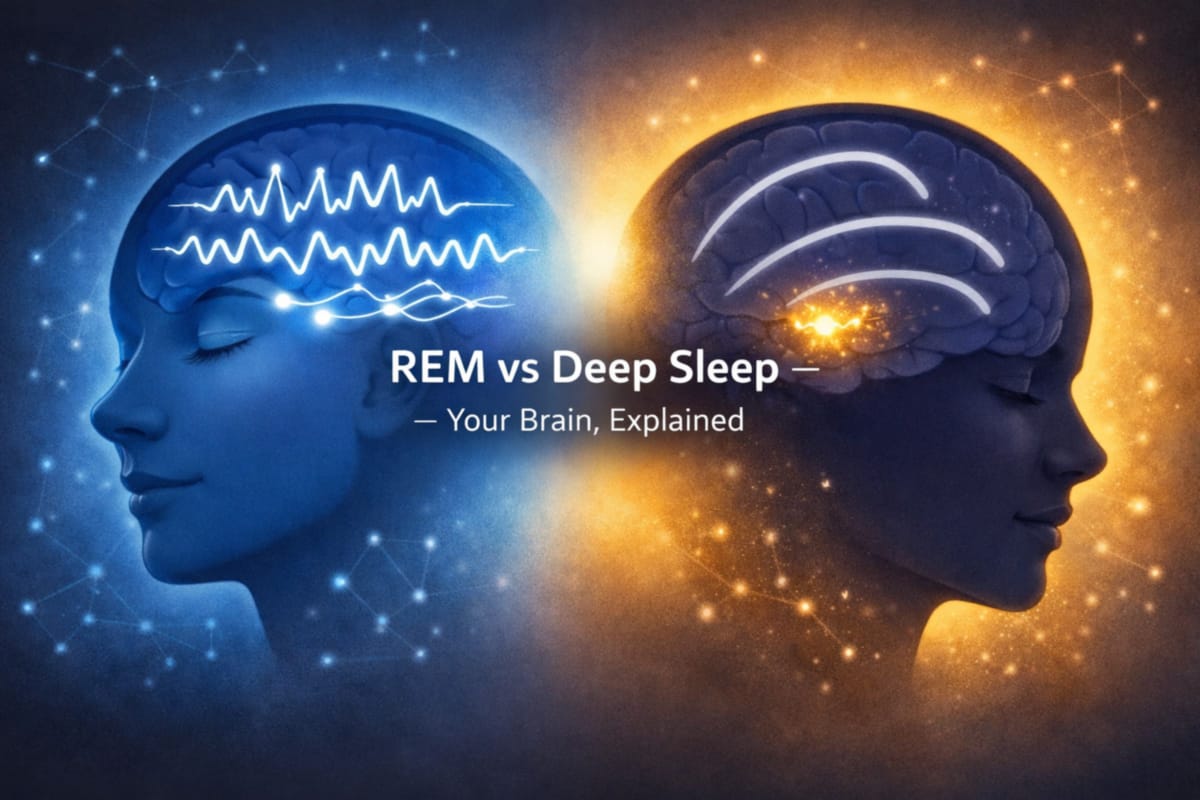
REM vs deep sleep: these are two distinct sleep stages with completely different biological jobs. Deep sleep (N3) repairs your body — releasing growth hormone, strengthening immunity, and clearing brain waste. REM sleep processes your emotions and consolidates memories. Healthy adults need both: roughly 13–23% deep sleep and 20–25% REM per night.
In short: Neither stage “wins” — your brain and body each need their own repair window, and a deficit in either shows up in ways most people don’t expect.
Why Your Tracker Number Feels So Alarming — And Why Context Changes Everything
You opened your sleep app this morning and saw a number that stopped you cold. Maybe it said 42 minutes of deep sleep. Maybe your REM was flagged in red. And now you’re here, quietly wondering: *is something wrong with me?* That feeling is completely understandable. “I slept 8 hours and I’m still exhausted” is one of the most frustrating things a body can do to a person — and when your tracker then points at a low stage reading, it’s natural to fill that gap with worry. Many people find themselves doing exactly what you’re doing right now: staring at a number, searching for what it means, and landing on articles that either catastrophise or explain nothing. You deserve better than that. Here’s the reassurance you actually need before we go any further: a single low reading on a consumer sleep tracker is more likely to reflect measurement noise than a medical crisis. Understanding REM vs deep sleep — what each stage actually does, what normal looks like for *your* age, and which of your symptoms points to which stage — is the entire point of this guide. Our sleep science hub exists specifically for moments like this one.Which Sleep Stage Is Your Body Missing?
Before we get into the science, take 10 seconds to scan these patterns. The ones you recognise will tell you exactly which section of this guide matters most to you.
- I wake up feeling physically heavy, sore, or unrefreshed — even after a full night
- I feel emotionally flat, irritable, or overwhelmed more than usual — especially in the morning
- My sleep tracker flags low deep sleep (N3) regularly
- My sleep tracker flags low REM regularly — or my REM seems to drop when I drink alcohol or sleep in
- I have vivid or disturbing dreams I remember — or I’ve stopped dreaming (or noticing dreams) entirely
- I struggle to retain new information or feel mentally sluggish even after sleeping
Physical symptoms (rows 1, 3) often point to a deep sleep deficit. Emotional and cognitive symptoms (rows 2, 4, 5, 6) often point to a REM deficit. If you checked both columns — you’re in the right place.
🔗 Those percentages mean something specific for your age — and the table later in this guide shows exactly where you should fall.
The stage that fixes your body and the stage that fixes your mind run on opposite ends of the night — and that timing gap changes everything.
This article is written for educational purposes and is not a substitute for personalised medical advice — if persistent sleep problems are affecting your daily life, please speak with a qualified healthcare professional.
The Biology of REM and Deep Sleep: What’s Actually Happening in Your Brain and Body
Now that you know a single low reading isn’t a verdict, the real question is: *why is this happening?* To answer that, you need to understand what your brain is actually doing during each of these stages — because REM and deep sleep are not two versions of the same thing. They’re as different from each other as running is from surgery. Sleep is not a uniform state. Your brain cycles through distinct stages throughout the night, and understanding where REM and deep sleep sit within that architecture is the key to interpreting everything else. Understanding circadian rhythm and sleep timing adds another layer: the body clock that governs *when* you sleep directly shapes *which* stages you get and how much.The Sleep Cycle: Where REM and Deep Sleep Sit — and When
A typical sleep cycle lasts approximately 90 minutes, and most adults complete four to six of these cycles across a full night. [Sleep Foundation, 2024] Within each cycle, you pass through three NREM stages (N1 light, N2 consolidated, and N3 deep sleep) before entering REM. But — and this is the detail that changes how you interpret your tracker data — these stages are not evenly distributed across the night. Deep sleep (N3) is heavily front-loaded. The most substantial N3 episodes occur in the first two sleep cycles, meaning the first three to four hours of your night are doing the lion’s share of your physical restoration. By the third or fourth cycle, N3 shrinks significantly and REM expands to dominate. The final 90-minute cycle before you wake is almost entirely REM. Think about what this means practically. If you go to bed at 11pm and set your alarm for 6am, those rich REM cycles are happening between roughly 4am and 6am. Cut that window short — by alcohol, an early alarm, or a restless night — and REM takes the hit disproportionately, even if your total sleep hours look fine on paper.REM sleep is just dreaming — it’s a passive, optional stage that matters less than deep sleep.
REM is an intensely active brain state performing critical emotional regulation, memory consolidation, and neural maintenance. Its deficit produces measurable cognitive and psychological impairment — often before any physical symptoms appear.
If I sleep 8 hours, I must be getting enough of each stage.
Total hours don’t guarantee stage adequacy. Fragmented sleep, alcohol, poor timing, or sleep-disordered breathing can collapse specific stages while leaving total sleep time intact.
Deep sleep is evenly distributed throughout the night.
N3 is concentrated in the first two cycles (the first 3–4 hours). The second half of the night is dominated by N2 and REM — which is why late bedtimes cost you more physical repair than they cost you REM.
🔗 These timing differences explain why two people can sleep the same hours but wake up feeling completely different — it’s about when sleep happens, not just how long.
What Deep Sleep (N3 / Slow-Wave Sleep) Does for Your Body
During deep sleep — also called N3, NREM Stage 3, or slow-wave sleep (SWS) — your brain produces slow, synchronised delta waves. Heart rate drops. Breathing slows. Your muscles are relaxed and essentially offline. From the outside, you look profoundly still. Inside, your body is working harder than at any other point in the night. The most significant process happening during N3 is growth hormone secretion. Research published in the NIH confirms that the majority of nightly growth hormone release occurs during the *first* slow-wave sleep episode of the night. [Van Cauter et al., NIH, 2000] Disrupting N3 — whether through alcohol, a late sleep time, or fragmented sleep architecture — measurably reduces how much of this hormone your body produces. This isn’t just relevant for athletes. Growth hormone governs tissue repair, immune cell production, and metabolic regulation in every adult body.🔗 That’s why people with chronically low deep sleep often feel physically heavy and slow to recover from exercise — even mild exercise — regardless of how many hours they slept.
Deep sleep is also the primary window for the glymphatic system — your brain’s waste-clearance network. During N3, the spaces between brain cells expand, allowing cerebrospinal fluid to flush out metabolic waste products that accumulate during waking hours. This includes proteins associated with neurological risk in emerging research. It’s a genuinely remarkable system, and it runs almost exclusively on deep sleep. Understanding how cortisol and sleep quality interact also matters here: elevated evening cortisol — common in people under chronic stress — specifically suppresses N3, creating a feedback loop where stress reduces the very sleep that would help regulate it.🔗 That 13–23% range is your baseline — but your age shifts the target, which is exactly what the next section’s table addresses.
What REM Sleep Does for Your Brain
REM sleep — rapid eye movement sleep — looks nothing like deep sleep in the brain. Where N3 is characterised by slow delta waves, REM produces fast, desynchronised theta wave activity that closely resembles the waking brain. Your eyes move rapidly beneath closed lids. Your breathing becomes irregular. And in a critical piece of biology that most people don’t know: your voluntary muscles are paralysed. This muscle atonia exists to prevent you from physically acting out your dreams. What is the brain doing during all this activity? Three things, primarily. First, memory consolidation. During REM, the hippocampus replays the day’s learning and transfers memories into longer-term storage. This is why a night of poor REM before an exam or an important presentation has real consequences for recall — not just fatigue. Second, emotional processing. REM sleep is the primary stage for regulating emotional memories. The brain revisits emotionally charged experiences and, under normal conditions, strips some of the emotional charge from them — a process researchers describe as “sleeping on it” in a very literal sense. People who are REM-deprived commonly report irritability, emotional blunting, and disproportionate reactions to minor stressors, often *before* they notice cognitive impairment. If you’ve been waking up emotionally raw or reactive lately, that’s worth flagging. Third, neural maintenance. REM appears to support the pruning and strengthening of synaptic connections — a process essential for brain plasticity and long-term cognitive health. REM isn’t optional. It’s a biological necessity.Healthy adults spend roughly 20–25% of their total sleep time in REM — approximately 90 to 120 minutes across a 7–8 hour night. [Sleep Foundation, 2024] This percentage shifts with age and lifestyle — which is a distinction most articles skip.
🔗 That shift with age is where many readers over 45 realise they’ve been comparing themselves to the wrong benchmark entirely.
Which Is More Important — REM or Deep Sleep?
This is the question that brought many of you here. And the honest answer is: the wrong one to ask. REM and deep sleep serve entirely different biological systems. Deep sleep dominates physical repair — your muscles, immune system, hormonal release, and brain waste clearance all depend on N3. REM dominates emotional and cognitive processing — memory, mood regulation, and neural plasticity all run on REM. They are not competing for the same role. They’re departments in the same building. Which *feels* more important depends entirely on which system is most under stress in your life right now. If you’re recovering from illness or heavy exercise, your body is screaming for N3. If you’re emotionally overwhelmed, struggling to retain information, or feeling inexplicably irritable, your brain is likely short on REM. The goal is never stage dominance — it’s stage balance. Optimising aggressively for one at the expense of the other — say, taking a supplement that deepens N3 but fragments REM — creates a new deficit in a different system. That’s a trade-off, not an improvement. For a broader look at how these stages interact with the full landscape of REM and deep sleep statistics, the data behind these findings is worth exploring in full.🔗 With that framework in place, you’re ready for the part most articles skip: whether your actual numbers are normal for your actual age.
Normal Ranges and How Your Numbers Compare — Including What Your Tracker Is (and Isn’t) Telling You
You’ve probably read at least one other article that gave you a single average number — “20–25% REM” — and left you stranded. If you’re 52 years old, that average was set against data that skews young. If you’re comparing yourself to a 25-year-old’s sleep architecture, you’re almost certainly alarming yourself unnecessarily. Can you actually change these numbers? Before answering that — which the next section does in full — you first need to know whether your numbers actually need changing.Normal Sleep Stage Percentages by Age: The Table Most Articles Don’t Provide
The data below synthesises normative sleep architecture research, including the landmark Ohayon et al. meta-analysis — the canonical reference for age-stratified sleep stage distribution across the adult lifespan. [Ohayon et al., NIH, 2004]| Age Group | Deep Sleep (N3) % | REM Sleep % | What to Know |
|---|---|---|---|
| 18–25 | 20–25% | 21–25% | Peak N3 years. High slow-wave activity supports physical growth and recovery. REM is robust. |
| 26–35 | 17–23% | 20–25% | Gradual N3 decline begins. REM remains stable. Lifestyle factors (alcohol, stress) start to show measurable impact. |
| 36–50 | 12–18% | 19–24% | N3 decline accelerates. REM relatively preserved. Most people in this band first notice unrefreshed waking. |
| 51–65 | 8–15% | 17–22% | N3 reduction is developmentally normal at this age. A reading of 10% N3 in a 58-year-old is not equivalent to the same reading in a 30-year-old. |
| 65+ | 5–12% | 15–20% | Minimal N3 is common and age-appropriate. REM also declines. Waking earlier in the morning is a normal circadian shift, not a pathology. |
🔗 Find your age band — if your tracker reading falls within that range, you’re likely looking at normal variation, not a sleep disorder.
A 55-year-old seeing 10% deep sleep on their tracker is not experiencing the same thing as a 25-year-old with the same reading. The older adult is almost certainly within normal developmental range. The younger adult might warrant a closer look. Age context is everything — and it’s the gap most competing articles leave open. For the full statistical picture on these ranges, the REM and deep sleep statistics page provides the underlying data.How Accurate Are Sleep Trackers for REM and Deep Sleep?
This matters — perhaps more than any other single fact in this article. Consumer sleep trackers (Fitbit, Garmin, Apple Watch, Oura Ring) measure sleep stages primarily through two signals: accelerometry (movement) and heart-rate variability. They cannot detect the slow delta-wave EEG signatures that define N3 in a clinical polysomnography (PSG) study. Research comparing consumer wrist-worn devices to laboratory PSG found that these trackers demonstrate significantly lower accuracy for distinguishing individual sleep stages — particularly N3 — compared to clinical measurement. [Meltzer et al., NIH, 2015] What this means is simple: your tracker is directionally useful, not diagnostically accurate. It can tell you whether a trend is moving up or down over weeks. It can flag that something shifted the night you had two glasses of wine. It cannot tell you with clinical precision exactly how many minutes you spent in N3 last Tuesday. A single bad reading — especially from a wrist-based device — is measurement noise as often as it is signal. This is not a reason to dismiss your tracker. It’s a reason to stop treating one night’s data as a verdict. What warrants attention is a *pattern*: consistent low-stage readings week after week, paired with persistent daytime symptoms. That’s a different conversation from a spike down on a Friday night after a stressful week. If you suspect an underlying sleep condition — particularly one that wouldn’t show up on a tracker at all — our complete guide to sleep disorders explains when a clinical evaluation is the appropriate next step.REM vs Deep Sleep: Side-by-Side Comparison
| Feature | REM Sleep | Deep Sleep (N3 / SWS) |
|---|---|---|
| Brain state | Active, near-waking EEG activity (theta waves) | Slow, synchronised delta waves — least like waking |
| EEG signature | Fast, desynchronised theta activity | High-amplitude, slow delta oscillations (0.5–4 Hz) |
| Timing in night | Back-loaded — dominates cycles 3–5 (final hours) | Front-loaded — dominates cycles 1–2 (first 3–4 hours) |
| % of total sleep (healthy adults) | 20–25% | 13–23% |
| Primary biological functions | Memory consolidation, emotional regulation, neural maintenance | Physical repair, growth hormone release, immune restoration, glymphatic clearance |
| Key processes | Hippocampal memory replay, amygdala modulation, synaptic pruning, muscle atonia | Growth hormone secretion, tissue repair, cytokine release, brain waste clearance |
| Deficiency symptoms | Irritability, emotional blunting, impaired learning, poor dream recall | Physical heaviness, slow recovery, immune vulnerability, cognitive fatigue |
| Most disrupted by | Alcohol (early-night suppression), late alarms, early wake time, stress | Alcohol (overall suppression), caffeine late in day, irregular sleep schedule, stress |
| Primary improvement levers | Protect final sleep cycles, consistent wake time, reduce evening alcohol | Earlier, consistent bedtime; morning or afternoon exercise; reduce late caffeine |
🔗 The “most disrupted by” row is particularly important — alcohol appears in both columns, but for different reasons at different times of night.
Symptoms of Low Deep Sleep vs Low REM Sleep: Which Stage Are Your Symptoms Pointing To?
This is the differentiation gap that no other mainstream article provides. Most sleep content lists “symptoms of poor sleep” as a single undifferentiated list. But your symptoms are stage-specific, and matching them to the right deficit is how you choose the right fix. **Symptoms that most commonly point to low deep sleep (N3):** – Waking up feeling physically heavy or unrefreshed despite adequate hours – Muscle soreness that doesn’t resolve with sleep – Slow post-exercise recovery – Increased susceptibility to colds or infections – Afternoon energy crashes that feel physical, not mental – Consistent low deep sleep readings on tracker across multiple weeks **Symptoms that most commonly point to low REM sleep:** – Waking up emotionally flat or inexplicably irritable – Difficulty recalling dreams — or unusually intense, disturbing dream recall – Poor retention of recently learned information – Feeling mentally foggy but not physically tired – Emotional reactivity that seems disproportionate to circumstances – REM readings that drop after alcohol or a shortened final sleep cycle The connection between REM deficiency and emotional dysregulation is particularly well-supported — and it’s one of the least-discussed aspects of sleep stage biology. Exploring the relationship between sleep and mental health reveals just how deeply REM deprivation affects mood, anxiety levels, and emotional processing capacity — often before a person connects the dots to sleep.See REM vs Deep Sleep as a Diagram
Visual breakdowns of sleep cycles, stage timing, and how your night actually unfolds.
See the Visual Guide →Questions Answered
Direct answers to the most common questions about REM, deep sleep, and tracker readings.
Read the Q&A →🔗 Once you’ve matched your symptoms to a stage, the next section gives you the specific interventions that target that stage — not a generic sleep hygiene list.
What Chronic Deficiency in Each Stage Actually Does to You Over Time
Short-term low readings from a tracker, taken alone, are unlikely to represent a serious health problem. But chronic deficiency — weeks or months of consistently below-range deep sleep or REM, paired with persistent daytime symptoms — is a different matter. **Chronic low deep sleep** has measurable physical consequences: reduced growth hormone output, which affects tissue repair and metabolic function; increased inflammatory markers; greater susceptibility to infection; and, in emerging research, elevated risk of neurological complications linked to impaired glymphatic clearance. There is also a documented relationship between chronic N3 suppression and the development of insomnia and disrupted sleep stage patterns — the fragmented, unrestorative sleep that feels like lying awake even when the tracker says you’re asleep. **Chronic low REM** produces a compounding psychological toll: emotional dysregulation that worsens over time, impaired learning and memory consolidation, and — in some research — associations with increased anxiety and depression risk. REM deprivation also appears to affect threat-detection sensitivity; people with sustained low REM can become hypervigilant in ways that further disrupt sleep, creating a self-reinforcing cycle. Is 1 hour of deep sleep enough? For most adults, the answer is: it depends on your age and total sleep time. A 65-year-old sleeping 7 hours who logs 55 minutes of N3 (about 13%) is within normal range. A 30-year-old sleeping 8 hours who logs 60 minutes (12.5%) is near the lower boundary and worth monitoring. The absolute number matters less than the percentage in context — and the symptoms that accompany it. A note on one specific clinical condition: **REM sleep behaviour disorder (RBD)** is a real medical condition in which the normal muscle atonia of REM fails, and the person physically acts out their dreams — punching, kicking, shouting during sleep. This is not a lifestyle issue. If you or a partner have described this pattern, please seek clinical evaluation rather than applying a self-help checklist. This requires professional assessment.The Mistake That Keeps Most People Stuck
Most people optimising their sleep focus on total hours — adding 30 minutes to bedtime, cutting screens, taking melatonin — without identifying *which stage* is deficient. Generic sleep hygiene can improve overall sleep quality but rarely resolves a specific stage deficit. If your deep sleep is low, you need N3-targeted interventions. If your REM is dropping, those interventions are partially different. Treating both with the same generic list is why many people feel like “they’ve tried everything” — they’ve been optimising the wrong variable for the wrong stage.
🔗 That’s precisely why the next section separates the fixes — one list for N3, one for REM, and a shared foundation that supports both.
How to Improve Deep Sleep and REM Sleep: Stage-Specific and Shared Strategies
You’ve been waking up exhausted, trying things that haven’t worked, and wondering if improvement is even possible. Here’s what “What should I try first?” actually means when you ask it seriously: it depends on which stage your symptoms are pointing to. The strategies below are separated deliberately — not because they’re incompatible, but because the most effective approach starts with the right target. Our sleep optimisation techniques guide provides the broader framework; what follows here is the stage-specific layer on top of it.Stage-Specific Fixes: How to Get More Deep Sleep (N3)
Deep sleep is most reliably improved by working with the body’s natural sleep homeostasis — the pressure to sleep that builds during waking hours. It’s also preferentially sensitive to timing, temperature, and the suppressive effect of alcohol and caffeine.Start tonight — targeted for N3:
- Move your bedtime 30 minutes earlier tonight. Deep sleep front-loads in the first two cycles. Going to bed earlier gives those cycles more room before any forced morning wake. This is the single highest-leverage change for most people.
- Cut alcohol at least 3 hours before bed. Alcohol suppresses N3 directly in the first half of the night — the exact window when deep sleep should be peaking. Two glasses of wine at 9pm will measurably reduce your N3 even if you fall asleep fine and sleep 8 hours.
- Stop all caffeine by 2pm today. Caffeine blocks adenosine — the sleep-pressure molecule that drives N3 initiation. Late caffeine doesn’t just delay sleep onset; it reduces slow-wave sleep depth even when you don’t feel its stimulant effect.
- Cool your bedroom to 65–68°F (18–20°C) tonight. Core body temperature drop is a direct trigger for N3 initiation. A cooler sleeping environment actively promotes the deep sleep stage — this is one of the fastest environmental changes with measurable effect.
🔗 These four steps target the most common causes of suppressed N3 — and most people can implement all four starting this evening.
The exercise timing insight is one that most articles skip entirely. Exercise significantly promotes deep sleep — but *when* you exercise matters. Morning or afternoon exercise (completing at least 3 hours before bedtime) shows the most consistent benefit for N3 in the research. Late evening exercise, particularly high-intensity, can elevate core temperature and cortisol in a window that competes with N3 initiation.Magnesium Glycinate for Deep Sleep Support
Magnesium glycinate is one of the more evidence-informed supplements for supporting N3 sleep quality — particularly in people whose dietary magnesium intake is low, which is common in Western diets. It does not knock you out; it supports the neurological conditions that allow deep sleep to deepen.
Some people find magnesium glycinate noticeably improves sleep quality within 1–2 weeks. Evidence is promising but not conclusive — always consult a healthcare provider before adding supplements, particularly if you take other medications.
🔗 The evidence-based sleep solutions guide covers supplemental and behavioural interventions in more depth for readers who want to go further.
For deeper reading on the full range of evidence-based sleep solutions, including environmental and behavioural protocols, the solutions library is the next natural step.Stage-Specific Fixes: How to Get More REM Sleep
REM is back-loaded in your night, which means the single most powerful lever for improving REM is protecting the final sleep cycles. Most REM deprivation is caused not by a problem falling asleep but by something cutting the sleep short — an early alarm, a restless final hour, or the REM-suppressive effect of alcohol in the first half of the night creating rebound fragmentation in the second half.Start tonight — targeted for REM:
- Set your alarm 30–45 minutes later than usual, if possible. The final 90-minute sleep cycle before waking is predominantly REM. Protecting that window is the highest-leverage change for REM-deficient individuals. A consistent wake time is important long-term, but if you’re chronically short on REM, temporarily extending morning sleep is a valid short-term intervention.
- No alcohol tonight. Alcohol suppresses REM in the first half of the night and creates a REM-rebound effect in the second half — fragmenting both simultaneously. If your tracker readings drop reliably on nights you drink, this is almost certainly why.
- Keep your bedroom dark through the morning hours. Light exposure in the final REM-rich cycles suppresses this stage directly. Blackout curtains have a disproportionate effect on REM adequacy compared to deep sleep, which is less sensitive to early light.
🔗 The alcohol-REM connection is one of the most important and under-communicated findings in sleep science — most people who drink socially have no idea they’re trading REM for sedation.
A consistent wake time — more so than a consistent bedtime — is the most powerful circadian anchor you can establish. Circadian rhythm questions answered explores this in depth; the short version is that your circadian system plans REM-rich cycles based on when it expects you to wake, not when you went to bed. A stable wake time teaches your body to position those final REM cycles reliably. Pre-sleep wind-down also matters specifically for REM. A calm, low-stimulation final hour helps transition the nervous system into a state that supports healthy REM architecture. Sleep meditation techniques offer structured approaches to this transition that go beyond the generic “no screens” advice. Does napping help with REM deficits? Rarely, at least for REM specifically. Short naps of 10–20 minutes target N2 — light sleep — and provide alertness recovery without sleep inertia. Naps of 60–90 minutes can include a brief N3 episode but carry the risk of grogginess on waking. REM is almost never captured in naps under 60 minutes, and longer naps can reduce sleep pressure for the following night, potentially disrupting the very stage you’re trying to recover.What Both Stages Need: Shared Foundations That Support the Whole Night
| Strategy | Targets N3 (Deep Sleep) | Targets REM | Targets Both |
|---|---|---|---|
| Consistent wake time (non-negotiable) | — | ✓ (anchors final REM cycles) | ✓ |
| No alcohol within 3 hours of sleep | ✓ (prevents first-half suppression) | ✓ (prevents rebound fragmentation) | ✓ |
| No caffeine after 2pm | ✓ (adenosine clearance supports N3) | ✓ (indirect — improves overall architecture) | ✓ |
| Cool bedroom (65–68°F / 18–20°C) | ✓ (core temp drop drives N3) | — | — |
| Morning/afternoon exercise (not evening) | ✓ (preferentially promotes N3) | — (indirect benefit) | — |
| Protect final 90-min sleep cycle (don’t cut sleep short) | — | ✓ (REM-dominant final cycles) | — |
| Dark, quiet bedroom environment | — | ✓ (morning light suppresses late REM) | ✓ |
| Reduce evening stress / cortisol (wind-down routine) | ✓ (cortisol suppresses N3 initiation) | ✓ (arousal competes with REM onset) | ✓ |
| Magnesium glycinate (200–400mg before bed) | ✓ (emerging evidence for N3 support) | — | — |
| Melatonin (low dose, 30–60 min before bed) | — (not a direct N3 promoter) | — (circadian anchor, not stage enhancer) | ✓ (circadian timing support) |
| 7+ hours of total sleep (AASM recommendation) | ✓ (adequate time for N3 cycles) | ✓ (adequate time for REM cycles) | ✓ |
| CBT-I (for chronic insomnia pattern) | ✓ (restores sleep efficiency and N3) | ✓ (improves overall architecture) | ✓ |
🔗 The most effective approach for most people is to start with the two or three strategies in the “both” column, then add the stage-specific ones that match their symptom pattern.
The Stage-First Fix Framework
How to Choose and Sequence Your Sleep Interventions
- Match your symptoms to a stage using the symptom sorter above — identify whether you’re primarily N3-deficient, REM-deficient, or both.
- Apply all three “both” foundations first — consistent wake time, alcohol cutoff, and caffeine cutoff. These are non-negotiable baselines before stage-specific tweaks matter.
- Add one stage-specific change this week — either the bedtime adjustment (for N3) or the alarm extension (for REM). Don’t change both simultaneously; you won’t know what worked.
- Monitor tracker trends across 7–10 nights, not individual nights. One low reading proves nothing. A directional shift over 10 nights is a real signal.
- Reassess symptoms, not just tracker numbers. Are you waking up feeling more refreshed? Less emotionally raw? That lived experience is the real outcome measure.
🔗 Progress with sleep optimisation is rarely linear — the next stage gives you the framework for maintaining what you’ve built when things inevitably wobble.
Signs This Is Working (Even Before Your Tracker Numbers Shift)
- You wake up and your first thought isn’t about how tired you feel — the physical heaviness has reduced slightly
- You find yourself less emotionally reactive mid-morning — small irritations feel less overwhelming
- You’re retaining information better during the day — conversations, tasks, and reading feel less effortory
Tracker numbers often lag behind lived experience by days to weeks — trust the symptoms before trusting the scores.
REM vs deep sleep imbalance → front/back timing mismatch disrupts stage adequacy
Sleeping 8 hours → still exhausted, emotionally dysregulated, or physically unrefreshed
Stage-specific targeting → address alcohol, timing, and wake consistency for real improvement
🔗 These targeted fixes resolve the majority of stage deficits — but for a persistent minority, a clinical conversation is the right next move.
When to Stop Self-Optimising and See a Doctor — And How to Keep Your Progress When Life Gets Messy
You’ve started the changes. Maybe you’re already noticing small shifts — slightly less heaviness on waking, mornings that feel incrementally less grim. And then a stressful week hits. Or you travel. Or you have a few bad nights in a row and your tracker goes back to flashing red. *What if it doesn’t work?* That’s the question this stage addresses honestly. First, a real distinction worth making: there is a difference between a lifestyle factor causing your stage deficit and a physiological condition causing it. Most people reading this article are dealing with the former — and the strategies in this guide address it. But a meaningful minority have an underlying condition that lifestyle changes cannot resolve.When Clinical Evaluation Is the Right Step
If you have tried the stage-specific interventions consistently for four to six weeks and you’re still experiencing persistent daytime impairment — difficulty functioning at work, inability to stay awake during low-stimulation activities, or mood disruption serious enough to affect relationships — it is time to speak with a doctor. Specifically, a clinical sleep evaluation (polysomnography) is worth pursuing if: – You or a partner report loud snoring, gasping, or breath-holding during sleep — these are cardinal signs of sleep apnea and sleep stage disruption. Obstructive sleep apnea is one of the most common and most under-diagnosed causes of collapsed N3 and fragmented REM — it is physically incompatible with adequate stage distribution and will not respond to behavioural interventions alone. – You are physically acting out your dreams — punching, kicking, vocalising during sleep. As noted earlier, this describes REM sleep behaviour disorder (RBD) and requires clinical assessment. – Your tracker consistently shows stage readings at the lowest end of the normal range *and* you are symptomatic — this combination warrants investigation, not more solo optimisation. – You’ve experienced significant daytime sleepiness for more than three months despite consistent sleep and normal total hours. If you’re unsure whether CBT-I (Cognitive Behavioural Therapy for Insomnia) might be appropriate before pursuing a full sleep study, CBT-I for sleep problems is the gold-standard non-pharmacological approach and is worth exploring with a qualified clinician. It has a stronger evidence base for restoring healthy sleep architecture than any supplement or device currently available.When Progress Stalls — What’s Usually Happening
The most common failure pattern after initial improvement is this: sleep gets better, the person relaxes the foundations (bedtime drifts, alcohol returns on weekends, the wake time becomes inconsistent), and three weeks later they’re back to square one. This isn’t failure — it’s the expected behaviour of sleep homeostasis responding to a changed schedule. The foundations aren’t a short course; they’re the ongoing conditions under which healthy sleep architecture sustains itself. When progress stalls, return to the framework first, before adding anything new. Check the three “both” foundations — consistent wake time, alcohol cutoff, caffeine cutoff — before assuming a new supplement or device is needed.
🔗 Sleep architecture responds to consistent conditions — one good week followed by a weekend of late nights doesn’t erase progress, but it does require returning to the baseline each time.
Weeks 2–8: Building the habit that makes improvement stick:
- Lock your wake time as a non-negotiable. Even on weekends. Even after a late night. The wake time anchors your circadian rhythm; everything else organises around it. This is the single most powerful long-term lever for REM adequacy.
- Track trends, not nights. Review your sleep stage data weekly, not daily. A single night below range is noise. Five out of seven nights below range is a pattern worth investigating.
- Reintroduce alcohol consciously. If you removed alcohol as a test and your sleep improved, you now have real-world data. If you choose to drink, shifting consumption to earlier in the evening (completing by 6pm if possible) reduces the first-half REM suppression significantly.
- Add one sleep-supporting habit per week. Exercise timing, bedroom temperature, magnesium — introduce them sequentially, not simultaneously. You’ll know what’s working.
🔗 Sustainable improvement in sleep architecture takes four to eight weeks of consistent conditions — expect the journey to be measured in weeks, not nights.
The link between stress and sleep is worth exploring separately — chronic stress is one of the most common and underappreciated drivers of both N3 fragmentation and REM suppression, and managing it is often the missing variable when everything else is optimised.- REM and deep sleep serve completely different systems — deep sleep repairs your body (growth hormone, immune function, glymphatic clearance); REM processes your emotions and consolidates memories. Neither can substitute for the other.
- Your tracker data needs age context — a 55-year-old with 10% deep sleep may be entirely normal; the same reading in a 30-year-old warrants attention. Always compare to your age band, not a universal average.
- Deep sleep is front-loaded; REM is back-loaded — alcohol, late bedtimes, and early alarms hit different stages in different ways. Knowing the timing map lets you make precise changes rather than guessing.
- Your symptoms point to the stage — physical heaviness and slow recovery point to low N3; emotional flatness, irritability, and poor memory retention point to low REM. Treat the right stage with the right interventions.
- Consumer trackers are directional, not diagnostic — a single low reading is more likely measurement noise than pathology. A consistent multi-week pattern paired with daytime symptoms is when investigation makes sense.
- The Stage-First Fix Framework works — establish the shared foundations first (consistent wake time, alcohol cutoff, caffeine cutoff), then add one stage-specific change. Monitor trends over 7–10 nights, not single nights.
- Self-optimisation has a ceiling — if four to six weeks of consistent effort hasn’t shifted persistent daytime impairment, a clinical conversation is the right next step, not more supplements.
🔗 You now have the full picture — here are the five things worth carrying with you after you close this tab.
Quick Overview
- Timing is the overlooked variable → deep sleep peaks in hours 1–3; REM peaks in hours 5–8 of your night
- Alcohol hits both stages — but differently → suppresses N3 first, then fragments REM as it metabolises
- Age changes the target, not the goal → compare your N3% to your age band, not a young-adult norm
- Symptoms are more reliable than tracker scores → emotional flatness = REM signal; physical heaviness = N3 signal
- One consistent wake time outperforms every supplement → it anchors circadian timing for both stages simultaneously
You Now Know What Your Tracker Is Actually Telling You — Here’s Where to Go Next
Explore our full sleep science library for deeper research on every topic covered in this guide.
See the Visual Breakdown →Sources
- Sleep Foundation — REM Sleep — Healthy adults spend approximately 20–25% of total sleep time in REM; REM serves memory consolidation and emotional regulation (2024)
- Sleep Foundation — Deep Sleep — Deep sleep (N3/SWS) comprises approximately 13–23% of total sleep in healthy adults and is the primary stage for physical restoration and growth hormone release (2024)
- American Academy of Sleep Medicine (AASM) — Adult Sleep Duration Consensus — Adults aged 18–60 should sleep 7 or more hours per night on a regular basis to promote optimal health (2015)
- Ohayon et al. — Meta-Analysis of Quantitative Sleep Parameters (NIH/PubMed) — Sleep stage composition changes substantially with age; slow-wave sleep decreases markedly from young adulthood onward (2004)
- Meltzer et al. — Consumer Tracker vs Polysomnography Comparison (NIH/PubMed) — Consumer wrist-worn sleep trackers demonstrate significantly lower accuracy for distinguishing individual sleep stages, particularly N3, compared to polysomnography (2015)
- Van Cauter et al. — Age-Related Changes in Slow Wave Sleep and Growth Hormone (NIH/PubMed) — The majority of nightly growth hormone secretion occurs during the first slow-wave sleep episode; suppression of N3 significantly reduces growth hormone output (2000)
What is the difference between REM sleep and deep sleep?
REM sleep and deep sleep are two distinct stages with completely different biological roles. Deep sleep (N3/slow-wave sleep) is your body’s physical repair stage — it’s when growth hormone is released, immune function is restored, and the brain’s glymphatic system clears metabolic waste. REM sleep is your brain’s processing stage — it handles memory consolidation, emotional regulation, and neural maintenance. Deep sleep dominates the first half of the night; REM dominates the second half. For a visual breakdown of how these stages differ, see the REM vs deep sleep visuals and diagrams.
Which sleep stage is most important?
Neither REM nor deep sleep is more important — they serve different biological systems and neither can substitute for the other. Deep sleep is most critical for physical restoration and growth hormone release; REM is most critical for emotional regulation, memory consolidation, and cognitive health. Optimising one at the expense of the other creates a new deficit in a different system. The goal is stage balance, not stage dominance. Which feels more important depends on which system is most stressed in your life — physical recovery (N3) or emotional and cognitive function (REM). Explore REM vs deep sleep — common questions answered for more detail.
How much deep sleep is normal?
For healthy adults aged 18–35, approximately 17–25% of total sleep in deep sleep (N3) is typical — roughly 75–110 minutes in a 7–8 hour night. This percentage declines significantly with age: adults aged 51–65 may see 8–15%, and adults over 65 commonly see 5–12%. A low percentage in an older adult is often developmentally normal. The critical question is whether the percentage is low *for your age band* — not whether it’s below a universal average. Persistent low N3 paired with physical symptoms (heaviness, slow recovery, immune vulnerability) warrants investigation.
What causes low REM sleep?
The most common causes of low REM sleep are alcohol consumption (which directly suppresses REM in the first half of the night), early alarm times (which cut the REM-rich final sleep cycles), and inconsistent sleep schedules (which disrupt the circadian timing that positions REM cycles). Chronic stress, elevated evening cortisol, and certain medications (particularly antidepressants and sedatives) also suppress REM. Since REM is back-loaded in the night, anything that shortens the final 90-minute sleep cycle has a disproportionate impact on this stage. The stress and sleep — common questions guide covers the cortisol-REM connection in detail.
Why am I sleeping 8 hours but still tired?
Sleeping 8 hours but waking exhausted typically points to one of three causes: fragmented sleep architecture (frequent micro-arousals that prevent adequate stage consolidation), poor stage distribution (alcohol, caffeine, or poor timing collapsing N3 or REM even while total hours remain intact), or undetected sleep-disordered breathing such as obstructive sleep apnea. Total sleep hours don’t guarantee stage adequacy — a night can look complete on a tracker while deep sleep and REM have both been disrupted. If this is a consistent pattern, matching your primary waking symptom to a stage deficit (physical vs emotional) is the first diagnostic step. Consider reading the REM vs deep sleep — common questions answered for a guided breakdown.
Does alcohol affect REM sleep or deep sleep?
Alcohol disrupts both stages — but in different ways and at different times. In the first half of the night, alcohol suppresses REM directly, reducing the early REM episodes that would otherwise occur in cycles two and three. It also suppresses N3 broadly. In the second half of the night, as alcohol metabolises, a REM-rebound effect occurs — producing fragmented, intense REM that disrupts sleep quality further. The net result: even moderate drinking in the evening measurably reduces both stage quality and total REM quantity. Stopping alcohol at least three hours before bed is the highest-leverage single change for people with consistently low tracker readings on nights they drink.
How do I interpret my Fitbit, Garmin, or Apple Watch sleep stage data?
Consumer sleep trackers measure sleep stages through movement and heart-rate variability — not the EEG delta-wave signatures used in clinical polysomnography. This means their accuracy for identifying N3 specifically is meaningfully limited. Treat your tracker data as directional trend information, not clinical data. One night below range is noise. A consistent pattern across 7–10 nights combined with daytime symptoms is a signal worth taking seriously. Use the age-stratified normal ranges in this article to contextualise your percentages — not the generic averages your app compares you to. For the complete data behind tracker accuracy limitations, see REM vs deep sleep visuals and diagrams.