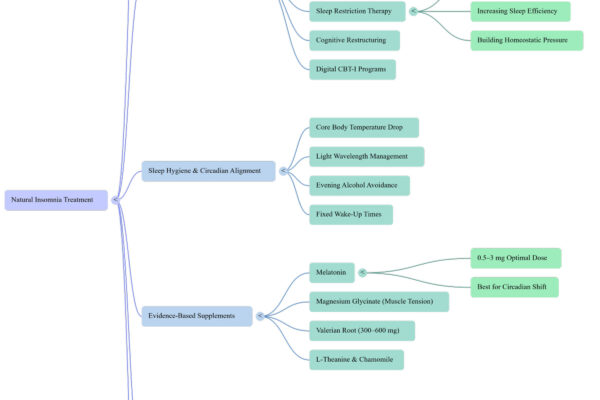

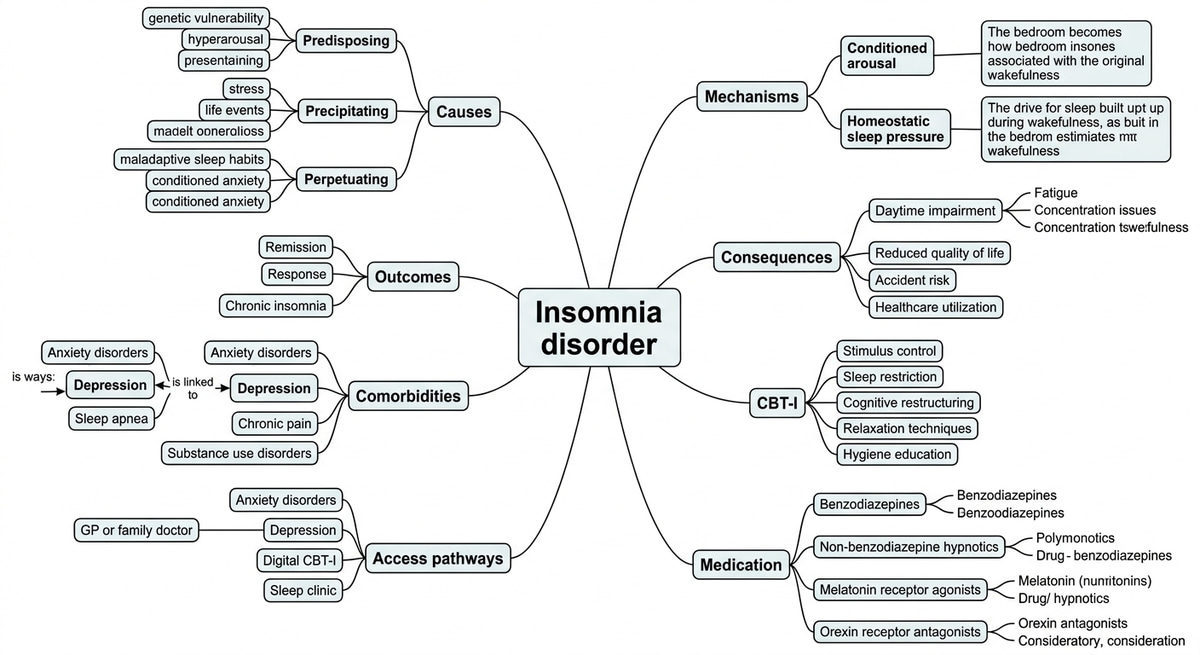
Insomnia rarely has one cause, and that’s exactly what makes it so confusing at 2am. This map lays out the whole picture — what starts it, what keeps it going, and what actually breaks the loop — so you can see how the pieces connect instead of chasing them one at a time.
Insomnia is a clinical sleep disorder, not just a run of bad nights. This map connects seven areas: what it is and how it’s diagnosed, the 3P causes behind it, the cycle that keeps it going, CBT-I and other treatments, who it affects differently, and what recovery actually looks like.
Explore the insomnia mind map
Tap any area to open it, and follow the links between ideas to see how one factor feeds the next. Anything that sounds like you can be added to your plan as you go.
Insomnia
01Definition & DiagnosisWhy it happens
Definition and diagnosis come first, because insomnia is a clinical disorder rather than a stretch of poor nights. It needs sleep difficulty plus daytime impairment to meet the threshold, and other conditions — sleep apnea, a mood disorder, restless legs — have to be considered before the label fits. (Palo Alto University, n.d.; Wikipedia, 2026)
Key insight: Duration matters more than severity — what separates a rough patch from insomnia disorder is how often the problem shows up over months, not how bad any single night feels. (PMC / Digital Health, 2025)
Insomnia vs Sleep Deprivation
Insomnia and sleep deprivation look similar the next day but behave differently. Sleep deprivation eases once you get extra time in bed; insomnia doesn’t, because the problem isn’t a shortage of opportunity to sleep. (Wikipedia, 2026)
Key difference
Sleep deprivation eases when you get more time in bed. Insomnia doesn’t — the chance to sleep is already there, and sleep still won’t come.
- Sleep opportunity
Diagnostic Threshold
Diagnostic threshold is where a sleep complaint becomes a diagnosis. Clinicians look for sleep difficulty on at least three nights a week for three months or longer, together with daytime impairment — and they rule out other explanations first. (Palo Alto University, n.d.; PMC / Digital Health, 2025)
Clinical criteria
This threshold is what separates insomnia disorder from short-term sleep trouble, which usually settles on its own once the original trigger has passed.
- becomes the perpetuating cycle if coping behaviours set in
Read more: what insomnia is and how it’s diagnosed
02Causes & Triggers (3P model)Why it happens
Causes and triggers are usually described with the 3P model: predisposing factors that make you vulnerable, precipitating factors that set an episode off, and perpetuating factors that keep it running. CBT-I works mainly on the third group, because that’s the part that’s still changeable now. (PMC / Klin Spec Psihol, 2022)
Key insight: The thing that started your insomnia is often not the thing keeping it going — which is why waiting for the original stress to pass rarely fixes it. (PMC / Klin Spec Psihol, 2022)
Predisposing Factors
Predisposing factors are the traits and circumstances that make sleep disruption more likely in the first place — biology, a naturally anxious temperament, being female, or being older. They don’t cause insomnia on their own; they lower the threshold. (PMC / Klin Spec Psihol, 2022; Sleep Medicine, 2021)
Vulnerability
These factors don’t cause insomnia by themselves. They make you more susceptible when something else — stress, illness, a life change — comes along.
- increases vulnerability to insomnia disorder
Precipitating Factors
Precipitating factors are the events that spark the first stretch of bad sleep — stress, illness, grief, a change in shift patterns, or a new medication. Most insomnia starts here, and would settle on its own if nothing else took over. (PMC / Klin Spec Psihol, 2022)
The trigger
The initial event that starts acute sleep difficulty. On its own it’s usually temporary — what happens next decides whether it lingers.
- triggers the onset of insomnia disorder
03The Perpetuating CycleYour options
The perpetuating cycle is what turns a few bad weeks into a long-term problem. Coping behaviours — spending longer in bed, napping, watching the clock — feel like help, but they build a state of hyperarousal that keeps sleep out of reach. (PMC / Klin Spec Psihol, 2022)
Key insight: The things you do to rescue your sleep are often the very things teaching your brain that bed is a place to be awake. (PMC / Klin Spec Psihol, 2022)
Extended Time in Bed
Extended time in bed is one of the most common perpetuating factors. Going to bed earlier and staying there later to “catch up” lowers sleep efficiency — the share of time in bed actually spent asleep — and weakens the link between bed and sleep. (PMC / Klin Spec Psihol, 2022)
Perpetuating factor
More time in bed doesn’t create more sleep. It spreads the same amount of sleep across a longer window and weakens the bed-sleep association.
- Compensatory sleep
Sleep Worry
Sleep worry is the cognitive side of the cycle. Anxiety about what another bad night will do to you keeps the nervous system switched on, which makes falling asleep harder — and the harder it gets, the more there is to worry about. (PMC / Klin Spec Psihol, 2022)
Cognitive arousal
Worrying about sleep keeps your nervous system activated. That arousal is itself a barrier to sleep, so the worry feeds the very problem it’s reacting to.
- Clock-watching
Read more: how the cycle keeps insomnia going
04CBT-I ComponentsWhat to do
CBT-I components make up the first-line treatment for chronic insomnia in adults, and major guidelines recommend it ahead of medication. It works by targeting the perpetuating factors directly, which is why it changes the cycle rather than just one night. (AASM, 2025; PMC / Klin Spec Psihol, 2022)
Key insight: CBT-I is designed as a short course with lasting effects — its benefits are still measurable after the programme ends. (Sleep Medicine Reviews, 2022)
Sleep Restriction
Sleep restriction limits time in bed to roughly how long you’re actually sleeping, then extends it as sleep consolidates. It rebuilds sleep drive, but it isn’t for everyone — it’s not recommended for people with bipolar disorder or seizure conditions. (PMC / Klin Spec Psihol, 2022; Sleep Foundation, 2026)
Mechanism
Shorter time in bed consolidates sleep and rebuilds sleep drive. Not recommended if you have bipolar disorder or seizure conditions — talk to a clinician first.
- directly targets extended time in bed
- how CBT-I works in detail
- Find your personal starting point
Stimulus Control
Stimulus control is the other core behavioural piece. The instruction is simple: if you can’t sleep, get out of bed and do something quiet until you’re sleepy, then go back. Over time this rebuilds the association between bed and sleep. (PMC / Klin Spec Psihol, 2022; Sleep Foundation, 2026)
Mechanism
Getting out of bed when you’re stuck reassociates the bed with sleep rather than wakefulness or frustration — the opposite of lying there and trying harder.
- CBT-I is linked to improvement in co-occurring depression
- Bed = sleep only
Read more: the CBT-I components explained in full
05Other Treatments & ApproachesWhat to do
Other treatments and approaches have real but narrower roles. Sleep hygiene helps at the edges, relaxation can lower arousal, and medication is usually an adjunct or a short-term option rather than the main answer for chronic insomnia. (AASM, 2025; PMC / Klin Spec Psihol, 2022)
Key insight: Guidelines put behavioural treatment first for chronic insomnia, with medication sitting alongside it or used short-term — not instead of it. (AASM, 2025)
Digital CBT-I
Digital CBT-I delivers the same programme through an app or an online course. A 2025 systematic review and meta-analysis found that fully automated digital CBT-I produces moderate to large improvements in insomnia severity compared with control. (npj Digital Medicine, 2025)
Evidence
Fully automated digital CBT-I shows moderate to large improvements in insomnia severity compared with control, which makes it a realistic option when in-person therapy isn’t available.
- is linked to a moderate to large effect on insomnia severity
06Comorbidities & Special PopulationsYour options
Comorbidities and special populations matter because insomnia rarely travels alone. It runs in both directions with depression and anxiety, and it shows up more often in women, during pregnancy, and in older adults — each with its own treatment considerations. (Sleep Medicine, 2023; Sleep Medicine, 2021; PMC / Frontiers in Psychiatry, 2024)
Key insight: Treating the insomnia often improves the mood symptoms too, so the two don’t have to be tackled one at a time. (Cleveland Clinic, 2026)
Pregnancy & Menopause
Pregnancy and menopause change sleep through hormonal and physical shifts. Insomnia affects around 38.2% of pregnant women, and because some insomnia medications aren’t safe in pregnancy, any treatment decision needs obstetric involvement. (PMC / Frontiers in Psychiatry, 2024)
Hormonal shifts
Hormonal and physical changes disrupt sleep during pregnancy and menopause. Some insomnia medications aren’t safe in pregnancy, so any medication question belongs with your obstetric team.
- Obstetric guidance
Mental Health Link
The mental health link runs both ways. Insomnia and psychiatric conditions such as depression and anxiety co-exist, and CBT-I has been shown to work even when another condition is present — including depression, PTSD and obstructive sleep apnea. (Sleep Medicine, 2023; Cleveland Clinic, 2026)
Comorbidity
Treating insomnia often improves mood and anxiety symptoms, and CBT-I stays effective when these conditions are present alongside it.
- is linked to chronic insomnia in both directions
- sleep and mental health
Read more: who insomnia affects differently
07Outcomes & RecoveryKeep it working
Outcomes and recovery are worth understanding up front, because chronic insomnia is treatable and the goal isn’t perfect sleep. It’s functional sleep — less daytime impairment, and enough confidence in your own sleep to stop monitoring it. (PMC / Klin Spec Psihol, 2022; Sleep Medicine Reviews, 2022)
Key insight: CBT-I’s gains tend to hold after the programme ends, which is unusual for a short course of treatment. (Sleep Medicine Reviews, 2022)
Realistic Recovery
Realistic recovery means improvement over weeks, not a perfect night every night. Treatment effects on sleep and quality of life persist after CBT-I finishes, and if insomnia returns, the same tools are usually the ones that settle it again. (Sleep Medicine Reviews, 2022)
Expectation
Recovery means less daytime impairment and more confidence in your ability to sleep — not a guarantee of eight uninterrupted hours every night.
- Relapse plan
Read more: what recovery and relapse look like
Insomnia is just stress, and it will go away on its own.
Stress often starts insomnia, but the behaviours people use to cope — longer bed times, naps, clock-watching — are what keep it going, and those don’t resolve by themselves. (PMC / Klin Spec Psihol, 2022)
More time in bed means more sleep.
Extending time in bed when sleep efficiency is already low is a perpetuating factor. Sleep restriction does the opposite, and it improves insomnia. (PMC / Klin Spec Psihol, 2022; Sleep Foundation, 2026)
You’ve seen the whole insomnia picture
You can now trace how a trigger turns into a cycle, and how each CBT-I component targets a specific link in it. Every step is explained in the full insomnia guide; quick answers are in insomnia questions answered.
Find my starting point →Sources
- Wikipedia — Insomnia (2026) — supports: symptom list and the differential diagnoses insomnia is weighed against.
- Palo Alto University — Cognitive Behavioral Therapy for Insomnia (n.d.) — supports: DSM-5 insomnia disorder diagnostic criteria, including frequency and duration thresholds.
- AASM — Practice Guidelines (2025) — supports: AASM guidelines for combination treatment of chronic insomnia disorder in adults; behavioural treatment as first-line.
- PMC / Klin Spec Psihol — Cognitive Behavioral Therapy for Insomnia (CBT-I): A Primer (2022) — supports: CBT-I addresses perpetuating factors per the 3P model; CBT-I recommended as a first-line intervention; the perpetuating cycle and its mechanisms.
- npj Digital Medicine — Systematic review and meta-analysis on fully automated digital CBT-I (2025) — supports: fully automated digital CBT-I shows moderate to large effects on insomnia severity versus control.
- PMC / Frontiers in Psychiatry — Evaluating the global prevalence of insomnia during pregnancy (2024) — supports: insomnia prevalence in pregnant women (~38.2%).
- Sleep Medicine — International study of the prevalence and factors associated with insomnia (2021) — supports: insomnia and severe insomnia are more prevalent in females than males across all age groups.
- Sleep Medicine — Insomnia symptoms in adulthood: prevalence and incidence over 25 years (2023) — supports: insomnia co-exists bidirectionally with psychiatric disorders.
- Sleep Foundation — Cognitive Behavioral Therapy for Insomnia (CBT-I): How It Works (2026) — supports: sleep restriction is not recommended for bipolar disorder or seizure conditions; stimulus control mechanism.
- Cleveland Clinic — Cognitive Behavioral Therapy for Insomnia (CBT-I): What It Is (2026) — supports: CBT-I is effective for comorbid conditions including depression, PTSD and obstructive sleep apnea.
- PMC / Digital Health — User Experiences and Effects of Expert-Led YouTube Mind-Body Interventions on Insomniacs (2025) — supports: ICSD-3 diagnostic characterisation of insomnia disorder.
- Sleep Medicine Reviews — Effects of CBT-I on quality of life: a systematic review and meta-analysis (2022) — supports: long-term benefits of CBT-I persist after treatment ends.
Sources checked · Next review due March 2027
This mind map is general information, not medical advice, and it can’t tell you which treatment is right for you. Sleep restriction therapy is not recommended for people with bipolar disorder, seizure conditions, or certain other conditions — talk to a clinician before starting it on your own. If you are pregnant, some insomnia medications are not safe, so any medication decision needs obstetric involvement.