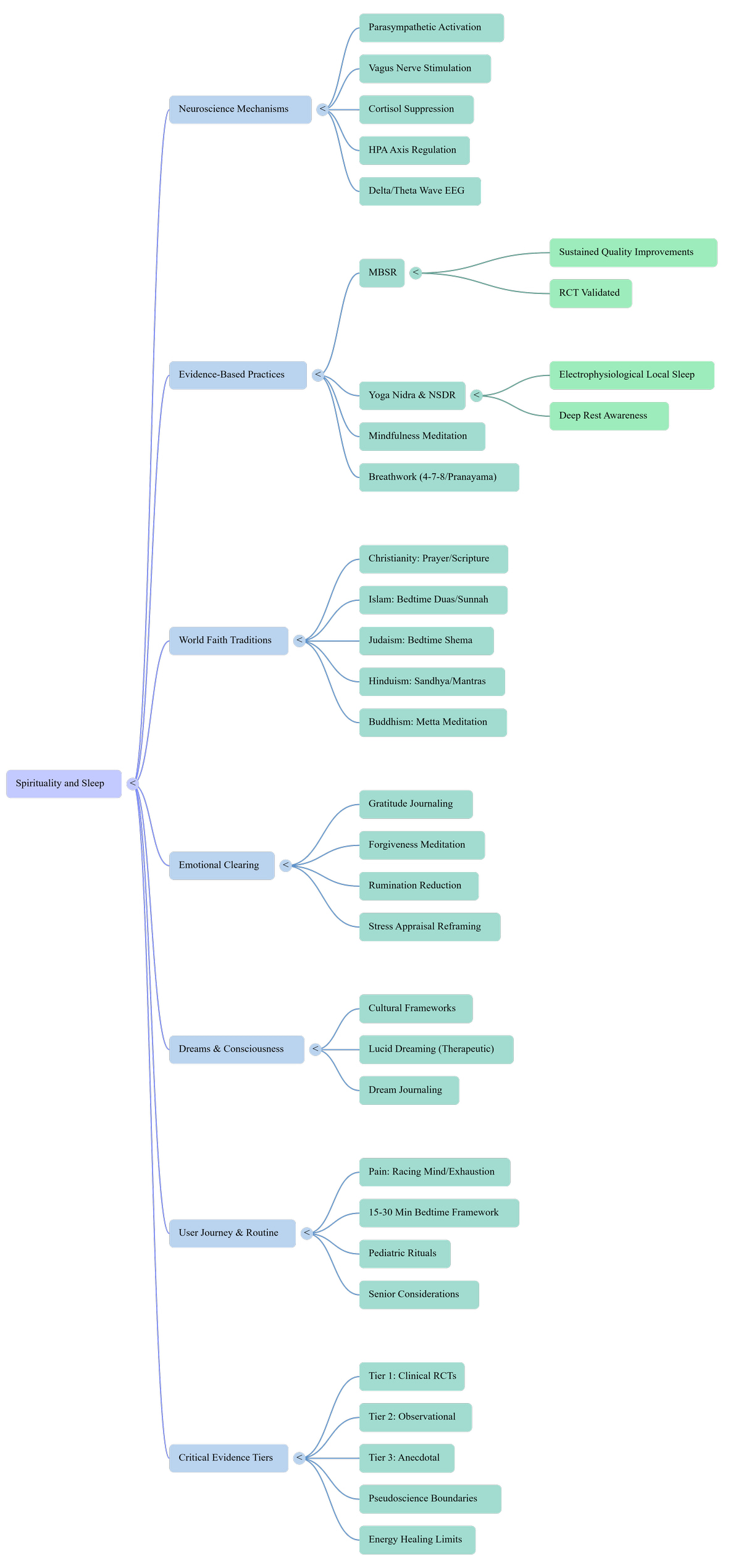
You’re lying awake, and you want to know if spirituality and sleep actually connect — or if it’s just wishful thinking. A static image can’t show you every path from “racing thoughts” to “an evidence-based practice that fits my beliefs.” This interactive map can: tap any branch to open the science, the traditions, and the exact techniques underneath it.
What does the spirituality and sleep mind map cover?
Spirituality and sleep connect across seven interconnected areas: the neuroscience bridge, bedtime rituals from six world traditions, evidence-based techniques like MBSR and Yoga Nidra, gratitude and forgiveness practices, dream spirituality, a personal routine builder, and the honest limits of the evidence. Explore any branch to go deeper.
At a Glance Racing thoughts and emotional residue keep the sympathetic nervous system activated at bedtime, and every spiritual practice that reliably helps sleep works by triggering the same parasympathetic pathway. Evidence-based techniques, tradition-specific rituals, and a personalized routine builder each address this pathway from a different angle.
Explore Every Level of the Spirituality and Sleep Map
Tap the map below to open it, then tap any of the seven areas to expand the science, the traditions, and the specific techniques underneath. Each card opens deeper — sub-topics, mechanisms, and named practices — so you can go exactly as far as you need tonight.
Spiritual practices change sleep biology through one shared physiological bridge: the parasympathetic nervous system. Slow breathing, repetitive prayer, and focused meditation all raise vagal tone, lower cortisol, and quiet the cognitive arousal that keeps a racing mind awake at bedtime — see the cortisol and sleep disruption mechanism directly.
Long-term meditators show measurably lower morning cortisol than non-meditators — a direct hormonal explanation for better sleep architecture (PubMed, 2012).
Vagal tone measures how efficiently the vagus nerve shifts the body from sympathetic “alert” mode into parasympathetic “rest” mode. Slow exhale-dominant breathing, prayer recitation, and chanting all mechanically stimulate this nerve, which is why rhythm — not belief content — drives the calming effect.
The HPA axis governs cortisol release, and elevated evening cortisol is the primary hormonal driver of nighttime waking. Novices completing an 8-week MBSR course showed measurably decreased morning cortisol alongside significantly improved self-reported sleep quality (PubMed, 2012).
Contemplative practices shift the brain toward theta and delta wave dominance — the same frequencies associated with deep rest. A 2022 Frontiers in Neurology study recorded delta-power increases in the central brain during conscious Yoga Nidra, a state normally seen only in deep non-REM sleep.
Five major world traditions each carry a structured nighttime practice — Christian prayer, Islamic duas, the Jewish Shema, Hindu sandhya, and Buddhist metta meditation. They differ completely in language and theology, but every one activates the same parasympathetic pathway through rhythm, repetition, and intentional stillness.
A 2020 scoping review in the Journal of Religion and Health found a promising role for spirituality and religion in sleep outcomes, particularly insomnia — though heterogeneity across studies warrants caution.
Christian bedtime practice often centers on Psalm 4:8 or Compline — slow, surrender-framed prayer that releases the day’s worries before rest, activating the same calm response as secular relaxation techniques.
Sunnah sleep practice includes wudu before bed, sleeping on the right side, and reciting Ayat al-Kursi and the three Quls — a structured sequence that pairs worship with intentional body positioning and rhythmic recitation.
Kriat Shema al HaMitah, the Bedtime Shema, weaves forgiveness of the day’s grievances into a declaration of faith — combining the same rumination-reduction mechanism found in secular forgiveness meditation.
Evening sandhya combines pranayama breath control with mantra repetition — a rhythmic pairing that overlaps mechanistically with the breathwork and chanting techniques used in the evidence-based section of this map.
Metta (loving-kindness) meditation directs warm attention toward self and others before sleep, redirecting the mind from threat-scanning — see the mechanism explained further in mindfulness for sleep.
MBSR, Yoga Nidra, mindfulness meditation, and structured breathwork carry the strongest clinical evidence in the spirituality and sleep field. A randomized controlled trial of 413 healthy adults found MBSR produced sustained sleep quality improvements lasting seven months (Journal of Clinical Sleep Medicine, 2020).
Yoga Nidra improved sleep quality in 93 participants within two weeks, with faster sleep onset and better subjective rest on waking (Frontiers in Neurology, 2022).
MBSR is an 8-week structured program combining body scan, sitting meditation, and gentle movement. An updated systematic review and meta-analysis confirmed it produces meaningful improvements in sleep disturbance outcomes in adults (BMJ Open, 2022).
Yoga Nidra guides conscious awareness to the threshold between waking and sleep. NSDR is its secular equivalent — same structure, no spiritual framing — and both are adjunctive, never a replacement for actual sleep.
Focused-attention and open-monitoring meditation both reduce pre-sleep cognitive arousal. Choose a passive, grounding style over vigorous breath retentions, which can activate rather than calm some practitioners.
Rooted in pranayama, 4-7-8 breathing (inhale 4, hold 7, exhale 8) activates vagal tone within minutes. Four cycles is enough to notice the shift — the fastest evidence-linked tool on this entire map.
Gratitude journaling has a measurable effect on pre-sleep cognitive arousal, not just mood, because it redirects prefrontal attention away from threat processing. Forgiveness practice before bed is linked to reduced nighttime rumination — a clinically observed cognitive intervention, not merely a moral exercise.
Neither practice requires prior experience or belief — both can measurably reduce cognitive arousal from the very first night.
Writing three specific gratitudes before bed shifts the brain’s appraisal system from unresolved threats toward positive, settled content — reducing sleep onset latency through cognitive reappraisal rather than distraction alone.
Forgiveness meditation targets unresolved interpersonal conflict — the most common driver of nighttime rumination — by completing the emotional loop the amygdala would otherwise keep active through the night.
Dream interpretation frameworks differ radically across Abrahamic, Hindu, Buddhist, and Indigenous traditions — there is no single “spiritual meaning of dreams,” and every tradition itself distinguishes significant dreams from ordinary memory-consolidation dreams. Lucid dreaming carries a separate evidence base, including therapeutic use in nightmare disorder and PTSD.
Most dreams reflect ordinary memory consolidation — reflective journaling supports psychological integration regardless of which interpretive frame is applied.
Recording dreams immediately on waking, before movement disrupts recall, is the most reliable method across every tradition and psychological approach — the practice itself matters more than the interpretive lens applied afterward.
Lucid dreaming — awareness within a dream — has its own evidence base separate from astral projection or metaphysical framing, with documented therapeutic applications for nightmare disorder distinct from its spiritual interpretation.
A 15–30 minute spiritual bedtime routine combines one evidence-based technique, one tradition-specific or gratitude practice, and an intentional close. Our free interactive builder matches a routine to your tradition, primary struggle, and available time in under a minute.
Consistency over two to eight weeks — not a single session — is where the cortisol-reduction benefits of a spiritual bedtime routine actually compound.
Answer four quick questions — tradition, primary sleep struggle, time available, and prior experience — and the free tool sorts recommendations into evidence-based essentials, tradition-specific rituals, complementary practices, and what to skip.
Blessing rituals and nighttime prayers may reduce sleep-onset anxiety in children through routine-priming and attachment signaling — the predictability of the ritual matters as much as its content.
For older adults managing chronic sleep changes, a shorter 10-minute version emphasizing seated breathwork and familiar prayer or scripture tends to sustain better than longer novel techniques.
Honesty about limits protects the credibility of everything above it. Energy healing and manifestation lack sleep-specific clinical evidence — where benefit is reported, the relaxation response from lying quietly with focused attention is the most likely explanation, not the proposed mechanism itself.
If a practice helps you feel calmer, that feeling is real — but it should not be expected to match MBSR or Yoga Nidra for chronic insomnia.
Reiki and crystal therapy have no high-quality clinical trials demonstrating sleep improvement attributable to their proposed mechanisms. Any benefit felt is most parsimoniously explained by the relaxation response, not energy-field manipulation.
Manifestation lacks direct RCT evidence for sleep improvement, but calm, detached visualization may reduce goal-related rumination for some people — high-arousal affirmations tend to backfire and increase pre-sleep activation instead.
Going deeper? The full spirituality and sleep guide covers every practice and tradition with step-by-step instructions.
All spiritual practices are equally effective for sleep.
Evidence quality varies dramatically — MBSR and Yoga Nidra have RCT support; energy healing does not (BMJ Open, 2022).
Meditation or Yoga Nidra can replace sleep itself.
Even NSDR-style practices are adjunctive — they support sleep quality but cannot substitute for glymphatic clearing and memory consolidation.
Spirituality and neuroscience are incompatible fields.
Contemplative neuroscience is a recognized field — dozens of peer-reviewed studies examine the neural mechanisms of meditation and prayer.
You’ve Seen the Map — Now Build Your Spiritual Bedtime Routine
Every branch above connects back to one place: a 15–30 minute routine you can start tonight. Read the complete Sleep & Spirituality resource hub for tradition guides, practice walkthroughs, and tools that go beyond what this map alone can show.
Read the Full Guide →Sources & References
This content is for informational purposes only and does not constitute medical advice. Always consult a qualified healthcare professional for personal health decisions. Content reviewed by the ZenSleepZone Research Team.