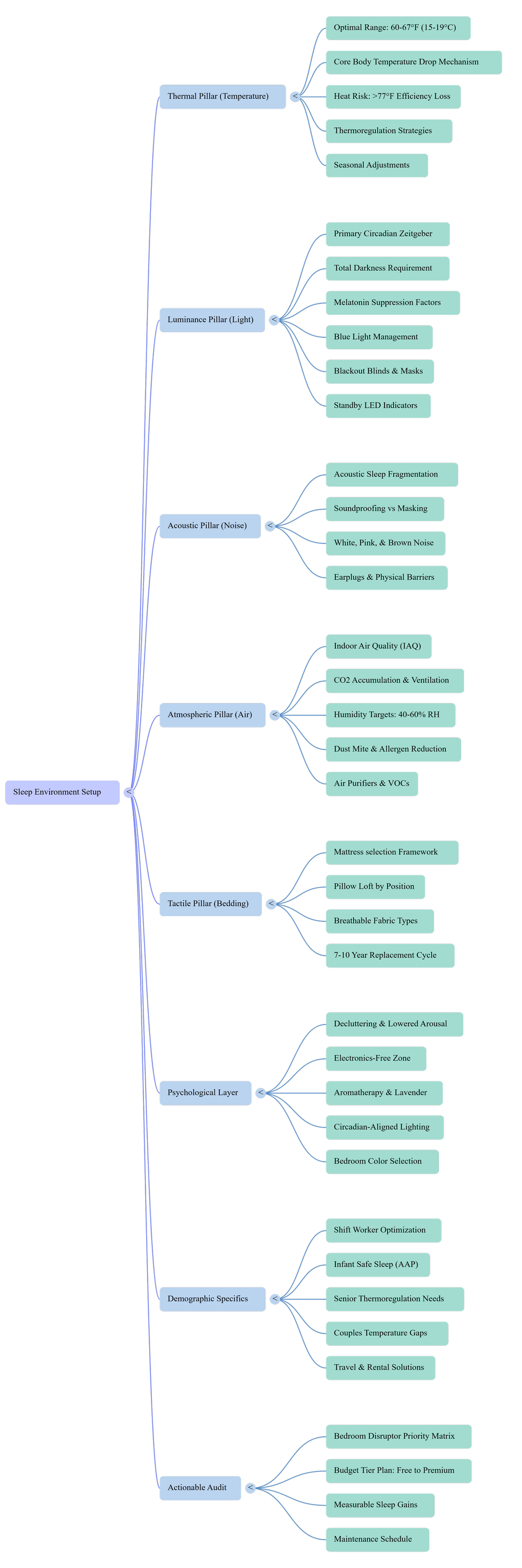

Sleep Environment Setup Mind Map
Waking up unrested or tossing at 3 AM often points to a room that works against you rather than for you. Creating an optimal sleep environment setup transforms the bedroom into a precision tool for deeper rest. Instead of a static checklist, this interactive map breaks down the seven core pillars—from thermal regulation to air quality—so you can zero in on what matters most for your unique sleep sanctuary.
What does the sleep environment setup mind map cover?
Sleep environment setup is broken into seven core pillars in this guide: Thermal Pillar (Temperature), Luminance Pillar (Light), Acoustic Pillar (Noise), Atmospheric Pillar (Air), Tactile Pillar (Bedding), Psychological Layer (Arousal), and Demographic Specifics. Each pillar moves from understanding the pain point to actionable, evidence-based solutions like optimal temperature ranges, blue light management, and mattress selection frameworks.
Sleep efficiency drops 5–10% when bedroom temperatures rise from 25°C to 30°C, making thermal management the foundation of rest. The solution lies in controlling the five environmental senses—temperature, light, noise, air, and touch—to trigger the body’s natural circadian and thermoregulatory sleep mechanisms.
Explore Every Level of the Sleep Environment Setup Map
Navigate the science-backed strategy to build a perfect sleep sanctuary. Each area opens deeper — sub-topics and specific techniques at every level, allowing you to focus on the solution that fits your needs right now.
The thermal pillar highlights how sleep environment setup must prioritize temperature because the body requires a specific core temperature drop to initiate and maintain restorative sleep. Research in Science of the Total Environment (Baniassadi et al., 2023) shows sleep efficiency drops 5-10% when ambient temperatures rise from 25°C to 30°C. Optimizing the bedroom around 60-67°F creates the necessary thermal gradient for deep restorative stages and sleep stages and cycles.
A 1°C deviation outside the optimal range can suppress slow-wave sleep production by delaying the core body temperature drop (Baniassadi et al., 2023).
The best sleep environment relies on a narrow thermal window. The Sleep Foundation (2024) and Cleveland Clinic (2021) agree on the 60–67°F range to facilitate the onset of REM sleep. This bracket ensures the body’s core temperature can drop to the level required for high-quality sleep architecture, supporting a comprehensive sleep environment strategy.
Light is the primary zeitgeber, or time-giver, for the human circadian system, making it a critical element of any bedroom sleep setup. The Sleep Foundation (2023) states that darkness at bedtime reinforces a healthy circadian rhythm, while a circadian rhythms disruption by light suppresses the body’s natural melatonin production. The luminance pillar dictates that total darkness is the biological gold standard, requiring blackout blinds and strict blue light management before bed.
Even a single LED indicator or streetlamp leak can disrupt the pineal gland’s melatonin release, delaying sleep onset and reducing REM sleep quality (AASM, 2023).
Achieving total darkness is a non-negotiable target for the ideal bedroom for sleep. Managing light requires blocking external sources like streetlights and internal sources like electronics. The AASM Sleep Prioritization Survey (2023) identified light as one of the top two environmental disruptors of sleep, validating the need for practical solutions like blackout blinds and sleep masks.
The acoustic pillar addresses sound management, which is central to preventing sleep environment fragmentation. Noise disrupts sleep architecture even when the sleeper does not fully awaken, causing micro-arousals that impair restorative deep sleep. AASM (2023) data confirms noise is a primary sleep disruptor. Effective interventions range from soundproofing and masking to utilizing specific frequency profiles like pink or brown noise to create a consistent, soothing auditory environment.
Consistent background noise, like “pink noise,” can stabilize brain activity during sleep, leading to a 50% reduction in spontaneous arousals compared to a silent room with intermittent loud sounds.
Designing for acoustic comfort in a bedroom sleep setup requires a dual approach: reducing peak noise intrusions and creating a stable masking baseline. White noise, pink noise, and brown noise each offer different frequency profiles for masking. Soundproofing materials and earplugs serve as physical barriers, while high-quality sound machines provide a reliable acoustic environment to protect sleep.
Indoor air quality is a foundational but often overlooked component of an ideal bedroom for sleep. The atmospheric pillar addresses CO2 accumulation, humidity targets, and allergen reduction. High CO2 levels in poorly ventilated rooms can cause night-time awakenings and morning headaches. Targeting a 40-60% relative humidity range prevents respiratory irritation and reduces dust mite proliferation, ensuring the air you breathe actively supports sleep health.
CO2 concentrations above 1,000 ppm in the bedroom can cause a 5-10% decrease in sleep efficiency and an increase in the number of arousals, independent of other environmental factors.
Optimizing IAQ involves managing the invisible variables in your sleep environment. Proper ventilation is crucial to reduce CO2 buildup, while maintaining a 40-60% humidity range can alleviate respiratory problems and allergies. Using air purifiers with HEPA filters significantly reduces particulate matter, making the bedroom a safe, clean space for deep restorative sleep.
Optimizing the tactile pillar means applying a rigorous bedroom sleep setup process to your physical resting surface. The materials that touch your body must align with sleep needs: a mattress that supports spinal alignment, a pillow that maintains cervical health, and fabrics that wick moisture. Following a mattress selection framework, positioning the pillow by sleep position, and adhering to a 7-10 year replacement cycle ensures the tactile experience promotes, rather than hinders, restorative sleep.
Evidence suggests that upgrading your mattress can reduce sleep disturbances by up to 30%, often providing more immediate benefit than a costly sleep tracker.
Selecting the right sleep surface is a key decision in the optimize sleep environment process. A mattress buying guide provides a framework to assess materials and support, while the pillow loft must be matched to sleep position for proper neck alignment. Replacing these items every 7-10 years prevents degraded materials from compromising spinal health and hygiene.
The psychological layer focuses on how the sleep environment setup extends beyond the physical into the mental and emotional space. Decluttering the bedroom and removing electronics creates a “sleep sanctuary” that lowers arousal levels. Integrating practices like aromatherapy with lavender and circadian-aligned lighting adjustments can condition the brain to associate the bedroom with calm and safety. These habits build a strong, long-term association for future stress and sleep management.
Clearing visual clutter in the bedroom can reduce cortisol levels and increase parasympathetic nervous system activity, making it easier to transition into a relaxed state.
Psychological safety is essential for deep sleep. Adopting a “bedroom is for sleep and sex only” rule, and removing work materials, helps break mental loops that keep the brain active. Complementary tools like calming scents and cool, soothing paint colors reduce cognitive load, which is vital for maintaining a balanced sleep environment.
The demographic specifics pillar ensures the sleep environment setup is tailored to the unique needs of different populations. Shift workers require optimized schedules and light management for daytime sleep, while new parents need AAP-compliant safe sleep practices for infants. Seniors often require warmer sleep temperatures due to reduced metabolic rates, and couples must navigate temperature gaps with dual-zone systems. These solutions transform universal principles into practical strategies for specific life stages.
Couples can resolve temperature preference conflicts by using dual-zone mattress toppers that allow each partner to control their side’s thermal environment, improving sleep satisfaction for both.
Optimizing a bedroom for sleep is not one-size-fits-all. Shift workers must prioritize high-quality blackout curtains and sleep masks to prevent circadian disruption during the day. Seniors benefit from ensuring the 60-67°F optimal range is maintained, as their thermal regulation is often less efficient. Travelers can re-create their jet lag recovery environment using portable white noise machines.
Going deeper? The full complete sleep environment setup guide covers every protocol with step-by-step instructions.
Suboptimal bedroom temperatures and excessive nighttime light → Suppressed melatonin and fragmented sleep architecture
Disrupted circadian rhythm → Reduced REM and slow-wave sleep, leading to morning fatigue and cognitive impairment
Target 65-68°F and total darkness to align your environment with your body’s natural sleep-wake cycle. Read the complete sleep environment setup guide.
Master your sleep environment setup with a prioritized plan for deeper rest.
This interactive map introduced the seven pillars of sleep optimization. The full guide provides the exact step-by-step protocols, seasonal adjustment calendars, and a budget-friendly priority matrix to transform your bedroom today. Read the complete comprehensive sleep environment guide.
Read the Full Guide →Sources & References
This content is for informational purposes only and does not constitute medical advice. Always consult a qualified healthcare professional for personal health decisions. Content reviewed by the ZenSleepZone Research Team.