
Jet lag recovery feels impossible when you’re exhausted but can’t sleep, your stomach is off, and your brain feels foggy after crossing time zones. This interactive mind map transforms overwhelming jet lag confusion into a clear, evidence-based recovery plan. Unlike static images, each section opens to reveal specific protocols, timing strategies, and personalized solutions you can implement immediately.
What does the jet lag recovery mind map cover?
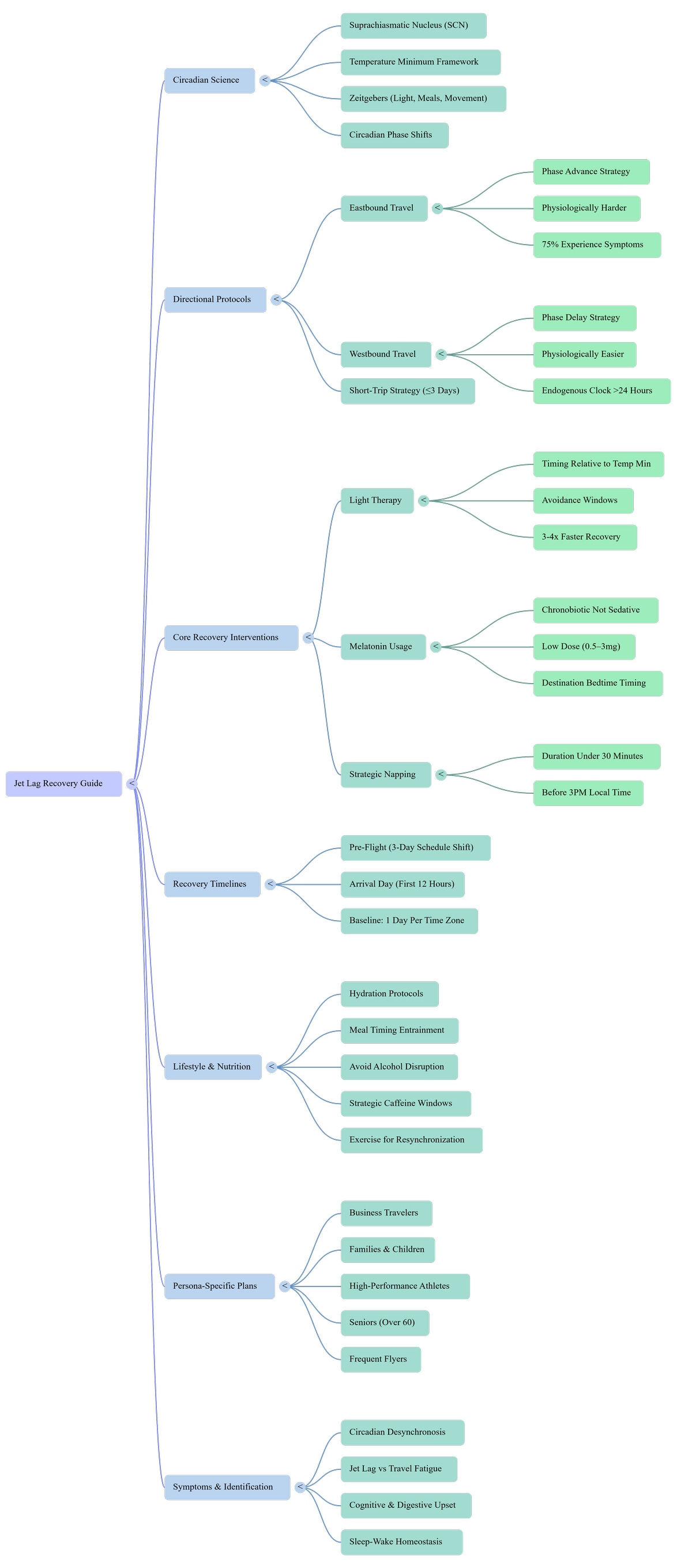
Jet lag recovery spans seven interconnected areas: circadian science explaining your body clock mechanisms, directional protocols for eastbound versus westbound travel, core interventions including light therapy and melatonin timing, recovery timelines setting realistic expectations, lifestyle and nutrition strategies, persona-specific plans for different traveler types, and symptom identification to distinguish jet lag from travel fatigue. Each area builds from understanding the biological problem through implementing targeted solutions.
Jet lag occurs when rapid transmeridian travel disrupts circadian alignment between your internal body clock and destination time zone, causing sleep disruption, cognitive impairment, and digestive issues. Strategic light exposure, properly timed melatonin, and direction-specific protocols can accelerate recovery by 3-4 times compared to unaided adjustment.
Explore Every Level of the Jet Lag Recovery Map
Click the root node below to reveal seven critical areas of jet lag recovery. Each area opens deeper — revealing sub-topics and specific techniques at every level. Start with your most pressing concern or explore systematically from science to solution.
Circadian science explains how your suprachiasmatic nucleus (SCN) controls sleep-wake cycles through light exposure, temperature rhythms, and zeitgebers like meals and movement. Understanding circadian phase shifts and the temperature minimum framework reveals why jet lag happens and how strategic interventions reset your body clock faster than waiting for natural adjustment.
Your body clock can shift 3-4 times faster with correctly timed light exposure compared to unaided adjustment, making circadian science the foundation of rapid jet lag recovery (Sleep Foundation, 2025).
The suprachiasmatic nucleus serves as your master circadian clock located in the hypothalamus, receiving direct light input from the retina to synchronize peripheral clocks throughout your body. SCN disruption from rapid time zone changes creates the misalignment causing jet lag symptoms.
Temperature minimum marks your lowest core body temperature point, occurring approximately 2 hours before natural wake time and serving as the critical reference point for timing light exposure and melatonin to shift your circadian phase effectively.
Zeitgebers are environmental time cues that entrain your circadian rhythm, with light being the strongest signal followed by meal timing and physical activity. Strategic manipulation of these zeitgebers accelerates circadian realignment after transmeridian travel.
Circadian phase shifts describe how your body clock moves earlier (phase advance) or later (phase delay) in response to timed light exposure and melatonin, with eastward travel requiring phase advances and westward travel requiring phase delays for successful adaptation.
Directional protocols address the critical difference between eastbound and westbound travel, with eastward journeys being physiologically harder and causing jet lag in 75% of travelers compared to westward travel. Phase advance strategies for eastbound flights differ fundamentally from phase delay strategies for westbound flights.
Eastward travel causes jet lag in 75% of travelers because advancing your body clock is physiologically harder than delaying it, which aligns with your natural endogenous clock being slightly longer than 24 hours (Sleep Foundation, 2025).
Eastbound travel requires phase advance strategies to shift your body clock earlier, demanding morning light exposure at destination and evening light avoidance. Eastbound jet lag affects 75% of travelers and typically takes longer to overcome than westward travel.
Westbound travel uses phase delay strategies to shift your body clock later, requiring afternoon and evening light exposure while avoiding early morning light. Westward adjustment feels easier because your endogenous clock naturally runs slightly longer than 24 hours.
Short-trip strategy applies when traveling across time zones for 3 days or less, where full circadian adjustment may not be worthwhile. Maintain home time zone sleep schedule when possible or use strategic napping and caffeine timing to bridge the gap.
Core recovery interventions include light therapy timed relative to your temperature minimum, low-dose melatonin (0.5-3mg) taken at destination bedtime, and strategic napping under 30 minutes before 3PM local time. These evidence-based tools can accelerate circadian realignment by 3-4 times compared to unaided recovery.
Correctly timed light exposure and melatonin can shift your circadian clock 3-4 hours per day versus approximately 1 hour per day without intervention, dramatically reducing jet lag duration (Sleep Foundation, 2025).
Light therapy for jet lag requires precise timing relative to your temperature minimum to either advance or delay your circadian phase. Avoiding light during specific windows prevents counterproductive phase shifts, while strategic exposure can accelerate recovery by 3-4 times the natural rate.
Melatonin functions as a chronobiotic (circadian timing agent) rather than a sedative for jet lag recovery, with low doses of 0.5-3mg taken 30-60 minutes before destination bedtime proving most effective. Proper timing matters more than dose for circadian phase shifting.
Strategic napping for jet lag recovery requires limiting nap duration to under 30 minutes and taking naps before 3PM local time to avoid interfering with nighttime sleep at your destination while providing enough rest to function during the adjustment period.
Recovery timelines establish realistic expectations with baseline adjustment taking approximately 1 day per time zone crossed without intervention, though pre-flight schedule shifting over 3 days and critical arrival day protocols during the first 12 hours can significantly accelerate adaptation and minimize jet lag severity.
Without intervention, jet lag recovery takes 1-1.5 days per time zone crossed, but strategic interventions can reduce this to less than half the natural adjustment time (Cleveland Clinic, 2024).
Pre-flight preparation involves gradually shifting your sleep schedule 1-2 hours earlier (eastbound) or later (westbound) over 3 days before departure, combined with strategic light exposure and meal timing to begin circadian adjustment before you board the plane.
The first 12 hours after arrival represent the critical window for jet lag recovery, requiring immediate alignment with destination time through strategic light exposure, staying awake until local bedtime, and avoiding long naps that delay circadian realignment.
Baseline recovery without intervention requires approximately 1 day per time zone crossed for your circadian rhythm to naturally realign with the destination, though this varies by travel direction, age, and individual chronotype with eastbound travel typically taking longer.
Lifestyle and nutrition strategies for jet lag recovery include hydration protocols to counteract dehydration from air travel, meal timing entrainment to reset peripheral clocks, avoiding alcohol which disrupts sleep quality, strategic caffeine windows for alertness, and exercise timing to support circadian resynchronization.
Caffeine and alcohol promote dehydration which worsens jet lag symptoms, while strategic meal timing can serve as a zeitgeber to help reset your circadian clock alongside light exposure (Harvard Health, 2016).
Hydration protocols for jet lag recovery require drinking extra water before, during, and after flights to counteract the dehydrating effects of cabin air and reduced humidity, as dehydration intensifies fatigue, headaches, and cognitive impairment associated with jet lag.
Meal timing entrainment uses food intake as a zeitgeber to reset peripheral circadian clocks in your digestive system and liver, with eating aligned to destination meal times helping synchronize your metabolism and supporting overall circadian realignment after transmeridian travel.
Avoiding alcohol during jet lag recovery prevents additional sleep disruption, dehydration, and circadian misalignment since alcohol fragments sleep architecture, suppresses REM sleep, and interferes with your body’s ability to adjust to the new time zone effectively.
Strategic caffeine windows for jet lag recovery involve consuming caffeine only during the first half of the destination day to promote alertness when needed while avoiding caffeine within 8-10 hours of local bedtime to prevent interference with nighttime sleep adaptation.
Exercise timing supports circadian resynchronization by serving as a zeitgeber that reinforces your body clock adjustment, with morning exercise helping advance your clock for eastbound travel and afternoon/evening exercise supporting phase delays for westbound travel.
Persona-specific plans recognize that jet lag recovery strategies must adapt to different traveler types including business travelers requiring immediate performance, families managing children’s sleep schedules, high-performance athletes optimizing competition timing, seniors over 60 facing slower adjustment, and frequent flyers developing sustainable long-term protocols.
Older adults experience more severe and prolonged jet lag symptoms due to age-related changes in circadian amplitude and sleep architecture, requiring more aggressive intervention strategies.
Business travelers require rapid jet lag recovery protocols prioritizing cognitive performance and professional presence, often necessitating aggressive pre-flight adjustment, strategic melatonin use, and precise light timing to function optimally within 24-48 hours of arrival.
Families with children require modified jet lag recovery approaches accounting for children’s developing circadian systems, stricter sleep schedules, and the need for gradual adjustment strategies that prevent overtiredness while managing multiple family members’ different adaptation rates.
High-performance athletes crossing time zones require precision jet lag protocols to optimize competition timing, with research showing circadian misalignment impairs neuromuscular performance, reaction time, and motor memory consolidation for 2-10 days without proper intervention.
Seniors over 60 experience more severe and prolonged jet lag due to age-related reductions in circadian amplitude, decreased melatonin production, and fragmented sleep architecture, requiring longer adjustment periods and more consistent light exposure protocols.
Frequent flyers crossing time zones regularly need sustainable long-term jet lag management strategies including maintaining consistent sleep anchors, strategic use of melatonin and light therapy, and developing personalized protocols that minimize cumulative circadian disruption from repeated travel.
Symptoms and identification distinguishes jet lag from simple travel fatigue by recognizing circadian desynchronosis markers including sleep-wake homeostasis disruption, cognitive impairment, digestive upset, and the characteristic pattern of symptoms persisting beyond 24-48 hours after arrival across multiple time zones.
Jet lag is a circadian rhythm sleep disorder caused by rapid travel across more than three time zones, disrupting the internal body clock and producing symptoms distinct from general travel fatigue (Cleveland Clinic, 2024).
Circadian desynchronosis describes the misalignment between your internal body clock and external environment after rapid transmeridian travel, creating the physiological state of jet lag where sleep-wake cycles, hormone release, and body temperature rhythms conflict with local time.
Jet lag differs from travel fatigue in that jet lag specifically involves circadian misalignment from crossing time zones with symptoms persisting for days, while travel fatigue results from the stress of travel itself and typically resolves within 24 hours regardless of time zone changes.
Cognitive and digestive symptoms of jet lag include impaired concentration, memory difficulties, mood changes, gastrointestinal distress, appetite disruption, and constipation or diarrhea as peripheral clocks in your digestive system become desynchronized from your central circadian pacemaker.
Sleep-wake homeostasis disruption in jet lag manifests as inability to sleep at destination bedtime despite exhaustion, premature awakening in the early morning hours, excessive daytime sleepiness, and the characteristic feeling of being tired but wired at inappropriate local times.
Going deeper? The full jet lag recovery guide covers every protocol with step-by-step instructions.
Rapid transmeridian travel across more than three time zones disrupts circadian alignment between your suprachiasmatic nucleus (master body clock) and the destination environment, creating circadian desynchronosis that affects sleep, cognition, and metabolism (Cleveland Clinic, 2024).
Without intervention, jet lag symptoms including sleep fragmentation, cognitive impairment, and digestive upset persist for 1-1.5 days per time zone crossed, with eastward travel causing symptoms in 75% of travelers and adverse effects lasting 2-10 days depending on direction and individual factors.
Strategic light exposure timed relative to your temperature minimum, low-dose melatonin (0.5-3mg) at destination bedtime, and direction-specific protocols can accelerate circadian realignment by 3-4 times compared to natural adjustment, reducing recovery time by more than half.
Sources & References
Master jet lag recovery with science-backed protocols for every travel scenario
The complete guide provides detailed step-by-step instructions for implementing light therapy timing, melatonin dosing schedules, pre-flight preparation protocols, and personalized strategies for business travelers, families, athletes, and frequent flyers. Read the complete jet lag recovery guide with full protocols.
Read the Full Guide →This content is for informational purposes only and does not constitute medical advice. Always consult a qualified healthcare professional for personal health decisions. Content reviewed by the ZenSleepZone Research Team.