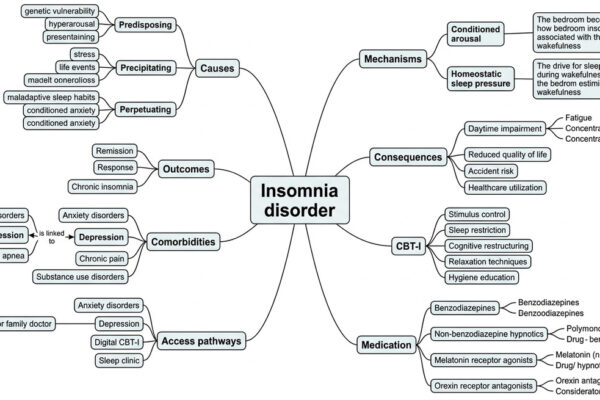

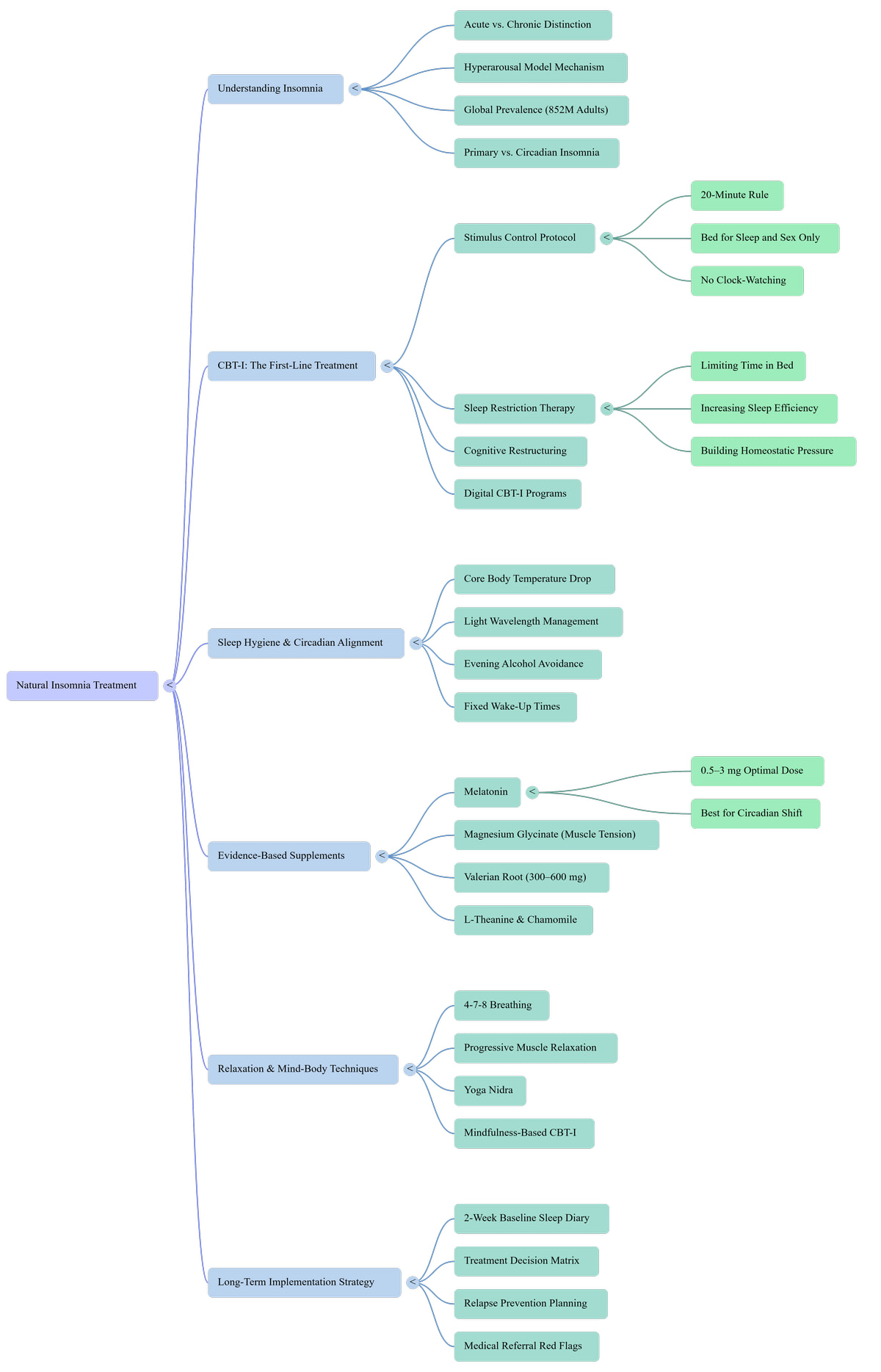
Natural insomnia treatment offers evidence-based alternatives to prescription sleep medication: CBT-I protocols, sleep hygiene optimization, targeted supplements, and relaxation techniques. This mind map guides you through six interconnected areas, from understanding why insomnia persists to long-term implementation, so you can explore at whatever depth you need — no medication required.
Natural insomnia treatment starts with understanding why insomnia persists, then applies CBT-I as the first-line fix, sleep hygiene and circadian alignment to support it, evidence-based supplements like melatonin and magnesium where useful, relaxation techniques to calm hyperarousal, and a long-term implementation plan to prevent relapse.
At a glance
Chronic insomnia is driven by hyperarousal and conditioned wakefulness — a nervous system stuck on alert and a bed that has become a cue for lying awake — rather than simple sleep deficiency. CBT-I is the evidence-based way forward, with sleep hygiene, targeted supplements, and relaxation techniques supporting it along the way.
Explore the natural insomnia treatment map
Explore how insomnia’s mechanisms connect to CBT-I, sleep hygiene, supplements, relaxation, and long-term maintenance — click into each area for the real techniques and numbers behind it.
Natural Insomnia Treatment
01Understanding InsomniaPain
Understanding insomnia starts with telling acute from chronic forms apart, since acute insomnia usually clears on its own while chronic insomnia needs structured treatment. The hyperarousal model explains why the nervous system won’t switch off, and global prevalence — 852 million adults worldwide — shows how common this is. Primary and circadian insomnia need different fixes entirely.
Key insight: Insomnia stems from conditioned wakefulness and hyperarousal, not simple sleep deficiency, which explains why basic sleep tips often fail (Sleep Foundation, 2026).
Acute vs. Chronic Distinction
Acute vs. chronic distinction matters because acute insomnia lasts days to weeks from stress, while chronic insomnia persists 3+ nights weekly for 3+ months. Natural treatment differs: acute needs stress management, chronic requires CBT-I protocols.
- Acute: Days to Weeks
- Chronic: 3+ Nights/Week, 3+ Months
Different Treatment Paths
Acute insomnia often responds to stress management alone, while chronic insomnia needs structured CBT-I protocols to break the conditioning that keeps it going.
Hyperarousal Model Mechanism
Hyperarousal model mechanism explains insomnia as elevated physiological and cognitive arousal preventing sleep onset. The nervous system remains in fight-or-flight mode, making relaxation techniques and CBT-I essential for natural insomnia treatment success.
- Fight-or-Flight Nervous System
Why It Blocks Sleep
The nervous system stays in fight-or-flight mode even when the body is exhausted, which is why relaxation techniques and CBT-I are essential rather than optional.
- Stress and sleep connection
Global Prevalence (852M Adults)
Global prevalence reaches 852 million adults with insomnia, representing 16.2% of the worldwide adult population. You are not alone in this struggle, and evidence-based natural treatments work across cultures and demographics without prescription dependency.
- 852 Million Adults Worldwide
- 16.2% Global Prevalence
Severe Cases
An estimated 415 million adults worldwide have severe insomnia within that total, according to a 2025 systematic review of global prevalence data (ScienceDirect, 2025).
Primary vs. Circadian Insomnia
Primary vs. circadian insomnia distinction determines treatment: primary insomnia needs CBT-I and relaxation, while circadian insomnia requires light management and fixed wake times. Correct identification prevents wasted effort on mismatched natural interventions.
- Primary: CBT-I + Relaxation
- Circadian: Light + Wake-Time Management
- More on circadian rhythms and the body clock
Read more: What insomnia really is, in the Article
02CBT-I: The First-Line TreatmentAwareness
CBT-I is the first-line treatment for chronic insomnia, built from four techniques: stimulus control, sleep restriction therapy, cognitive restructuring, and digital CBT-I programs delivered through apps. The American Academy of Sleep Medicine recommends CBT-I ahead of medication because it treats the conditioning behind insomnia rather than just masking it, with results that last.
Key insight: CBT-I produces lasting improvements in 70-80% of patients, with benefits maintained 12+ months post-treatment versus medication rebound insomnia (Cleveland Clinic, 2026).
Stimulus Control Protocol
Stimulus control protocol reconditions the bed as a sleep cue through the 20-minute rule, bed for sleep and sex only, and no clock-watching. This breaks conditioned wakefulness that develops after weeks of lying awake in bed.
20-Minute Rule
Leave bed after 20 minutes awake. Go to another room for quiet activity until sleepy. Return to bed only when drowsy. This prevents bed becoming a wakefulness cue.
Bed for Sleep and Sex Only
Eliminate all wakeful activities from bed: no reading, phones, TV, or work. Bed becomes a conditioned sleep trigger through consistent use over 2-4 weeks.
No Clock-Watching
Turn the clock face away from bed. Clock-watching increases anxiety about lost sleep time, triggering cortisol release that further delays sleep onset naturally.
Sleep Restriction Therapy
Sleep restriction therapy limits time in bed to match actual sleep time, increasing sleep efficiency and building homeostatic pressure. Start with 5-6 hours, then expand by 15-minute increments as efficiency exceeds 85%.
Limiting Time in Bed
Calculate average sleep time from a sleep diary. Set bedtime and wake time to match that duration exactly. Never spend more time in bed than actually sleeping at first.
Increasing Sleep Efficiency
Sleep efficiency equals time asleep divided by time in bed, times 100. Target 85%+ efficiency before expanding time in bed by 15-minute weekly increments.
Building Homeostatic Pressure
Sleep drive builds during wakefulness like hunger. Restriction increases that pressure, making sleep onset faster and reducing nighttime awakenings through natural biological mechanisms.
Cognitive Restructuring
Cognitive restructuring challenges catastrophic sleep thoughts like “I’ll fail tomorrow if I don’t sleep 8 hours.” Evidence shows 6 hours often suffices, reducing the performance anxiety that perpetuates insomnia naturally.
- Catastrophic Sleep Thoughts
- 6 Hours Often Suffices
Breaking Performance Anxiety
Reframing exaggerated fears about a single bad night — like assuming tomorrow is ruined — lowers the performance anxiety that keeps chronic insomnia going.
Digital CBT-I Programs
Digital CBT-I programs deliver therapist-guided protocols through apps and online platforms. A 2025 study found moderate-to-large effects on insomnia severity versus control groups, making professional help accessible at home.
- App & Online Delivery
Clinically Equivalent to In-Person
A 2025 study found digital CBT-I programs produce moderate-to-large improvements in insomnia severity versus control groups, with effects considered clinically equivalent to in-person therapy.
- Read the full CBT-I protocol guide
Read more: The full CBT-I evidence and how-to, in the Article
03Sleep Hygiene & Circadian AlignmentConsideration
Sleep hygiene and circadian alignment work on the environment around sleep: core body temperature drop, light wavelength management, evening alcohol avoidance, and fixed wake-up times. Together these factors support the body’s own melatonin production and sleep drive, without relying on any supplement to do the work.
Key insight: Light exposure timing affects circadian rhythm more than sleep hygiene alone; morning sunlight and evening darkness create stronger sleep signals than bedroom changes (Mayo Clinic, 2023).
Core Body Temperature Drop
Core body temperature drop signals sleep onset through natural circadian biology. A warm bath 90 minutes before bed accelerates heat loss, triggering drowsiness. Bedroom temperature should stay 60-67°F for optimal natural sleep conditions.
- Warm Bath 90 Min Before Bed
- 60-67°F Bedroom Temperature
Why Temperature Matters
Core body temperature naturally drops to trigger sleep onset; warming up 90 minutes before bed accelerates that drop through the rebound cooling effect afterward.
Light Wavelength Management
Light wavelength management blocks blue light 2-3 hours before bed while maximizing morning sunlight exposure. Blue light suppresses melatonin production, delaying sleep onset by 1-3 hours in sensitive individuals naturally.
- Block Blue Light 2-3 Hrs Before Bed
- Morning Sunlight Exposure
Delay Effect
Blue light suppresses natural melatonin production and can delay sleep onset by one to three hours in people who are especially light-sensitive.
Evening Alcohol Avoidance
Evening alcohol avoidance prevents sleep fragmentation despite initial drowsiness. Alcohol reduces REM sleep quality and causes 3am awakenings as metabolism clears the substance, perpetuating insomnia cycles naturally.
- Reduces REM Sleep Quality
- Triggers 3AM Awakenings
Fixed Wake-Up Times
Fixed wake-up times anchor circadian rhythm regardless of the previous night’s sleep duration. Consistency within 30 minutes daily strengthens sleep-wake cycles, making bedtime naturally consistent within 2-3 weeks.
- Anchor Within 30 Minutes Daily
- Consistent Bedtime in 2-3 Weeks
Read more: The complete sleep hygiene checklist, in the Article
04Evidence-Based SupplementsDecision
Evidence-based supplements can support natural insomnia treatment without replacing it: melatonin for circadian shift, magnesium glycinate for muscle tension, valerian root at 300-600 mg, and L-theanine with chamomile for gentle calm. Melatonin only reduces sleep onset by about 7-10 minutes on average, which sets realistic expectations against CBT-I’s behavioral results.
Key insight: Supplements support but cannot replace CBT-I; melatonin works best for circadian issues, not chronic insomnia rooted in hyperarousal and conditioned wakefulness patterns.
Melatonin
Melatonin supplements work best for circadian rhythm disruption, not primary insomnia. The 0.5-3 mg optimal dose range prevents morning grogginess while supporting natural sleep-wake cycle regulation effectively.
0.5-3 mg Optimal Dose
Start with 0.5 mg taken 2-3 hours before desired bedtime. Increase to 3 mg only if needed. Higher doses cause receptor desensitization and morning grogginess.
Best for Circadian Shift
Melatonin excels at shifting sleep timing for jet lag, shift work, or delayed sleep phase. It is less effective for insomnia caused by anxiety, pain, or conditioned wakefulness.
- Already tried sleep hygiene? Find your next step
Magnesium Glycinate (Muscle Tension)
Magnesium glycinate reduces muscle tension and supports GABA production for relaxation. Take 200-400 mg 1-2 hours before bed. The glycinate form absorbs better than oxide, minimizing digestive side effects naturally.
- 200-400 mg, 1-2 Hrs Before Bed
- Glycinate Form (Better Absorption)
Why Glycinate
Magnesium glycinate absorbs better than magnesium oxide and causes fewer digestive side effects, while supporting the GABA production that eases muscle tension before sleep.
Valerian Root (300-600 mg)
Valerian root 300-600 mg taken 30-60 minutes before bed may improve sleep quality through GABA modulation. Effects build over 2-4 weeks of consistent use rather than providing immediate sedation naturally.
- 300-600 mg, 30-60 Min Before Bed
- Builds Over 2-4 Weeks
L-Theanine & Chamomile
L-theanine and chamomile combine for gentle relaxation without drowsiness. L-theanine 100-200 mg promotes alpha brain waves, while chamomile tea provides apigenin compounds that bind GABA receptors for natural calm.
- L-Theanine 100-200 mg
- Chamomile’s Apigenin Compound
Read more: Evidence-ranked supplement profiles, in the Article
05Relaxation & Mind-Body TechniquesDecision
Relaxation and mind-body techniques calm the hyperarousal that keeps insomnia going: 4-7-8 breathing, progressive muscle relaxation, yoga nidra, and mindfulness-based CBT-I. Each one activates the parasympathetic nervous system a different way, but what matters most is doing one of them consistently rather than chasing the “best” technique.
Key insight: Consistent practice matters more than technique choice; 10 minutes daily for 2 weeks produces measurable cortisol reduction and faster sleep onset than occasional longer sessions.
4-7-8 Breathing
4-7-8 breathing inhales for 4 seconds, holds for 7 seconds, and exhales for 8 seconds across 4 cycles. This pattern activates vagal tone, slowing heart rate and signaling safety to the nervous system for natural relaxation.
- 4-7-8-Second Pattern, 4 Cycles
Vagal Tone Activation
The extended exhale activates vagal tone, slowing heart rate and signaling safety to the nervous system so it can shift out of alert mode.
Progressive Muscle Relaxation
Progressive muscle relaxation tenses then releases muscle groups from toes to head over 10-15 minutes. This builds body awareness and releases physical tension that often accompanies mental hyperarousal naturally.
- Toes to Head, 10-15 Minutes
- Releases Physical Tension
Yoga Nidra
Yoga nidra provides guided body scan meditation, inducing sleep-like consciousness while remaining aware. 20-30 minute sessions before bed reduce sleep onset latency and improve sleep quality through deep relaxation naturally.
- 20-30 Minute Guided Sessions
- Reduces Sleep Onset Latency
Mindfulness-Based CBT-I
Mindfulness-based CBT-I combines traditional CBT-I with present-moment awareness practices. This reduces sleep-related anxiety by changing your relationship to wakefulness rather than fighting it, improving sleep efficiency naturally.
- Combines CBT-I + Present-Moment Awareness
- Changes Relationship to Wakefulness
Read more: More relaxation and mind-body techniques, in the Article
06Long-Term Implementation StrategyRetention
Long-term implementation strategy is what keeps early progress from fading: a 2-week baseline sleep diary, a treatment decision matrix matched to your insomnia type, relapse prevention planning for high-risk periods, and the medical referral red flags that mean it’s time to see a doctor. Tracking and adjustment matter as much as the initial protocol.
Key insight: Relapse occurs in 30% of people within 6 months without maintenance; weekly check-ins and quarterly protocol reviews prevent a return to old sleep patterns and medication dependency.
2-Week Baseline Sleep Diary
2-week baseline sleep diary tracks bedtime, wake time, sleep latency, awakenings, and sleep quality daily. This data identifies patterns, measures treatment progress, and guides sleep restriction therapy adjustments accurately.
- Tracks 5 Nightly Metrics
- Guides Sleep Restriction Adjustments
Treatment Decision Matrix
Treatment decision matrix matches insomnia type to intervention: circadian issues need light management, hyperarousal needs relaxation, conditioned wakefulness needs stimulus control. Correct matching prevents wasted effort on ineffective approaches.
- Circadian → Light Management
- Hyperarousal → Relaxation
- Conditioned Wakefulness → Stimulus Control
Relapse Prevention Planning
Relapse prevention planning identifies high-risk situations like stress, travel, or illness that trigger old patterns. Pre-planned responses maintain gains during disruptions, preventing a full return to chronic insomnia naturally.
- High-Risk Triggers: Stress, Travel, Illness
30% Relapse Without Maintenance
Roughly 30% of people relapse within six months without ongoing maintenance; weekly check-ins and quarterly protocol reviews are what keep the gains in place.
Medical Referral Red Flags
Medical referral red flags include sleep apnea symptoms, restless legs, depression signs, or no improvement after 8 weeks of consistent CBT-I. Professional evaluation rules out underlying conditions requiring medical intervention naturally.
- Sleep Apnea or Restless Legs Signs
- No Improvement After 8 Weeks
- Signs of Depression
Read more: The full long-term maintenance plan, in the Article
Melatonin is the best natural remedy for insomnia
Melatonin has only a modest effect on sleep latency — about 7-10 minutes on average — and works best for circadian-phase issues like jet lag, not primary insomnia; CBT-I has far stronger long-term evidence.
More time in bed means more sleep
Extra time in bed fragments sleep and deepens insomnia; sleep restriction therapy deliberately limits time in bed to rebuild sleep drive and raise sleep efficiency.
Natural means safe, so supplements can be taken freely
Several sleep supplements interact with medications, so anyone taking other drugs should get medical review before adding melatonin, valerian root, or similar supplements.
Turn This Natural Insomnia Map Into Tonight’s Plan
This map introduced the mechanisms and the choices; the full guide walks through every CBT-I protocol, supplement dose, and relaxation technique step by step. Every step is explained in the complete natural insomnia treatment guide; quick answers are in the natural insomnia treatment Q&A, and the numbers are in the natural insomnia treatment statistics.
Find my starting point →Three quick questions · about a minute · nothing is sent anywhere
Sources
- CDC National Center for Health Statistics (2025) — 15.4% of US adults had trouble falling asleep most days or every day in 2024
- Sleep Foundation (2026) — CBT-I is a structured, evidence-based treatment for chronic insomnia focused on thoughts, behaviors, and sleep patterns
- Missouri Medicine / PubMed (2024) — CBT-I should always be the first-line treatment for insomnia; pharmacotherapy only for inadequate response to CBT-I
- ScienceDirect (2025) — systematic review estimating 852 million adults with insomnia worldwide (16.2% global prevalence), including 415 million with severe insomnia
Last reviewed: September 2026
This map is for information only and is not medical advice. Several natural supplements — including melatonin, valerian root, and magnesium — can interact with other medications, so check with a healthcare provider before starting any new supplement if you take other drugs.