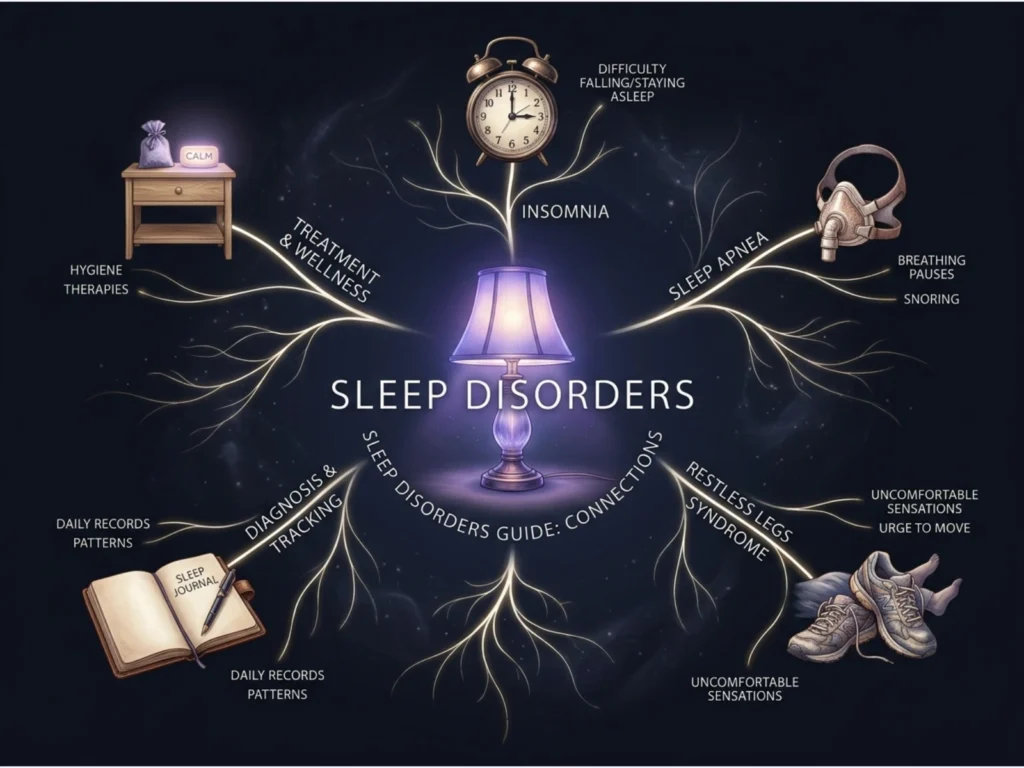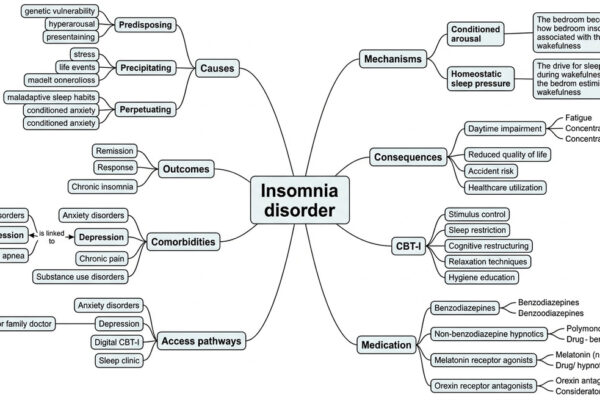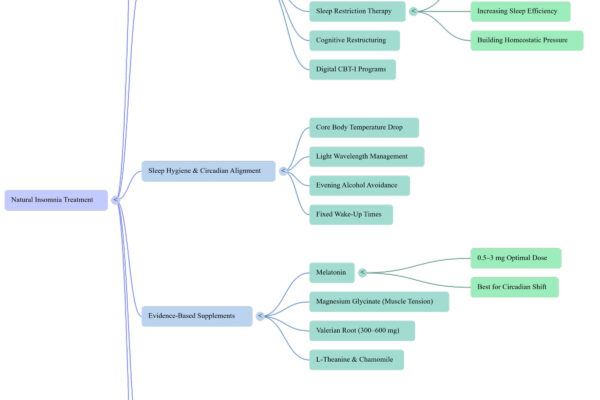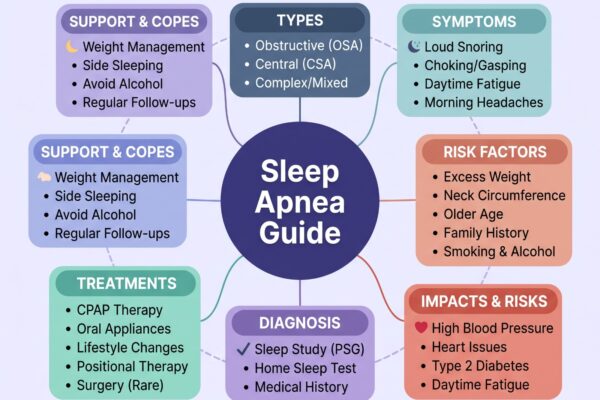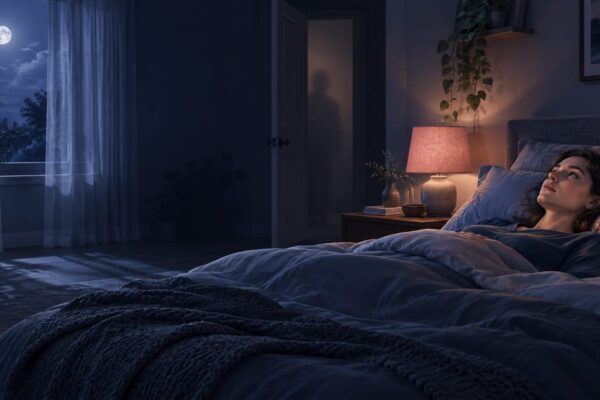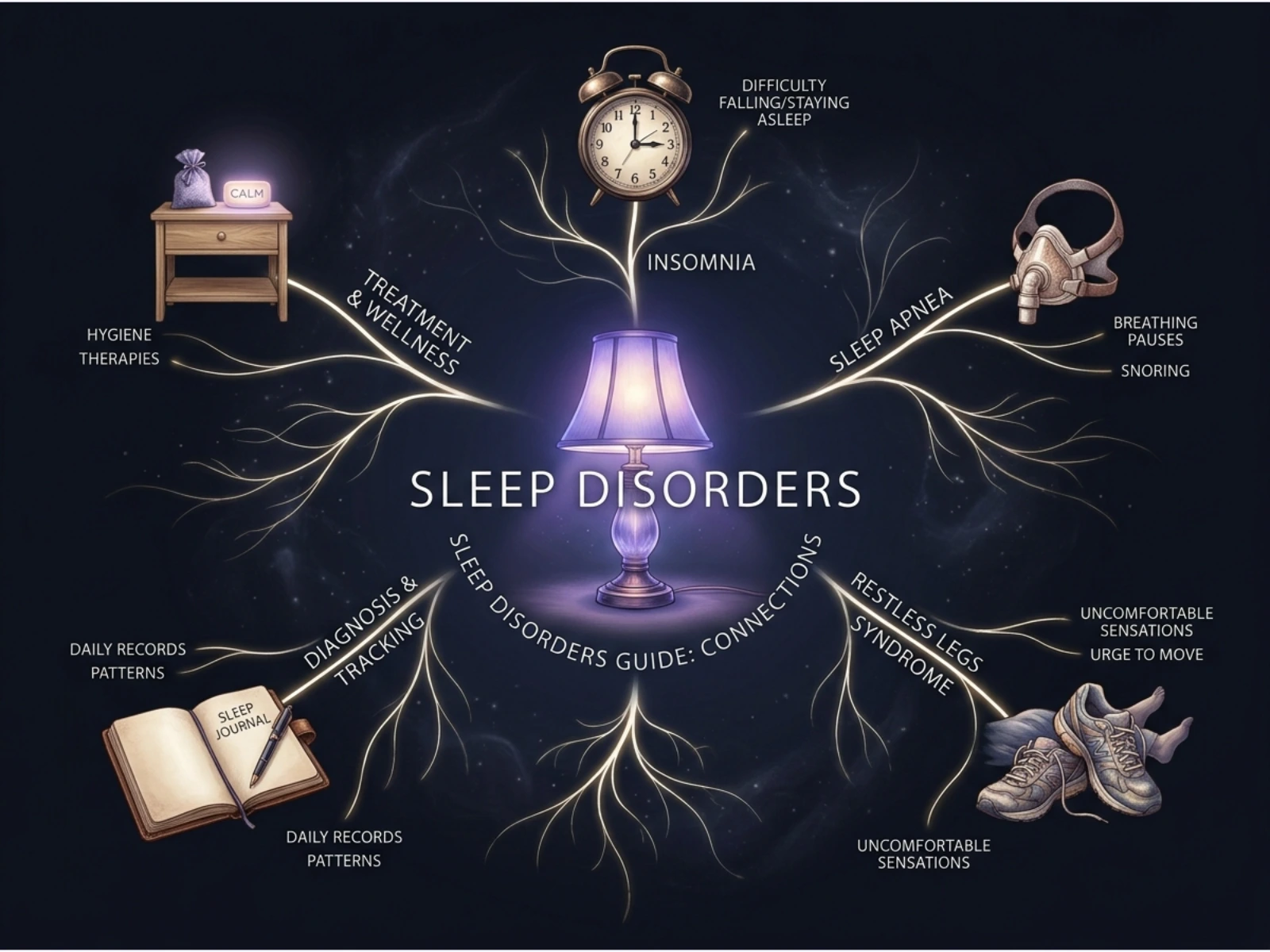

This sleep disorders mind map shows how nighttime signs, daytime effects, and care options fit together. Open one area, answer its Ask yourself question, and try one small step. Add what fits to your plan, then follow the link that goes deeper.
Sleep disorders mind map: how it all connects
Sleep disorders
01What your nights are telling youThe problem
Sleep disorders disturb normal sleep patterns and can change how you feel the next day. The first useful step is to describe what you notice at night and during the day. A repeated pattern, not one bad night, guides the next decision.
Key insight: Your pattern of symptoms points to a group of possible explanations. It does not name a diagnosis on its own.
Ask yourself: Do you notice the problem mostly at night, mostly during the day, or both? What does your partner see?
Trouble falling or staying asleep
Trouble falling asleep and trouble staying asleep are the two most reported complaints. Persistent insomnia means months of poor sleep that affect your days, not one restless week.
Try this: Write down your bedtime, wake time, and any naps for three nights. Stop if tracking makes you more anxious about sleep.
Why persistence matters
Assessment looks at how long the problem has lasted and how much it changes your daytime energy, mood, or work.
- can overlap with breathing pauses
- is treated by structured therapy
Breathing that pauses or gasps
Obstructive sleep apnea happens when the upper airway narrows and blocks airflow. Central sleep apnea happens when the brain’s breathing control is disrupted. Symptoms alone cannot tell the two apart.
Try this: Ask your partner to note any pauses, gasps, or snorts during sleep. Do not delay care to collect more nights.
What a partner sees
A bed partner often notices the pauses and gasps first. Their account is useful evidence for a clinical conversation.
- is checked by a home or lab test
Unusual actions around sleep
Parasomnias are unusual actions or experiences around sleep. REM sleep behavior disorder can involve acting out dreams. Sleepwalking can lead to injuries if the sleeping area is not safe.
Try this: Clear trip hazards from the route between bed and bathroom tonight. Seek medical advice if events risk injury.
Safety first
Environmental protection does not replace assessment when events cause concern. Write down what happened, when, and who saw it.
- raises a safety question first
Urge to move your legs at rest
Restless legs syndrome gives a strong urge to move the legs when resting. It is different from movements someone else observes during sleep. Tell your clinician which one you experience.
Try this: Note the time of day the urge appears and whether movement relieves it. Do not start iron supplements on your own.
Iron status matters
Clinically significant RLS warrants a clinician’s check of iron studies, including ferritin. Self-prescribing iron is not advised.
- needs a clinician’s iron check
Read more: What is happening to your sleep
02Sleepy, tired, or both?Why it happens
Feeling drained and falling asleep during the day are different experiences. Excessive daytime sleepiness means you doze or struggle to stay awake. Fatigue means low energy. Describing both clearly helps your clinician choose the right questions. Neither one is a diagnosis.
Key insight: Sleepiness and fatigue can occur together, but they point to different assessments.
Ask yourself: Do you actually doze off during the day, or do you feel drained but stay awake? Does either happen while driving?
Sleepiness versus fatigue
Excessive daytime sleepiness means repeatedly dozing or fighting to stay awake. Fatigue means feeling drained or low in energy. Many people have both, and each one is worth describing.
Try this: For one day, mark each time you actually doze off and each time you feel drained. Bring the list to your visit.
Why the difference matters
Sleepiness raises safety questions, including driving. Fatigue raises questions about mood, health conditions, and sleep length.
- raises a driving safety question
Too little sleep opportunity
Some people who feel tired during the day simply do not get enough sleep. Work, caregiving, and early starts can shrink the time available for sleep. Sleep opportunity is checked before a disorder is assumed.
Try this: Add up your usual time in bed for one week. If it is under seven hours, treat that as the first thing to discuss.
Not a disorder by itself
Short sleep from a busy schedule is not the same as insomnia. The pattern and the daytime effect guide the next step.
- can look like insomnia
Difficult waking and unrefreshing naps
Idiopathic hypersomnia can involve daytime sleepiness, great difficulty waking, and naps that do not refresh you. These signs differ from ordinary tiredness after a short night.
Try this: Describe your last unrefreshing nap: time, length, and how you felt after. Share the note with your clinician.
Why assessment matters
A clinician excludes other explanations before considering this diagnosis. Symptom patterns vary between people.
- needs assessment, not a fatigue label
Read more: Is this a sleep disorder, too little sleep, or fatigue?
03The six disorder groupsWhy it happens
Overview sources group sleep disorders into six broad areas. They are insomnia, sleep-related breathing disorders, central disorders of hypersomnolence, body-clock disorders, parasomnias, and sleep-related movement disorders. The groups help you orient within sleep-wake disorders, not self-diagnose. Symptoms often overlap between groups.
Key insight: The groups describe clusters of problems, not a checklist for one diagnosis.
Ask yourself: Which group sounds most like your main problem? Which second group also fits?
Insomnia and breathing disorders
Insomnia covers trouble falling or staying asleep. Sleep-related breathing disorders cover blocked or disrupted breathing during sleep. Both can appear in the same person, and both deserve assessment.
Try this: Name your main nighttime problem in one sentence, then your main daytime problem. Keep both short and specific.
Overlap is common
Sleep apnea can include insomnia symptoms, so a fixed checklist cannot rule it out. A full history matters.
- can overlap with apnea
- How common are these symptoms?
Hypersomnolence and body-clock disorders
Central disorders of hypersomnolence include narcolepsy and idiopathic hypersomnia. Body-clock disorders involve sleep timing that is out of step with daily life. Both affect daytime function.
Try this: Note what time your body wants to sleep and wake, versus what your schedule requires. Bring both times.
Timing is the clue
Body-clock treatment depends on the pattern. Selection and timing of light or melatonin belong with a clinician.
- is treated by timing, not a bedtime rule
Parasomnias and movement disorders
Parasomnias include sleepwalking and acting out dreams. Sleep-related movement disorders include restless legs syndrome and periodic limb movement disorder. Describing what others observe helps.
Try this: Ask someone in your home to describe any unusual movements or actions they see. Write their words, not your guess.
Observed versus felt
An urge to move while awake and movements seen during sleep are different observations. Report both.
- urge at rest needs an iron check
Read more: What are the main types of sleep disorders?
04What testing can showYour options
Not everyone with a sleep problem needs a sleep study. Some problems are assessed through history alone. When testing is needed, the suspected condition decides which test fits and what question it answers. No single test detects every disorder.
Key insight: A test answers a specific question. Ask what yours measures before you book it (Kapur et al., 2017).
Ask yourself: What question do you want the test to answer? What would a normal result leave unexplained?
History first, tests when needed
Your sleep history covers timing, naps, nighttime events, medicines, and daytime effects. For many problems, this history is enough to choose a next step. Testing is added when the answer is unclear.
Try this: Write three sentences about your sleep before your appointment. Include when it started and what changed.
Notes, not a score
A sleep diary records sleep, waking, naps, and daytime sleepiness. It is discussion material, not a pass or fail.
- Questions about tests and results
- guides which test fits
Overnight sleep study
Polysomnography records brain waves, oxygen levels, breathing, and eye and leg movements during sleep. It is the most detailed sleep test. Clinicians choose it for specific suspected conditions.
Try this: Before booking, ask which clinical question the study answers and who will interpret the result.
When a lab study is preferred
For suspected apnea with heart or lung disease, neuromuscular weakness, stroke history, or opioid use, a lab study is favoured.
- may follow a negative home test
Home apnea test and follow-up
A home sleep apnea test records breathing at home. If the result is negative, inconclusive, or technically inadequate, a lab study is recommended for adult apnea assessment. Ask what your result leaves unanswered.
Try this: If a home test was negative but symptoms continue, ask your clinician whether lab testing is indicated.
The follow-up rule
A strong recommendation supports polysomnography after an inadequate single home test. It is a clinician-led pathway.
- may need a lab study
Daytime nap test and movement monitor
A multiple sleep latency test measures how quickly you fall asleep during daytime naps. Actigraphy tracks rest and activity with a small movement monitor over time. Each test answers a different question.
Try this: Ask whether your test needs preparation, such as a set sleep schedule the week before. Follow the clinic’s instructions.
Not a watch score
Clinical actigraphy is not interchangeable with every consumer watch. The clinic sets how the data is used.
- records different signals from a home test
Read more: Which sleep tests might you need?
05Treatment that fits the causeYour options
Treatment follows the condition, not the general label of a sleep disorder. Structured insomnia therapy, breathing support, body-clock treatment, and specialist management serve different needs. No single approach fits every problem. Ask what the treatment is meant to change.
Key insight: The same symptom can need very different treatments depending on its cause (Edinger et al., 2021).
Ask yourself: Which treatment matches your main problem? What would you want it to change first?
CBT-I for chronic insomnia
Multicomponent CBT-I is strongly recommended for adult chronic insomnia. It combines several behavioral and psychological methods. Sleep hygiene alone is not recommended as a stand-alone treatment.
Try this: Ask your clinician about a CBT-I program, in person or online. Do not start sleep restriction on your own.
Combination questions
The 2026 guideline conditionally advises against preferring CBT-I plus medication over CBT-I alone, with low certainty.
- starts with structured therapy
CPAP for sleep apnea
CPAP supplies air through a mask during sleep to keep the airway open. It is one pathway for sleep apnea treatment. Clinicians select the treatment and settings for each person.
Try this: If CPAP feels uncomfortable, tell your doctor rather than stopping on your own. Ask about mask fit and follow-up.
Follow-up matters
Difficult or uncomfortable use should be discussed with the doctor. Pressure changes belong with the clinical team.
- is one pathway for breathing pauses
Body-clock treatment
Body-clock treatment may involve healthy lifestyle changes, bright light therapy, and melatonin. Timing depends on the specific pattern. There is no universal light schedule or supplement dose.
Try this: Record your natural sleep and wake times for one week before asking about timing treatment.
Timing is individual
The same light exposure at a different hour can shift the body clock in opposite directions. A clinician sets the plan.
- fits the pattern, not a fixed bedtime
RLS and specialist care
Clinically significant restless legs syndrome warrants a clinician’s check of iron status. Management also addresses factors that worsen symptoms. Prescribing decisions, including pramipexole, belong with the clinician.
Try this: List medicines and supplements you take, including ones for other conditions. Do not stop any on your own.
Iron first, then decisions
Serum iron studies, including ferritin and transferrin saturation, guide the next step. Symptoms alone do not decide iron treatment.
- starts with an iron check
Read more: How does treatment differ between sleep disorders?
06Getting help and getting readyWhat to do
Care routes and payment rules differ by country. In the US, the UK, Canada, and Australia, a referral is often the first step. Bring clear observations, and treat sleepy driving as an urgent safety issue. Preparation makes the visit shorter and more useful.
Key insight: The route to care and the bill are separate questions. Ask about both before you book (NHS, 2026).
Ask yourself: Which route fits where you live? What would you ask about cost and referral first?
Care routes by country
US Medicare Part B covers eligible sleep tests ordered by a clinician, but this is not universal coverage. UK GPs refer suspected apnea to a specialist sleep clinic. Canada and Australia use referral pathways too.
Try this: Call one service and ask three things: referral needed, wait time, and what the payer covers.
Four markets, one question
Coverage depends on your plan, eligibility, referral, test, and country. Confirm the arrangement before booking.
- Where should you start?
What to bring
A sleep diary records sleep, waking, naps, and daytime sleepiness. A partner’s account can add what you cannot see yourself. Bring a list of medicines and what you have already tried.
Try this: Fill one page with bedtime, wake time, naps, nighttime events, and daytime effects. Keep it to a single page.
Notes, not a diagnosis
These notes are discussion material. They do not score your sleep or name a condition.
- Build your appointment notes
Safety first
Do not drive when you feel sleepy; arrange another way to travel. Arrange medical assessment if your breathing stops and starts during sleep. Frequent unintended daytime sleep and months of poor sleep also deserve care.
Try this: Plan a backup way home tonight if you feel sleepy before driving. Do not push through a drive while drowsy.
Urgent versus routine
Sleepy driving is an immediate safety issue. Breathing pauses, repeated daytime sleep, and months of insomnia are reasons to arrange care.
- sleepiness raises the driving question
Read more: How do you get help in your country?
07Connected topics to exploreKeep it working
Each sleep disorder has its own deeper guide. This map connects you to the pages that go further, from insomnia and apnea to body-clock problems and structured therapy. Follow the one that matches your main pattern. Come back to the map when your question changes.
Key insight: A good next page is the one that answers your current question, not the one with the most detail.
Ask yourself: Which page matches your main pattern right now? Which question is still open?
Insomnia guide
Persistent trouble falling or staying asleep has its own assessment and treatment detail. The insomnia guide covers patterns, therapy, and what to discuss with a clinician.
When to go deeper
Move to the insomnia guide when sleep is your main problem and you want treatment detail beyond this map.
- Read the insomnia guide
Sleep apnea guide
Breathing pauses, snoring, and home-test questions have their own dedicated page. The apnea guide explains testing pathways and treatment choices in more detail.
When to go deeper
Use the apnea guide if breathing is your main concern or a home test left you with questions.
- Read the sleep apnea guide
CBT-I and body-clock guides
Structured therapy for chronic insomnia and body-clock treatment each have deeper pages. They explain the methods, the timing, and what to ask before starting.
Treatment detail
These pages explain how each treatment works and what a clinician decides, without doses or personal schedules.
- How CBT-I works
- Understand your body clock
RLS and sleep paralysis
An urge to move your legs at rest and being unable to move around waking each have their own explanation. Both pages separate what you feel from what others observe.
- Read the restless legs guide
- Explore sleep paralysis
Read more: What if symptoms continue or treatment is difficult?
Sleep disorders: the connections that matter most
Read the map as a chain: what you notice leads to a question, the question picks a test, and the test result picks a treatment. These six links show how sleep-wake disorders fit together. Each one changes what you would ask at your next visit.
- Feeling tired → check sleep opportunity first — some people who feel tired simply do not get enough sleep. Add up your time in bed before assuming a disorder.
- Breathing pauses → home or lab breathing test — blocked upper-airway airflow and brain-controlled breathing problems need clinical assessment. A partner’s account helps.
- Negative home apnea test → lab study — a strong recommendation supports polysomnography after a negative, inconclusive, or inadequate single home test. Ask what your result leaves open.
- Chronic insomnia → multicomponent CBT-I — structured therapy is strongly recommended for adult chronic insomnia. Sleep hygiene alone is not a stand-alone treatment.
- Sleep apnea → clinician-selected breathing support — CPAP is one pathway, and settings belong with the clinical team. Uncomfortable use is a reason to call, not to stop.
- Restless legs → clinician iron check — clinically significant RLS warrants serum iron studies including ferritin. Symptoms alone do not decide iron treatment.
You can see the whole picture — here’s where to start
Still unsure? The Compass picks a starting point. The Article goes deeper on each branch. Questions live in Answers. More in Sleep Disorders.
Find my starting point →Sources
- National Library of Medicine, MedlinePlus — Sleep Disorders (n.d.). Supports: what a sleep disorder is, the urge to move the legs, causes, and sleep opportunity.
- Cleveland Clinic — Sleep Disorders (2023). Supports: the six disorder groups and acting out dreams.
- NHS — Excessive daytime sleepiness (hypersomnia) (n.d.). Supports: sleepiness versus fatigue, and repeated daytime sleep as a reason to see a clinician.
- NHLBI — Sleep Apnea Causes and Risk Factors (n.d.). Supports: obstructive versus central apnea mechanisms.
- A.D.A.M. — Idiopathic hypersomnia (2025). Supports: difficult waking and unrefreshing naps.
- NHS — Narcolepsy (n.d.). Supports: narcolepsy as a central disorder of hypersomnolence.
- NHLBI — Circadian Rhythm Disorders Treatment (n.d.). Supports: lifestyle changes, bright light therapy, and melatonin, with clinician-set timing.
- Mayo Clinic Staff — Sleep disorders: Diagnosis and treatment (2024). Supports: polysomnography signals, the multiple sleep latency test, actigraphy, and the partner account.
- NHS — Sleep apnoea (2026). Supports: CPAP, breathing pauses as a reason for assessment, UK referral to a specialist sleep clinic, and discussing difficult CPAP use.
- NHS — Insomnia (2024). Supports: sleepy driving, persistent insomnia, and checking before taking something for sleep.
- NHLBI — Sleep Deprivation and Deficiency Diagnosis (n.d.). Supports: the sleep diary, assessment of medicines, and history-led assessment.
- Edinger et al. — Behavioral and psychological treatments for chronic insomnia (AASM) (2021). Supports: strong recommendation for multicomponent CBT-I and advice against sleep hygiene alone.
- Buysse et al. — Combination treatment for chronic insomnia (AASM) (2026). Supports: the conditional advice on CBT-I plus medication versus CBT-I alone.
- Kapur et al. — Diagnostic Testing for Adult Obstructive Sleep Apnea (AASM) (2017). Supports: polysomnography after a negative, inconclusive, or inadequate home test, and lab-study preference in specific conditions.
- Winkelman et al. — Treatment of restless legs syndrome and periodic limb movement disorder (AASM) (2025). Supports: iron studies for clinically significant RLS, addressing worsening factors, and caution on standard pramipexole use.
- NHLBI — Sleep Apnea Symptoms (2025). Supports: apnea can include fatigue and insomnia symptoms, so a checklist cannot rule it out.
- Medicare.gov — Sleep studies (n.d.). Supports: US Medicare Part B coverage for eligible clinician-ordered sleep tests, not universal coverage.
- HealthLink BC — Sleep Lab (n.d.). Supports: a Canadian regional referral route to a sleep lab.
- Australian Government, MBS Note DN.1.17 (2026). Supports: the Australian adult sleep-study pathway and private or bulk-billed arrangements.
- AASM — Find a sleep doctor (n.d.). Supports: the accredited sleep-facility locator for US care routes.
Sources checked · Next review
How we made this map: built from the sources above, drafted with AI assistance and edited by Aamir Bashir, Founder & Editor. Read our editorial policy.
This page is information, not medical advice. See a doctor if your breathing pauses during sleep, you often fall asleep during the day, or poor sleep has lasted months.