
Sleep disorders disturb normal sleep and can affect how you function during the day. They include problems with falling asleep, breathing, body-clock timing, movements, and staying awake. A clinician uses your symptoms and sleep history to decide whether testing is needed. Treatment depends on the condition.
Based on MedlinePlus and Cleveland Clinic · match your symptoms to a next step

Many people arrive after months of feeling tired all the time and wondering if that is just normal. Some still wake up exhausted after a full night. Others feel dramatic or lazy for asking for help.
Doctors sort sleep disorders into six main groups (Cleveland Clinic, 2023). A clinician then matches testing and treatment to the condition.
This guide shows what to notice, what tests can measure, and how to prepare for care. It can’t tell you what you have. It can help you describe it. Browse more in the sleep disorders hub.
Not sure which part applies to you? The Sleep Compass for sleep disorders points you to your starting point in about a minute.
Is this you? Pick the line that sounds most like you.
- I feel dramatic or lazy for still asking for help → a short set of notes to bring
- I thought being tired all the time was just normal → how tiredness, sleepiness and a disorder differ
- I wake up exhausted after a full night → patterns to match to your symptoms
- Testing sounds like a hassle → what each test is for
These are starting points for recognition, not a diagnosis.
This guide explains sleep disorders for general education. It can’t diagnose you or replace care from a clinician who knows your health.
What is happening to your sleep, and what is the next step?
Sleep disorder symptoms fall into patterns you can describe: what happens at night, what happens during the day, and how both affect your tasks. Naming the pattern is the first step toward the right kind of help. It is not a diagnosis, and you do not need to decide alone.
A bad stretch of tiredness can have a simple cause, because some people don’t get enough sleep (MedlinePlus). A pattern that keeps returning deserves a closer look.
| What you notice | Possible explanation | What to note | When to seek care |
|---|---|---|---|
| Trouble falling or staying asleep | Insomnia is one group. It means trouble falling or staying asleep. | Bedtime, wake-ups, naps, and how you feel the next day. | Ask for assessment if it has lasted for months. Earlier is reasonable when daily life is affected. |
| Breathing that stops and starts | Sleep apnea. Blocked airflow and the brain’s breathing control are different types, and symptoms alone can’t tell which. | What a partner sees or hears. | Arrange a medical assessment. |
| Dozing off or staying sleepy by day | Conditions such as narcolepsy or idiopathic hypersomnia. Narcolepsy can bring sudden muscle weakness with strong emotions. Idiopathic hypersomnia can bring hard waking and naps that don’t refresh. | When you doze, whether naps refresh you, and how waking feels. | See a clinician if you often fall asleep during the day. |
| An urge to move your legs at rest | Restless legs syndrome. | Whether you feel the urge while awake, or someone sees movements in your sleep. | A clinician should check iron status if it is significant. Don’t start iron on your own. |
| Unusual actions or acting out dreams | Parasomnias, such as sleepwalking or REM sleep behavior disorder. | What happens, how often, and any injuries. | Seek advice if you worry about accidents or injuries, and make the sleeping area safer. |
| Sleep timing out of step with your day | Body-clock disorders. | When you fall asleep and wake without an alarm. | Ask a clinician about timing treatment. The right choice depends on the pattern. |
Use the table as a map, not a verdict. Patterns overlap, so a clinician looks at your whole history.
Waking exhausted after a full night in bed is worth describing in detail. Low energy and dozing off are different experiences, and it helps to say which one you have (NHS).
When should you seek medical advice?
Sleep problems deserve medical advice when they keep returning or put you at risk. Do not drive when you feel sleepy, and arrange another way to travel. Breathing that stops and starts, frequent daytime dozing, months of poor sleep, and worrying night-time events all call for assessment.
Check these first
- Do not drive when sleepy — arrange another way to travel. Sleepiness can get in the way of ordinary life and safety.
- Breathing that stops and starts — arrange a medical assessment (NHS, 2026).
- Often falling asleep by day — see a clinician. Narcolepsy guidance also advises avoiding activities that would be dangerous if you slept or fell unexpectedly.
- Months of trouble sleeping — seek medical assessment, and sooner if daily life is affected.
- Worrying night-time events — if sleepwalking raises concern about accidents or injuries, seek medical advice and make the sleeping area safer.
Each line above is a reason to start a conversation, not a verdict.
Is this a sleep disorder, too little sleep, or fatigue?
A sleep disorder is a condition that disturbs normal sleep patterns. Too little time in bed, low energy, and real daytime sleepiness can look alike but mean different things. Telling them apart helps you describe your own experience, without handing yourself a diagnosis.
Too little sleep. Some people who feel tired during the day simply don’t get enough sleep (MedlinePlus). Clinicians therefore look at your sleep schedule and habits (NHLBI).
Low energy versus dozing. Feeling drained means low energy. Sleepiness means you repeatedly doze or struggle to stay awake (NHS). If you have both, say so.
A disorder. Recurring symptoms and daytime effects help guide assessment. A clinician decides whether the pattern fits a condition.
Feeling drained and falling asleep during the day mean the same thing.
They are different experiences. Describe both if you have both.
Good sleep habits are a complete treatment for long-term insomnia.
A 2021 AASM guideline conditionally advises against sleep hygiene alone. Healthy habits can still support treatment.
A normal home apnea test rules out every sleep disorder.
Home apnea testing doesn’t replace every kind of assessment. A negative or inconclusive result may need further testing.
Notice how much of this comes down to describing, not labeling. Symptoms guide assessment, the suspected condition guides testing, and the diagnosis guides treatment. The sleep disorders mind map shows how those pieces connect.
What are the main types of sleep disorders?
The main types of sleep disorders are insomnia, sleep-related breathing disorders, central disorders of hypersomnolence, body-clock disorders, parasomnias, and movement disorders. Each group has its own clues. Groups can overlap, so a clinician looks at the whole picture rather than one symptom.
- Insomnia. This means trouble falling or staying asleep. The insomnia guide covers persistent cases in depth.
- Sleep-related breathing disorders. Obstructive sleep apnea (spelled apnoea in the UK) means breathing blocked by a narrowed upper airway. In central sleep apnea, the brain’s breathing control is disrupted. Symptoms alone can’t tell the two apart, and the sleep apnea guide covers the assessment path.
- Central disorders of hypersomnolence. Narcolepsy may bring daytime sleepiness and cataplexy, which is sudden muscle weakness linked to emotions. Idiopathic hypersomnia brings daytime sleepiness, difficult waking, and naps that don’t refresh. A clinician rules out other explanations.
- Body-clock (circadian rhythm) disorders. Here your sleep timing is out of step with your day. The body clock guide explains timing rather than generic bedtime rules.
- Parasomnias. These are unusual actions or experiences around sleep, such as sleepwalking or acting out dreams. Tell a clinician about events that risk injury. If you have felt unable to move while waking, a separate sleep paralysis guide covers that experience.
- Sleep-related movement disorders. Restless legs syndrome is an urge to move your legs when resting. The restless legs guide gives a dedicated explanation.
These six types of sleep disorders are groups, not a checklist to score yourself against.
Sleep disorder symptoms worth describing
Sleep disorder symptoms are easier to discuss when you describe them as events: what happened, when, and how often. An urge to move your legs while awake is not the same as movements someone sees during your sleep. Tell the clinician which one you mean. Short answers on narcolepsy, idiopathic hypersomnia, and other overlapping patterns are on the sleep disorders questions page.
What can cause or worsen sleep problems?
Sleep problems can have more than one contributor. Too little time for sleep, other health conditions, medicines, and genetics can all play a part. Because causes vary by condition, a useful history covers all of them, not just the symptom that bothers you most.
Sleep apnea can include fatigue and insomnia symptoms (NHLBI, 2025). A standard symptom list therefore can’t confirm or exclude it.
Assessment may also look at other medical and mental-health conditions (Mayo Clinic Staff, 2024). That doesn’t mean every sleep symptom is psychological. A clinician will also ask about prescription and nonprescription products that may affect sleep.
List what you take before your visit. Then discuss any change with the prescriber first, because stopping prescribed treatment on your own can cause problems. If stress is part of your picture, the stress and sleep guide looks at it as one possible contributor, not the explanation for every symptom.
At a glance
- Sleepy is not the same as drained — sleepiness means struggling to stay awake, while feeling drained means low energy.
- Assessment starts with your story — some problems can be assessed through history, and others need a sleep study or other tests.
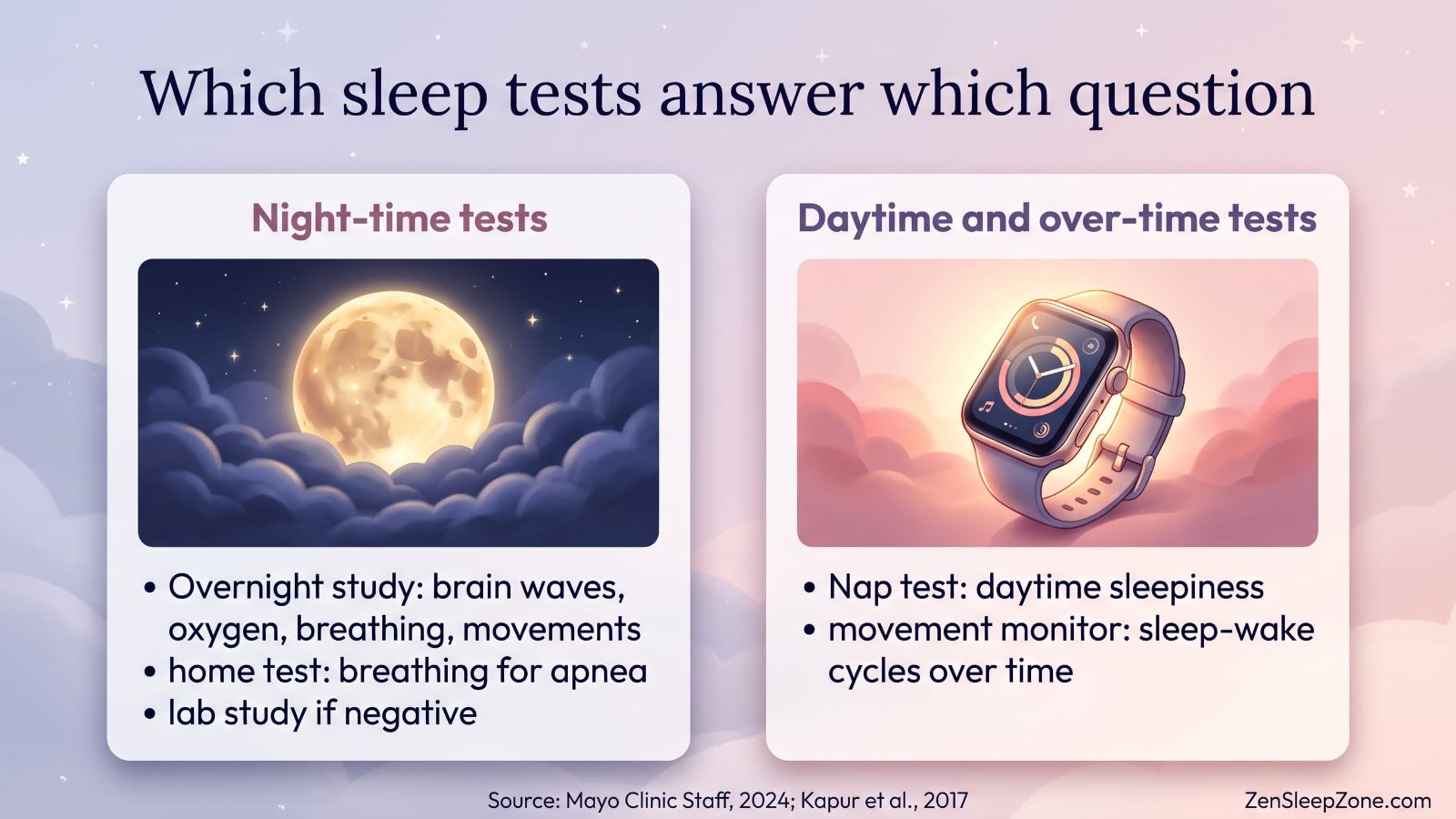
- Tests answer different questions — a night study, a nap test, and a movement monitor each measure something different.
- Treatment fits the condition — insomnia therapy, breathing support, and timing treatments serve different needs.
Which sleep tests might you need?
A sleep study isn’t needed for everyone with sleep problems. Some problems are assessed through your history alone. Others need a sleep study or other medical tests, and the suspected condition decides which test fits. Each test answers a different question, so ask what yours will and won’t show.
Testing can feel like a hassle, and that worry is fair. Knowing what a test measures makes it easier to judge whether it is worth your time.
- History and sleep diary. A clinician looks at your sleep schedule, habits, and medicines. A diary of sleep, waking, naps, and sleepiness adds detail (NHLBI).
- Overnight sleep study (polysomnography). It records brain waves, oxygen levels, breathing, and eye and leg movements during sleep (Mayo Clinic Staff, 2024).
- Home breathing test. It checks for sleep apnea at home. It records different signals than a lab study.
- Daytime nap test. The multiple sleep latency test assesses daytime sleepiness. A specialist chooses and prepares it.
- Movement monitor (actigraphy). It shows sleep-wake cycles over time. A clinical monitor isn’t interchangeable with every consumer watch.
Did you know?
Some sleep problems can be assessed through history alone, while others need a sleep study or other medical tests. Short answers on what to ask before paying for a test are on the sleep disorders questions page.
So “which test?” matters as much as “do I need one?”
A negative home test isn’t always the end of the road. If a single home test for sleep apnea is negative, inconclusive, or technically inadequate, the AASM strongly recommends an overnight lab study for adults (Kapur et al., 2017).
The same guideline says a clinician should pick a lab study over a home test for suspected sleep apnea in adults with any of these:
- Significant cardiorespiratory disease.
- Possible respiratory muscle weakness from a neuromuscular condition.
- Awake or sleep-related hypoventilation (too-shallow breathing), or a suspicion of it.
- Chronic opioid medication use.
- A history of stroke.
- Severe insomnia.
Your clinician makes that choice. You don’t need to pick the test yourself.
Here is a made-up example. Alex’s home breathing test comes back negative, yet Alex still dozes off without meaning to. Alex avoids driving while sleepy, tells the clinician about the dozing, and asks whether a lab study makes sense. That is a conversation, not a diagnosis or a promised result.
The sleep apnea guide follows the breathing-test pathway in more detail.
How does treatment differ between sleep disorders?
Treatment for sleep disorders depends on the condition. Structured therapy suits long-term insomnia, breathing support suits sleep apnea, and timing treatments suit body-clock problems. A specialist guides care for conditions such as narcolepsy. No one approach fits every disorder. That is why the first job is working out which problem you have.
Structured insomnia therapy (CBT-I)
CBT-I is structured therapy for long-term insomnia. A 2021 AASM guideline strongly recommends the multicomponent form for adults with chronic insomnia (Edinger et al., 2021). A strong recommendation is not the same as certainty about the evidence.
The strong recommendation applies to CBT-I for chronic insomnia. The other items are guidance for specific problems, not equal treatments. Don’t stop prescribed medicine without talking to your prescriber.
That recommendation covers one condition. The others in this guide have their own paths.
Insomnia and medicine. A 2026 AASM guideline conditionally favors CBT-I plus medication over medication alone for adults with chronic insomnia. It also conditionally advises against preferring combination treatment over CBT-I alone. Certainty is low for both statements, and personal priorities matter (Buysse et al., 2026). The CBT-I guide explains what the therapy involves.
Restless legs. If symptoms are clinically significant, a clinician should check your iron status. Management also includes addressing anything that makes symptoms worse (Winkelman et al., 2025). The AASM conditionally advises against standard pramipexole use for adults, with moderate certainty. Those choices belong with your clinician. The restless legs guide covers iron and treatment questions.
Sleep apnea. CPAP supplies air through a mask while you sleep (NHS, 2026). If it feels hard or uncomfortable, tell your doctor instead of stopping or changing it yourself.
Narcolepsy. Care may include planned naps and medicines that support wakefulness (NHS).
Body clock. Timing problems need timing-based care. The body clock guide explores timing rather than generic bedtime advice.
If you prefer to listen, this NHS video gives a short spoken overview of sleep problems.
Sleep problems — NHS
How do you get help in your country?
Getting help for sleep disorders depends on where you live. This section compares routes in the United States, the United Kingdom, Canada, and Australia. Referral and payment rules differ, so confirm both with the service before you book. Each route below comes from an official source.
| Country | How to reach a sleep service | What to know about payment |
|---|---|---|
| United States | The AASM links an accredited sleep-facility locator. Confirm referral and insurer requirements with the facility. | Medicare Part B covers eligible sleep tests ordered by a clinician. That isn’t universal insurance coverage. |
| United Kingdom | A GP can refer suspected sleep apnoea to a specialist sleep clinic. | NHS CPAP is free when needed. |
| Canada | HealthLink BC lists an Island Health sleep-lab route that needs a referral from a family physician or specialist. It is a regional example. | Ask the lab or your referring clinician what you will be charged. |
| Australia | Adult sleep-study pathways include specialist assessment, face to face or by video. The healthdirect sleep-disorders hub has a Service Finder. | Sleep studies can be privately billed or bulk billed. Confirm the arrangement before booking. |
A route is not a bill. A referral gets you to the service, and payment is a separate question. Exact costs and wait times aren’t covered here, so ask the service directly.
What should you bring to a sleep appointment?
A sleep appointment goes further with notes about your sleep, your days, and what anyone else has noticed. A sleep diary, your medicines, and a partner’s account give the clinician something concrete to work with. Notes are for discussion, not a diagnosis, and tracking should never delay care.
Appointment notes
Build a one-page summary
- Sleep timing — Write when you go to sleep, wake up, and nap. A diary can run alongside your usual routine.
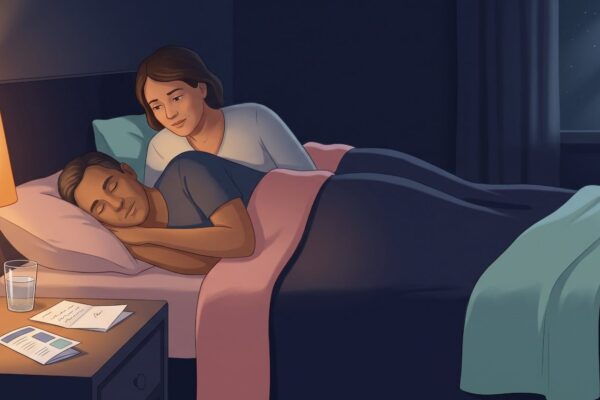
- Night-time events — Note anything you notice, such as breathing, movements, or unusual actions. Ask a bed partner to describe what they see.
- Daytime effects — Record how sleepy you feel and how it affects ordinary tasks. Say whether you feel drained, dozy, or both.
- Medicines and substances — List prescription and nonprescription products that may affect sleep. Don’t stop any of them without asking the prescriber.
- Your questions — Ask what a test measures and what its result leaves unanswered.
If you worry about sounding dramatic, concrete notes let you describe what happens without arguing your case. The Sleep appointment planner helps you organise observations and questions for your clinician.
While you wait, avoid driving when sleepy and keep floors clear if you sleepwalk. The sleep environment guide covers practical bedroom barriers alongside assessment.
What if symptoms continue or treatment is difficult?
Ongoing symptoms or a treatment that feels hard are reasons to go back, not to give up. Tell your clinician exactly what is difficult and what still affects your days. Treatment and other contributing conditions may need review. Often falling asleep during the day is a reason to see a clinician.
Return with specifics. Say which part of CPAP or therapy is hard, and bring your latest notes. Then your clinician can adjust the plan with you.
Numbers can add perspective, but they describe groups. In a 2024 US national survey, 15.4% of adults (about 15 in 100) said they had trouble falling asleep most days or every day in the past 30 days. For trouble staying asleep, the figure was 18.1%. Those are symptom reports, not diagnosed insomnia (Ng et al., 2026).
Apnea figures come from a different kind of study. A 2019 model estimated that 936 million adults aged 30 to 69 worldwide have mild to severe obstructive sleep apnea. It put moderate to severe cases at 425 million (Benjafield et al., 2019). The second number is part of the first, so never add them.
Surveys of symptoms and models of breathing events measure different things. Neither gives one total for all sleep disorders, and neither tells you what you have. You can see every figure, with who it applies to, on the statistics page.
Sleep appointment plannerOrganise observations and questions for your clinician.Key takeaways
- Remember — tiredness, sleepiness, and a sleep disorder are different ideas, and describing yours well matters more than naming it.
- Do — avoid driving when sleepy, and write down what happens at night and during the day.
- If it continues — go back with specifics, and seek assessment for repeated daytime sleep, breathing pauses, or months of poor sleep.
You can now describe your sleep. Choose where to go next.
Not sure where to start? The Sleep Compass sorts your next step by what you notice most. More in sleep disorders guides.
Find your starting point →Sleep disorders questions
Can too little time for sleep look like a sleep disorder?
Yes. Too little time for sleep can look like a sleep disorder, because both leave you tired. Some people who feel tired during the day simply don’t get enough sleep. That’s why sleep opportunity has to be considered alongside other symptoms, such as dozing or breathing pauses.
A clinician usually asks about your sleep schedule and habits first. If your schedule leaves enough time and you still feel tired or doze off, that pattern is worth describing. The section on sleep, fatigue and sleepiness shows how to tell them apart.
Can insomnia and sleep apnea overlap?
Sleep apnea can include insomnia symptoms and fatigue, so the two can overlap. That is a reason for individual assessment. It doesn’t mean most people with insomnia have apnea. A clinician looks at your full history to decide what fits your symptoms.
Sleep apnea symptoms don’t follow one fixed checklist, so a standard symptom list can’t confirm or exclude it. If you wake unrefreshed or notice breathing pauses, mention both. The tests section explains the home-test pathway.
Can I receive help online?
Yes, some insomnia therapy is available remotely. CBT-I can be delivered in person, by telephone, or online by a doctor, nurse, or therapist. Availability and suitability vary, so ask the service what it offers for your problem. Treatment choice still depends on the condition.
In Australia, specialist assessment for an adult sleep study can happen face to face or by video conference. Some problems still need tests, so ask what yours requires. The CBT-I guide explains what insomnia therapy involves.
Is a sleep study covered by insurance?
Coverage for a sleep study depends on your plan, your eligibility, the referral, the test, and your country. Check with the service and the payer before you book. A route to care and a bill are separate questions, so confirm both.
Rules differ by country. In the US, for example, Medicare Part B covers eligible sleep tests ordered by a clinician. That isn’t the same as universal insurance coverage. The country comparison shows the routes in four countries, and each service can confirm its own charges.
Can a sleep disorder be cured?
Whether a sleep disorder can be cured depends on the condition. No single outlook applies to every sleep disorder. Narcolepsy currently has no cure, but its symptoms can be managed. Other conditions have their own treatments and outcomes. A clinician can discuss yours once the problem is named.
Narcolepsy management may include planned naps and medicines that support wakefulness. Treatment for other conditions looks different, so ask what to expect for yours. The sleep disorders questions page explains how narcolepsy differs from other sleepiness patterns in short answers.
Are sleeping pills the solution for every sleep problem?
No. Sleeping pills aren’t the answer to every sleep problem, because treatment follows the condition. Therapy, breathing support, and body-clock treatment each have their own role. Check with a doctor before taking something for sleep, since medicines and supplements carry condition-specific benefits and risks.
For example, insomnia therapy and CPAP address different problems. If you take prescribed medicine, don’t stop it without talking to the prescriber first. The treatment section compares the main approaches and what each one is for.
Sources
- Buysse et al., Journal of Clinical Sleep Medicine, 2026 (DOI: 10.1007/s44470-025-00038-8). Supports: CBT-I plus medication versus medication alone, and combination treatment versus CBT-I alone.
- Winkelman et al., Journal of Clinical Sleep Medicine, 2025 (DOI: 10.5664/jcsm.11390). Supports: iron status checks, addressing worsening factors, and the pramipexole recommendation for restless legs.
- Edinger et al., Journal of Clinical Sleep Medicine, 2021 (DOI: 10.5664/jcsm.8986). Supports: the strong recommendation for CBT-I and the conditional advice against sleep hygiene alone.
- Kapur et al., Journal of Clinical Sleep Medicine, 2017 (DOI: 10.5664/jcsm.6506). Supports: lab study after a negative, inconclusive, or inadequate home apnea test, and when a lab study is preferred.
- National Library of Medicine, MedlinePlus, n.d.. Supports: what a sleep disorder is, tiredness from too little sleep, contributors, and the leg urge in restless legs.
- NHS, Excessive daytime sleepiness (hypersomnia), n.d.. Supports: sleepiness versus feeling tired, and seeing a clinician for frequent daytime sleep.
- NHLBI, Sleep Apnea Causes and Risk Factors, n.d.. Supports: the difference between obstructive and central sleep apnea.
- NHS, Narcolepsy, n.d.. Supports: narcolepsy symptoms, planned naps, wakefulness medicines, safety, and the lack of a cure.
- NHLBI, Circadian Rhythm Disorders Treatment, n.d.. Supports: lifestyle changes, bright light therapy, and melatonin for body-clock disorders.
- NHS, Sleep apnoea, 2026. Supports: breathing that stops and starts, CPAP, difficulty with CPAP, specialist clinic referral, and free NHS CPAP.
- NHS, Insomnia, 2024. Supports: not driving when sleepy, months of poor sleep, and checking with a doctor before taking something for sleep.
- NHS, Sleepwalking, 2025. Supports: clearing floors, concern about injuries, and not stopping medicines without advice.
- NHLBI, Sleep Deprivation and Deficiency Diagnosis, n.d.. Supports: sleep diaries, history-based assessment, other medical tests, and reviewing medicines.
- Ng et al., NCHS Data Brief 559, 2026. Supports: the 2024 US survey figures on trouble falling and staying asleep.
- Benjafield et al., The Lancet Respiratory Medicine, 2019 (DOI: 10.1016/S2213-2600(19)30198-5). Supports: the modelled global estimates of obstructive sleep apnea.
- Medicare.gov, Sleep studies, n.d.. Supports: US Medicare Part B coverage of eligible sleep tests ordered by a clinician.
- HealthLink BC, Sleep Lab, n.d.. Supports: the Island Health sleep-lab referral route.
- Australian Government, MBS Note DN.1.17, 2026. Supports: specialist assessment by video or in person, and private or bulk billing of sleep studies.
- NHLBI, Insomnia Treatment, 2022. Supports: CBT-I delivered by a doctor, nurse, or therapist in person, by telephone, or online.
- AASM, Find a sleep doctor, n.d.. Supports: the accredited sleep-facility locator.
- healthdirect Australia, Sleep disorders, n.d.. Supports: the Australian Service Finder.
- NHLBI, Sleep Apnea Symptoms, 2025. Supports: fatigue and insomnia as sleep apnea symptoms.
- Cleveland Clinic, Sleep Disorders, 2023. Supports: the six main groups and REM sleep behavior disorder.
- A.D.A.M., Idiopathic hypersomnia, 2025. Supports: difficult waking and unrefreshing naps in idiopathic hypersomnia.
- Mayo Clinic Staff, Sleep disorders: Diagnosis and treatment, 2024. Supports: what sleep tests record, the nap test, movement monitoring, partner accounts, and other medical contributors.
Sources checked · Next review
How we made this guide: researched from the sources above, drafted with AI assistance and edited by Aamir Bashir, Founder & Editor. Read our editorial policy.