
The short answer
Where to start with sleep disorders depends on what bothers you most. Breathing that pauses points one way. Months of poor sleep point another. A body clock out of step points a third. What decides your first step is the pattern you can describe. Pick what you need below and go straight to the page that fits.
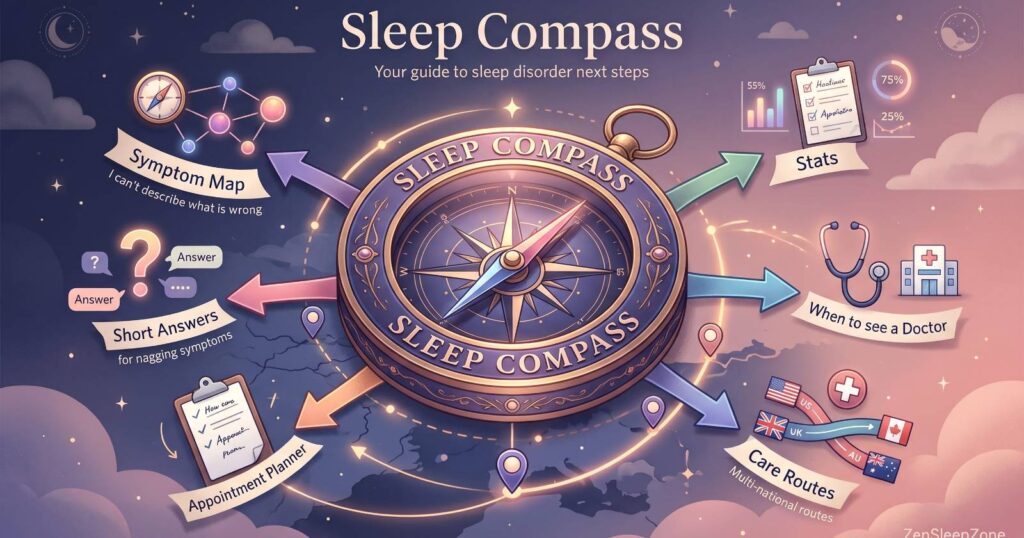
Where to start with sleep disorders: pick what you notice most
Pick what you need right now. You go straight to the page that fits, with no reading first.
Do not drive when you feel sleepy. Arrange another way to travel today.
Every starting point
If you can’t describe what is wrong
See your symptoms on one map
What you notice at night points to different questions. One map shows how they connect before you name anything.
The sleep disorders mind mapSix branches from night symptoms to tests and care, so you can see where you fit. Is this a disorder or too little sleep?Separates sleep opportunity, low energy and real daytime sleepiness.If one symptom question keeps nagging you
Get one plain answer and move on
Overlapping symptoms cause most of the confusion. Sleep apnea can bring fatigue and insomnia symptoms, NHLBI says. One clue rarely settles it.
Sleep disorders questions, answered shortPlain answers on overlapping symptoms, hypersomnia and what one test can miss. The six main types of sleep disordersWhat each group looks like at night, and what assessment usually follows.If you want to walk in prepared
Bring notes your clinician can use
Vague complaints get vague answers. A planner turns sleep times, naps and a partner’s account into one page you can print.
The sleep appointment plannerSleep times, naps, night events and medicines on one page you can print. What to bring to a sleep appointmentThe details that help, from wake times to what your partner noticed.If you want the numbers first
See how common these problems are
About 18 in 100 US adults report trouble staying asleep most nights, NCHS figures show. Group numbers describe populations, never your own diagnosis.
Sleep disorders statisticsReported symptoms, estimated apnea counts, and why the two are never added together. What if symptoms continue after care?How to go back with specifics instead of giving up on treatment.If you are not sure this needs a doctor
Know when to see a doctor
Repeated daytime dozing, or breathing that stops and starts, are reasons to get checked, NHS guidance says.
When to seek medical adviceThe signs that deserve assessment, and the one that means stop driving today.If you need care and the cost
Find the route that fits your country
Referral rules and payment differ by country. The guide sets the route and the bill side by side for the US, UK, Canada and Australia.
How to get help in your countryFour countries, with referral steps and what Medicare, the NHS or the MBS covers.Quick questions
Where should I start if I cannot identify my sleep problem?
Start with the thing that bothers you most, not with a label. If you cannot name it, take the mind map. If one question keeps returning, take the short answers. If you already have an appointment, take the planner. Any of the three gives you words for the next conversation.
The full map is the calmest place to begin. See how symptoms, tests and care connect.
What if two of these paths sound like me?
Take the one that worries you more. Breathing that stops and starts, or dozing off without meaning to, belongs with assessment first. A vague sense that something is off can start on the map. You can always come back and take the other path afterwards.
Nothing here is a one-way door. Read the short list of reasons to seek advice.
Do I need to read the whole guide first?
No. The guide is long because sleep problems are not one thing. Each path here opens a single section that answers the question you arrived with. Read that section, use it, and come back for the rest only if you need it.
One page at a time is the point. Start with the tired-or-sleepy explainer.
Sources
Sleep disorders disturb normal sleep and include problems with falling asleep, breathing, body-clock timing, movements and staying awake.
Excessive daytime sleepiness means dozing or fighting to stay awake, which is different from feeling tired all the time.
Breathing that stops and starts during sleep is a reason to arrange medical assessment.
In 2024, 18.1% of US adults reported trouble staying asleep most days or every day in the past 30 days.
Sleep apnea can include fatigue and insomnia symptoms, so snoring is not the only clue.
This Compass points you to the right page; it can’t diagnose you or replace care from a clinician who knows your health. Sources checked . Researched from the sources above, drafted with AI assistance and edited by Aamir Bashir, Founder & Editor (editorial policy).