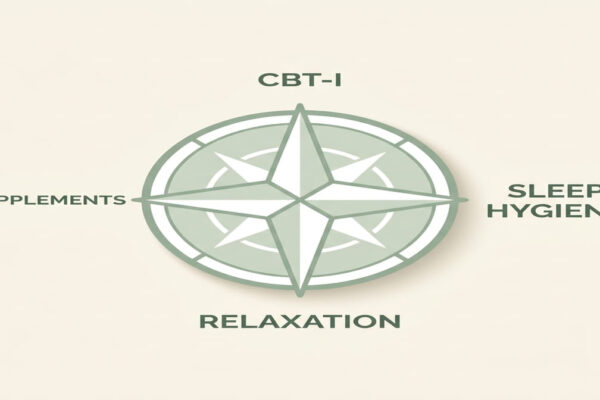

The short answer
The right first step depends on how long you’ve been struggling and what your nights actually look like. If it’s been days or a couple of weeks, a steady wake time and getting out of bed when you’re wide awake is usually enough. If it’s been months, start with a two-week sleep diary and ask your doctor about CBT-I — the treatment guidelines recommend first (PMC / Klin Spec Psihol, 2022; Mayo Clinic, 2023).
- 6–10% of adultshave chronic insomnia, the kind that runs for months rather than nights (PMC / Klin Spec Psihol, 2022)
- 1–2 weeksis how long to keep a sleep diary before a clinician can see your actual pattern (Mayo Clinic, 2023)
- First-line treatmentCBT-I is recommended ahead of medication for long-running insomnia (PMC / Klin Spec Psihol, 2022)
Find your starting point
Two quick questions, plus an optional safety check, to find the best place to start.
Browse all starting points
These are general, evidence-based starting points — not a diagnosis. Read the one that sounds most like you, or the closest match.
If your sleep trouble started a few days or a couple of weeks ago
Stop a bad week turning into a bad year
This often happens when a stressor, an illness or a schedule change knocks your sleep off course. The sleep itself tends to recover — but the habits you reach for in the meantime are what stretch a bad week into a long one (PMC / Klin Spec Psihol, 2022). These steps suit adults who’ve had trouble for under a month and have none of the warning signs above.
Start here
- Set one wake-up time and keep it every day, weekends included.It anchors your body clock, which is what actually makes you sleepy at the right hour.
- If you’re still awake after about 20 minutes, get up and do something quiet and dull in low light.Staying put teaches your brain that bed is a place for lying awake and worrying.
If you’ve been sleeping badly for months or years
Break the cycle that’s keeping insomnia going
This often happens when whatever started your insomnia is long gone, but the coping you built around it has become the problem: longer and longer in bed, naps, watching the clock, dreading the night. That’s what CBT-I is built to reverse (PMC / Klin Spec Psihol, 2022). These steps suit adults whose sleep trouble has gone on for months and is showing up in their days.
Start here
- Start a sleep diary and keep it for two weeks.It gives your doctor real data instead of a vague memory of bad nights.
- Ask your doctor about CBT-I.It’s the recommended first-line treatment, and it targets the habits that keep insomnia alive.
If your mind won’t switch off at night
Turn the volume down on bedtime worry
This often happens when the thing keeping you awake isn’t your schedule — it’s your nervous system staying switched on. Then you start worrying about not sleeping, and that worry becomes its own reason you can’t sleep (PMC / Klin Spec Psihol, 2022). These steps suit adults whose main obstacle is a racing mind or dread about going to bed.
Start here
- Give worry its own appointment earlier in the day — write down what’s on your mind at, say, 6pm.It moves rumination out of the bedroom and off the pillow.
- Ask about CBT-I or anxiety-focused support.CBT-I includes cognitive work aimed squarely at sleep worry.
If you snore, stop breathing, or fall asleep without meaning to
Get your breathing checked before you treat this as insomnia
This often happens when your airway narrows or closes during sleep and your brain keeps waking you to restart your breathing. That pattern points to obstructive sleep apnea rather than insomnia, and it’s a recognised reason to see a doctor promptly (Wikipedia, 2026). These steps suit anyone whose bed partner has noticed snoring or pauses in breathing, or who feels dangerously sleepy in the day.
Start here
- Book an appointment with your doctor or a sleep specialist.Suspected sleep apnea needs a proper assessment, not a bedtime routine.
- Park the sleep-hygiene experiments until your breathing has been checked.If your breathing is being interrupted, no wind-down routine will clear it.
If you’re pregnant, over 65, or going through menopause
Find advice that fits your body and your stage of life
This often happens when physical and hormonal changes are doing the disrupting — pregnancy discomfort, night sweats, or the way sleep deepens less with age. The basic habits still apply, but what’s safe to take changes a great deal (PMC / Frontiers in Psychiatry, 2024). These steps suit pregnant women, adults 65 and over, and anyone in the menopausal transition.
Start here
- Check with your doctor or obstetrician before taking any sleep aid, including over-the-counter ones.Many sleep medicines aren’t safe in pregnancy, and antihistamine aids carry extra risks after 65.
- Ask whether CBT-I can be adapted for you.It’s appropriate and effective for older adults, and in pregnancy the pacing can be adjusted with your clinician.
What to expect over the next weeks
Two timelines matter here, and they’re different. A recent bout of bad sleep usually settles within days to weeks once the trigger passes and your wake time stays steady. Long-running insomnia treated with CBT-I typically shows real improvement over about six to eight weeks — but the first stretch can feel harder before it feels easier, because the sleep-restriction part temporarily cuts your time in bed. That’s expected, and it’s exactly why it’s done with a clinician’s guidance (PMC / Klin Spec Psihol, 2022; Mayo Clinic, 2023).
- Days to weeksA short bout settles
Most recent-onset sleep trouble eases once the trigger passes and you hold your wake time steady. If it’s still going weeks later, treat it as the longer-running kind and start the steps for chronic insomnia.
- First few weeks of CBT-IThe hard stretch
Sleep restriction can leave you sleepier before you sleep better. That’s normal, and your clinician will adjust the plan if it’s too much to carry.
- Six to eight weeksReal improvement
CBT-I usually produces meaningful improvement by this point. If nothing has shifted, that’s a reason to go back to your doctor — not a reason to keep waiting.
Why this keeps happening
Sleep researchers describe insomnia in three layers. One makes you vulnerable, one sets it off, and one — the layer almost nobody notices — is what keeps it running long after the first two have faded.
Your starting point. Biology, a naturally anxious temperament or a light-sleeper’s wiring leaves some people more vulnerable to disrupted sleep in the first place.
The trigger. A stressful stretch, an illness, grief, a new baby, a shift change — something starts the first run of bad nights.
The part that keeps it going. Going to bed earlier and earlier, napping, clock-watching, lying there trying harder — these coping moves are what turn a bad month into a lasting problem (PMC / Klin Spec Psihol, 2022).
The encouraging part: the perpetuating layer is the one you can actually change, and it’s exactly what CBT-I targets.
The evidence behind this page
CBT-I is recommended as a first-line treatment for chronic insomnia.
Chronic insomnia affects roughly 6–10% of adults.
A sleep diary kept for 1–2 weeks is the standard starting point for a clinical assessment.
CBT-I for chronic insomnia typically brings meaningful improvement within about six to eight weeks, while recent-onset insomnia usually settles within days to weeks.
Fully automated digital CBT-I produces moderate-to-large improvements in insomnia severity compared with control.
Insomnia affects about 38.2% of pregnant women.
Snoring with witnessed breathing pauses is a recognised differential diagnosis for insomnia — something to have assessed, not self-treated.
Getting out of bed when you’re still awake after about 20 minutes is a standard stimulus-control instruction within CBT-I.
All the figures are on the insomnia statistics page. Spotted an error? Tell us.
When to see a doctor
- Chest pain, trouble breathing at night, or sudden severe confusion — get urgent medical help.
- Thoughts of harming yourself — contact a crisis service right away: US 988, UK 116 123, Canada 988, Australia 13 11 14.
- Loud snoring, or a bed partner who has seen you stop breathing.
- Daytime sleepiness that makes driving or operating machinery unsafe.
- An uncontrollable urge to move your legs at night, or sudden muscle weakness when you feel a strong emotion.
- Sleep trouble that has run for months, or is spilling into your mood, work or relationships — ask a clinician about CBT-I.
- You’re over 65 and using an over-the-counter antihistamine sleep aid. These raise the risk of falls, confusion and memory problems, and CBT-I is the better route.
- You’re pregnant and thinking about any sleep medicine or supplement. That needs your obstetric team’s approval first.
Quick questions
I’ve only had sleep problems for a few weeks — should I be worried?
Not usually, but it’s worth protecting. Sleep trouble after a stressor, an illness or a schedule change is common, and the bad week itself isn’t the risk — the habits that grow around it are.
Keep your wake time fixed and get out of bed if you’re wide awake and frustrated. If it’s still going weeks later, switch to the steps for long-running insomnia.
I’ve had insomnia for months — what should I do first?
Start a sleep diary tonight and book an appointment with your doctor. Two weeks of diary entries lets them see your actual pattern instead of a rough impression.
Ask specifically about CBT-I. It’s recommended as first-line treatment for chronic insomnia, and digital versions are widely available if in-person therapy is hard to reach.
I’m worried I might have sleep apnea, not insomnia — how can I tell?
The loudest clues are snoring, a bed partner who has seen you stop breathing, and daytime sleepiness that has become a safety worry.
Those are reasons to see a doctor promptly rather than work through an insomnia checklist. Self-treating apnea as insomnia won’t help, and it delays the assessment you actually need.
I don’t want to take sleeping pills — are there other options?
Yes, and the main one is the treatment guidelines put first. CBT-I involves no medication at all and targets the habits that keep insomnia going.
It’s available in digital form too, and studies of fully automated digital CBT-I show moderate-to-large improvements in insomnia severity.
Educational information, not medical advice or a diagnosis. If your sleep problem comes with chest pain, breathing pauses, or sleepiness that feels unsafe, talk to a doctor rather than waiting it out. Sources checked September 2026.