
The short answer
Natural insomnia treatment starts with cognitive behavioural therapy for insomnia (CBT-I), the only approach with a strong American Academy of Sleep Medicine (AASM) recommendation for chronic insomnia. Stimulus control — reserving the bed for sleep and keeping a fixed wake time — can be started tonight at no cost, without a prescription or a therapist.
Natural Insomnia Treatment: Where Should You Start Tonight?
- 6–8 weeksTypical timeframe to see meaningful, lasting improvement with structured CBT-I (AASM, 2021).
- 12.4%Estimated prevalence of insomnia disorder in the general adult population (PubMed meta-analysis, 2025).
- Strong recommendationCBT-I is the sole natural, non-drug approach at the highest AASM evidence tier for chronic insomnia.
Find your starting point
Three quick questions. Your answers stay in this browser tab and are never sent anywhere.
Every starting point, explained
These are general, evidence-based starting points, not a diagnosis. Choose the pattern that best matches your experience.
If you lie awake for hours after going to bed
Break the wakefulness association tonight
This pattern often happens when the brain learns to associate the bed with racing thoughts rather than sleep. Reversing this conditioned arousal is the primary goal of your first steps.
For recent sleep issues, these steps alone may be enough to reset your rhythm within a couple of weeks.
If this has lasted 3 months or more, a full CBT-I programme is the recommended first-line treatment.
Start tonight
- Set a fixed wake time for tomorrow.A consistent wake time is the single most powerful anchor for your body clock, regardless of how little you sleep.
- Get out of bed if you are awake for more than 20 minutes.This breaks the learned association between your bed and frustration.
- Do a quiet, non-stimulating activity in dim light until genuinely sleepy.Reading a physical book or listening to calm audio lowers cognitive arousal without reinforcing wakefulness in bed.
If you wake at 2–4am and that’s it for the night
Manage middle-of-the-night arousal
Waking and being unable to return to sleep is often driven by a spike in cognitive arousal or cortisol. Clock-watching intensifies this stress response, making sleep physiologically harder.
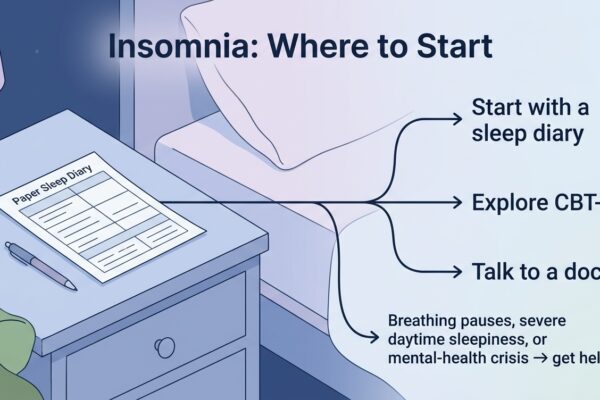
Begin structured self-help immediately with a sleep diary and a free digital CBT-I programme.
This pattern strongly indicates chronic insomnia disorder; a structured CBT-I approach is your best path forward.
Start tonight
- Apply stimulus control if you cannot sleep.Leaving the bed prevents your brain from linking the mattress with wakeful frustration.
- Turn your clock away from view.Checking the time triggers “sleep math” anxiety, which spikes adrenaline and delays sleep onset.
- Try slow-paced diaphragmatic breathing.This activates the parasympathetic nervous system, gently lowering your heart rate and physical tension.
If you wake up an hour or two before your alarm and can’t go back
Protect your circadian anchor
Early morning awakening is common in older adults and those experiencing low mood. The body’s sleep pressure has depleted, and the circadian clock may be shifting earlier.
If this persists alongside low mood or fatigue, professional evaluation is the safest next step.
Start tonight
- Keep your wake time fixed — do not try to sleep in.Sleeping in fragments your rhythm further and reduces sleep drive for the following night.
- Note how much total sleep you are actually getting.Many people sleep more than they perceive; tracking provides objective data to reduce anxiety.
- Plan to speak to a GP if this is accompanied by low mood.Early awakening is a recognised symptom that warrants a holistic health review.
If your whole night is broken; you can’t fall asleep and wake repeatedly
Anchor your rhythm and seek structured support
This is often the most chronic and distressing pattern. It indicates strong conditioned hyperarousal, making a full, multi-component CBT-I programme the most effective path forward.
Full CBT-I (in-person, digital, or self-guided) is the evidence-based first-line treatment for this pattern.
Start tonight
- Set a single, fixed wake time and anchor everything to it.Consistency rebuilds your homeostatic sleep drive, even when the night feels chaotic.
- Apply stimulus control rules for all wakings.Every time you leave the bed when awake, you weaken the brain’s wakefulness association.
- Download a free, validated app like CBT-I Coach or Insomnia Coach.These provide the structured, step-by-step guidance needed for complex insomnia patterns without a specialist referral.
If you sleep okay but never feel rested
Pause self-treatment and seek evaluation
Non-restorative sleep can indicate an underlying health condition, such as sleep apnea or sleep stage disruption, rather than primary insomnia. Natural insomnia self-treatment is not the appropriate primary approach here.
Persistent non-restorative sleep over 3 months requires professional medical evaluation.
Start tonight
- Note whether you snore or have morning headaches.These are key red flags for sleep-disordered breathing that require a different treatment pathway.
- Do not begin sleep restriction therapy.Restricting sleep when the root cause is not insomnia can worsen daytime fatigue and is unsafe without a diagnosis.
- Speak to a doctor about your symptoms.A clinician can order appropriate tests, such as a sleep study, to identify the true cause of your fatigue.
Week by week: The structured pathway
A typical CBT-I or structured self-help pathway takes 6 to 8 weeks. It is common to feel slightly more tired in the first week as your body adjusts; this is a normal part of rebuilding sleep drive.
- Week 1Anchor and observe
Set a fixed daily wake time (non-negotiable). Apply stimulus control rules every night. Start a sleep diary using paper or the free CBT-I Coach app.
- Week 2Introduce the sleep window
Calculate your average time asleep from your diary. Set a conservative sleep window (sleep restriction). Begin a 10-minute relaxation practice, such as progressive muscle relaxation, before bed. Note: If you have epilepsy, bipolar disorder, or are pregnant, consult a clinician before restricting your time in bed.
- Weeks 3–4Titrate and reframe
Gradually extend your sleep window upward as your sleep efficiency improves (target ≥85–90%). Identify and challenge unhelpful sleep beliefs (cognitive restructuring). Keep your wake time fixed, even on weekends.
- Weeks 5–6Consolidate and review
Review your sleep diary. If your sleep efficiency is consistently ≥85% and you are sleeping 7+ hours, begin gradual expansion of your sleep opportunity. If there is insufficient improvement, seek a professional CBT-I or GP referral.
Why this keeps happening
Insomnia is rarely just about “bad habits”. It is maintained by a cycle of physiological and psychological factors that reinforce each other over time.
Your brain has learned to associate the bed with wakefulness and frustration, rather than sleep. Stimulus control directly reverses this learned association.
Spending excessive time in bed to “catch up” weakens your homeostatic drive to sleep. Sleep restriction deliberately rebuilds this pressure.
Irregular sleep and wake times confuse your body clock. A consistent wake time is the single most powerful anchor to reset it.
These are learned patterns, and learned patterns can be unlearned. Most people who complete a structured CBT-I programme see significant improvement within 4 to 6 weeks.
How the options compare
| Approach | Helps soon | Lasting benefit | Downsides | Guidelines |
|---|---|---|---|---|
| CBT-I (multicomponent) | Moderate (weeks 2–4) | Yes — effects persist after therapy ends | Requires effort, 4–8 sessions, initial sleep restriction is uncomfortable | AASM strong recommendation |
| Stimulus control | Yes (days to 2 weeks) | Yes | Getting out of bed at 3am is difficult and feels counterintuitive | AASM conditional recommendation |
| Sleep restriction | Yes (often fastest-acting) | Yes | Short-term daytime tiredness; unsafe for certain medical conditions | AASM conditional recommendation |
| Relaxation therapy | Moderate | Moderate | Does not address conditioned bed-wakefulness arousal on its own | AASM conditional recommendation |
| Sleep hygiene (standalone) | Low | Low for chronic insomnia | Insufficient as a sole treatment; delays effective care | AASM conditional recommendation against |
Pharmacological options may be appropriate for short-term crisis management, but the choice to use them should always be made with a doctor who understands your full medical history.
The evidence behind this page
CBT-I carries the only strong recommendation from the AASM for treating chronic insomnia disorder in adults.
Stimulus control and sleep restriction each carry conditional recommendations as effective standalone therapies.
The 2025 AASM clinical practice guideline gives a conditional recommendation against melatonin and valerian for chronic insomnia due to insufficient high-quality evidence.
CBT-I has efficacy similar to hypnotic medications in the short term, but is more durable, with effects continuing after therapy ends.
The pooled prevalence of insomnia disorder by interview-based DSM criteria is approximately 12.4% in the general adult population.
Full references and additional statistics are on the natural insomnia treatment statistics page. Spotted an error? Tell us and we will check it.
When to see a doctor
- Your insomnia has lasted 3 months or more and is causing significant daytime impairment affecting work, driving, or relationships.
- You suspect sleep apnea (e.g., loud snoring, witnessed breathing pauses, morning headaches, or non-restorative sleep).
- You are pregnant and considering sleep restriction or other structured behavioural changes.
- You have a history of epilepsy, bipolar disorder, or severe parasomnias (sleep restriction requires clinical oversight).
- You have tried 4 to 6 weeks of consistent, structured self-help with no meaningful improvement.
Quick questions
Can I do stimulus control even if I have a baby or young child?
Yes, but with modifications. If you are the primary nighttime caregiver, strict stimulus control (leaving the bed) may not be practical. Instead, focus on the fixed wake time, maximise rest when the child sleeps, and ask a partner to take over the first night waking if possible. Discuss realistic modifications with a CBT-I provider.
What if I can’t get out of bed because of pain or disability?
Stimulus control can be adapted. If you cannot leave the bed, the goal shifts to breaking the cognitive association. Sit up in bed, turn on a dim light, and engage in a quiet, non-sleep activity (like listening to an audiobook or gentle stretching) until you feel sleepy, rather than lying there frustrated.
How do I calculate my sleep window for sleep restriction?
Review your sleep diary for the past week. Calculate your average total sleep time (not time in bed). Add 30 minutes to this number, but never set the window below 5.5 hours. If your average sleep is 5 hours, your initial sleep window might be 5.5 hours (e.g., 12:30am to 6:00am).
Is it safe to drive while doing sleep restriction therapy?
Sleep restriction can cause temporary daytime sleepiness in the first 1 to 2 weeks. If your job involves driving or operating heavy machinery, you must discuss this with a clinician before starting. Do not drive if you feel drowsy, and consider delaying the therapy until a safer period.
Can I use melatonin while doing CBT-I?
While not strictly forbidden, it is generally discouraged during CBT-I. The goal of CBT-I is to rebuild your natural sleep drive and circadian rhythm. Relying on a supplement can mask your true baseline sleep patterns, making it harder to accurately calculate your sleep window and measure progress.
What if I feel even more tired in week 1 of sleep restriction?
This is a normal, expected part of the process. By temporarily limiting your time in bed, you are intentionally building up homeostatic sleep pressure. This initial dip in energy usually resolves by weeks 3 to 4 as your sleep efficiency improves and your body adapts to the new rhythm.
Educational information, not medical advice or a diagnosis. If insomnia is accompanied by thoughts of harming yourself, contact a doctor, your local emergency number, or a crisis line today. Last reviewed September 2026.