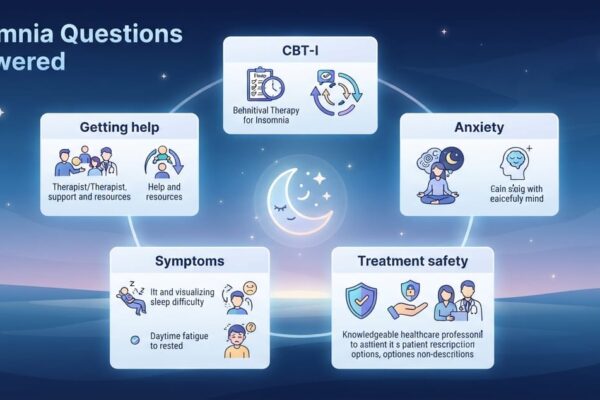

Sleep disorders questions come up fast once ordinary advice stops working: snoring, breathing pauses, racing nights, restless legs, and daytime sleepiness that won’t lift. Short, sourced answers are below. The full picture lives in our Sleep Disorders Guide.
Not sure where to start? The Sleep Disorders Compass points you to your first step.
These answers explain sleep disorders for general education. They can’t diagnose you or replace care from a clinician who knows your health.

Sleep disorders questions people ask first
Start here if you’re still working out what’s actually happening to your sleep.
What is a sleep disorder?
A sleep disorder disturbs your normal sleep pattern and can affect how you feel during the day. It covers very different problems: trouble falling asleep, breathing pauses, body-clock shifts, and unusual movements. One rough night rarely means a disorder — a repeating pattern does.
A clinician weighs how often symptoms happen and how they affect your days, not one bad night. Repeating patterns matter more than a single rough sleep. See how specific symptoms map to next steps in the full symptom guide.
Is being sleepy different from being tired?
Sleepiness and tiredness are not the same thing. Sleepiness means you doze off or struggle to stay awake during the day. Tiredness, or fatigue, means low energy without necessarily falling asleep. Describing both to a clinician helps them figure out what’s really going on.
This distinction matters: excessive daytime sleepiness points toward certain conditions, while fatigue alone often has other causes. See how each pattern connects to assessment in our sleep disorders mind map.
What are the main types of sleep disorders?
Sleep disorders generally fall into six groups: trouble falling or staying asleep, breathing problems, excess daytime sleepiness, body-clock shifts, unusual nighttime behaviors, and movement disorders. Knowing the broad group helps you describe symptoms clearly. Each has distinct patterns and causes.
These groups overlap sometimes — fatigue or insomnia-type symptoms can show up with sleep apnea, for example. The full breakdown, with examples of each type, is in the main types section of the guide.
Can you have more than one sleep disorder at the same time?
Yes, it’s possible to have more than one sleep disorder at once. Sleep apnea, for instance, can include fatigue and insomnia-type symptoms alongside breathing pauses. That overlap is exactly why a full history, not one symptom, guides assessment.
Overlapping symptoms are why forum stories can mislead — one person’s diagnosis doesn’t predict yours. Population figures can’t diagnose you either, as the numbers page explains.
Sleep disorder symptoms: breathing, snoring and sleep apnea questions
These cover the questions that come up most when breathing or snoring is the worry.
Is snoring always a sign of sleep apnea?
No, snoring doesn’t always mean you have sleep apnea. Plenty of people snore from congestion, alcohol, or sleeping position without any breathing disorder. Apnea is more likely when snoring is loud and frequent, paired with pauses, gasping, or daytime sleepiness.
A clinician looks at the whole pattern, not snoring alone, before suspecting obstructive sleep apnea. Obstructive apnea happens when the airway narrows; central apnea involves how the brain controls breathing — different mechanisms, different tests. If this sounds like you, the sleep apnea guide covers assessment in depth.
Can sleep apnea include symptoms other than snoring?
Yes — sleep apnea can show up without the classic snoring picture at all. Fatigue and insomnia-type symptoms are both associated with apnea, and they’re reported more often by women. Relying on a stereotypical checklist can miss the diagnosis.
This is why assessment covers your whole history — energy levels, waking feeling, and sleep quality — not snoring alone. A clinician can help sort out what fits your pattern.
What happens if sleep apnea is left untreated?
Untreated sleep apnea can affect more than your sleep. Repeated breathing pauses and oxygen drops are linked with a higher risk of high blood pressure and diabetes over time. Daytime sleepiness from poor sleep can also make driving and daily tasks less safe.
These are population-level associations, not a prediction for any one person. If you feel drowsy and are about to drive, treat that as urgent — pull over or ask someone else to drive instead. More on daytime risk is in the safety section.
Does sleep apnea run in families?
Sleep apnea can run in families, though it’s not guaranteed to pass down. Having a close biological relative with obstructive sleep apnea raises your own risk two to four times. Inherited jaw and airway shape, not one single gene, usually explain the link.
A family history is a good reason to mention snoring, fatigue, or breathing pauses to your doctor (Cleveland Clinic, 2026). It doesn’t mean you’ll definitely develop apnea yourself.
Narcolepsy, hypersomnia, restless legs and other patterns
Quick answers for the less common patterns people search for once breathing has been ruled in or out.
Is narcolepsy just falling asleep suddenly?
No, narcolepsy involves more than sudden sleep attacks. It often includes persistent daytime sleepiness that doesn’t go away with rest. Some people also have cataplexy, a sudden muscle weakness triggered by strong emotions like laughter. Not everyone has every symptom.
Symptom combinations vary person to person, so a specialist looks at your full pattern. There’s currently no cure, but planned naps and wake-promoting medicines can help manage daily life.
How is idiopathic hypersomnia different from ordinary tiredness?
Idiopathic hypersomnia goes beyond feeling tired. It can involve persistent daytime sleepiness, real trouble waking up even after long sleep, and naps that don’t leave you feeling refreshed. Ordinary tiredness usually improves with rest — this pattern often doesn’t.
A clinician rules out other explanations, like insufficient sleep opportunity or another sleep disorder, before considering idiopathic hypersomnia. It’s a less common pattern worth describing precisely.
Is an urge to move my legs the same as moving during sleep?
No — these describe two different things worth reporting separately. An urge to move your legs while awake and resting points toward restless legs syndrome. Movements someone observes while you’re asleep are a separate finding, recorded differently during assessment.
Both pieces matter, so describe the awake urge and any observed sleep movements on their own terms. Restless legs has its own evidence-based guide at this dedicated RLS page.
Can unusual nighttime behavior need assessment?
Yes — unusual nighttime behavior is worth describing to a doctor, especially with any risk of injury. Acting out dreams, walking, or other unexpected actions during sleep can have several explanations. The exact details help guide assessment.
REM sleep behavior disorder, for example, can involve acting out dreams, sometimes forcefully. Sleepwalking safety starts with clearing floor hazards near the bed. See more on these patterns in the main types section.
What causes or worsens sleep problems
Short answers on why sleep problems start or stick around.
What causes sleep disorders?
Causes vary a lot by condition. Other health conditions, certain medicines, and genetics can all contribute to sleep disorders. Sometimes what looks like a disorder is really not enough time scheduled for sleep in the first place. There’s rarely one single cause.
A useful history covers your health conditions, medicines, and sleep schedule together, not just one factor. See how contributors are untangled in the causes section of the guide.
Can stress cause sleep problems like insomnia?
Yes, stress is a common contributor to sleep problems, including trouble falling or staying asleep. It’s one of several possible contributors, not an automatic explanation for every case. Medical conditions and medicines can play a role too, alongside or instead of stress.
Assessment considers your whole picture, including mental-health conditions, rather than assuming stress explains everything. How stress and sleep affect each other is covered in a dedicated guide.
Should I stop a medicine that might affect my sleep?
No — don’t stop a prescribed medicine on your own, even if you suspect it’s affecting your sleep. Some medicines genuinely can disturb sleep, but stopping abruptly can cause other problems. Talk to the prescriber first about what you’re noticing.
Stopping suddenly can sometimes cause effects unrelated to sleep (NHS, Sleepwalking, 2025). Bring up the question at your next appointment instead of changing a dose yourself.
How are sleep disorders diagnosed, and what do tests show?
Questions about who needs a sleep study, and what to expect from one.
Does everyone with sleep problems need a sleep study?
No — not everyone needs a sleep study. Some sleep problems are assessed well through your history and symptoms alone. Others need a specific test: an overnight recording, a home breathing test, a daytime nap test, or a movement monitor, depending on what’s suspected.
The suspected condition decides which test, if any, fits best. See what each test actually measures in the testing section.
What if my home apnea test is negative but symptoms continue?
A negative home apnea test isn’t always the final answer. The AASM guideline recommends a full in-lab sleep study after a single home test that’s negative, inconclusive, or technically inadequate. Your symptoms still matter even when the first test looks clear.
Ask your doctor exactly what your result ruled out, and whether a lab study is the right next step (Kapur et al., Journal of Clinical Sleep Medicine, 2017).
How long does a sleep study take?
Most sleep studies happen overnight, in a single night at a clinic or at home. You arrive in the evening, sensors record your breathing and movements while you sleep, and you leave the next morning. A full night’s sleep isn’t required for useful results.
Results take time to score and review before your clinician discusses them with you. Bring your usual bedtime routine items — a lab stay isn’t meant to be a hassle.
What should I ask before paying for a sleep test?
Before you pay, ask four things. What exact question does this test answer? Who interprets the results? What follow-up is included if it’s negative or unclear? And what does your insurance or health system actually cover?
Coverage and referral rules vary a lot by country and plan, so confirm them with the service before booking. Four-country specifics are compared in the access section.
What are the guidelines for sleep disorders?
Doctors follow clinical practice guidelines from bodies like the American Academy of Sleep Medicine to diagnose and treat sleep disorders. These cover which tests to use, when a negative test needs follow-up, and which therapies are strongly versus conditionally recommended. They’re updated as evidence changes.
For chronic insomnia, the guideline strongly recommends structured therapy over sleep hygiene alone (Edinger et al., Journal of Clinical Sleep Medicine, 2021). Recommendation strength is copied exactly, never upgraded.
How are sleep disorders treated, condition by condition?
What treatment actually involves, and why it looks different for each diagnosis.
How are sleep disorders treated?
Treatment depends entirely on which condition you have. Chronic insomnia responds well to structured therapy. Breathing disorders often use devices like CPAP. Body-clock problems may use light therapy or melatonin. Movement and other conditions need their own specialist approach.
No single treatment fits every sleep disorder, so matching the plan to the diagnosis matters. The condition-by-condition breakdown is in the treatment section.
Does adding medication always improve CBT-I for insomnia?
No — adding medication doesn’t automatically make CBT-I work better. A 2026 guideline advises against routinely preferring combination treatment over CBT-I alone for chronic insomnia, though the evidence behind that advice is rated low-certainty. Individual priorities still matter.
This is a conditional recommendation — it leans one way without being a strict rule for everyone (Buysse et al., Journal of Clinical Sleep Medicine, 2026). It isn’t an instruction to stop any medication you’re already taking.
What if treatment is difficult or I still feel unwell?
Go back and describe exactly what’s still wrong — treatment difficulty is common and worth revisiting. Discomfort with a device, side effects, or symptoms that haven’t improved are all reasons to return rather than quietly stopping on your own.
Sometimes another condition is contributing alongside the one being treated. Persistent daytime sleepiness after treatment still deserves follow-up — don’t assume it’s just how things are now.
What does CBT-I involve for chronic insomnia?
CBT-I is structured therapy, strongly recommended for chronic insomnia. It can be delivered in person, by phone, or online by a doctor, nurse, or therapist. It isn’t the same thing as general sleep-hygiene advice.
What each part of CBT-I covers, and how to find a provider, is explained step by step in the CBT-I guide.
What are the treatment options for sleep apnea?
CPAP, which gently supplies air through a mask overnight, is one common sleep apnea treatment. Oral devices and other approaches exist too, chosen based on severity and anatomy. The right fit is a clinical decision, not a one-size answer.
A full comparison of apnea treatment options lives in the dedicated sleep apnea guide.
Should I take iron for restless legs?
Not without a blood test first. Clinically significant restless legs syndrome calls for checking your iron levels before considering iron treatment. Symptoms alone don’t tell a clinician whether iron is the right next step.
The guideline supports testing serum iron and ferritin as part of assessment (Winkelman et al., Journal of Clinical Sleep Medicine, 2025). More detail is in the RLS guide.
Safety and daily life questions
What symptoms to act on, and how to describe them well.
Can sleep disorders affect daytime functioning?
Yes, sleep disorders can interfere with ordinary daily life and safety. Excessive sleepiness can make driving, work, and other tasks genuinely dangerous, not just inconvenient. Some conditions also carry specific risks, like sudden muscle weakness during the day.
Don’t drive when you feel sleepy — arrange another way to travel instead (NHS, Insomnia, 2024). Daily-life impact, not just nighttime symptoms, is part of why these patterns deserve assessment.
When should I seek medical advice?
Seek medical advice for repeated daytime sleep attacks, breathing pauses someone notices, insomnia lasting months, or nighttime events that worry you about injury. These recurring patterns are reasons to get assessed, not something to wait out. Earlier assessment is reasonable if daily life is already affected.
Avoid driving when sleepy in the meantime, and arrange a safer way to travel. If you’re ever in immediate danger, call your local emergency number rather than waiting for an appointment.
What symptoms should I tell a doctor about?
Describe what happens at night, what happens during the day, and how both affect your ordinary tasks. Specific details — how often, how long, what a partner notices — are more useful than a vague “I’m always tired.”
A sleep diary covering sleep times, naps, and how sleepy you feel helps organize these observations. Build one with the appointment planner tool.
What can I do while waiting for an appointment?
While you wait, record what happens and keep yourself safe. Write down your sleep and wake times, naps, and how sleepy you feel each day. Avoid driving when you’re sleepy, and clear floor hazards if unusual nighttime movement is a concern.
Don’t stop a prescribed medicine on your own, even if you suspect it affects sleep — discuss it with the prescriber first. This waiting period is for observing, not for self-diagnosing.
Getting help and paying for care
Where to start by country, and what to bring with you.
Where can I get help and what should I bring?
Where you start depends on your country, but a symptom history helps everywhere. In the US, the AASM lists accredited sleep facilities. In the UK, a GP can refer you to an NHS sleep clinic. Canada and Australia have their own referral routes.
Bring sleep and wake patterns, daytime effects, medicines, and anything a partner has noticed. Full country-by-country routes and payment details are in the access section.
How can I prepare a useful appointment summary?
Gather five things: sleep timing, naps, nighttime observations, daytime effects, and your current medicines. Add what a partner has noticed if you have one. These notes guide a clinical conversation — they aren’t a diagnosis on their own.
Write it down in plain terms rather than guessing at a condition name. Build and export this summary with the sleep appointment planner.
Turn your symptoms into notes a clinician can use
Try the sleep appointment planner next. More in Sleep Disorders.
Build my notes →Sources
- Journal of Clinical Sleep Medicine — Combination treatment for chronic insomnia disorder in adults (Buysse et al.) (2026). Supports: whether adding medication to CBT-I helps.
- Journal of Clinical Sleep Medicine — Treatment of restless legs syndrome and periodic limb movement disorder (Winkelman et al.) (2025). Supports: iron testing before RLS treatment.
- Journal of Clinical Sleep Medicine — Behavioral and psychological treatments for chronic insomnia (Edinger et al.) (2021). Supports: the CBT-I guideline recommendation.
- Journal of Clinical Sleep Medicine — Diagnostic Testing for Adult Obstructive Sleep Apnea (Kapur et al.) (2017). Supports: the negative home-test follow-up answer.
- Cleveland Clinic — Sleep Disorders (2023). Supports: the six main types of sleep disorders.
- NHS — Excessive daytime sleepiness (hypersomnia). Supports: sleepiness versus tiredness.
- NHLBI — Sleep Apnea Causes and Risk Factors. Supports: obstructive versus central apnea mechanisms.
- A.D.A.M. Medical Encyclopedia — Idiopathic hypersomnia (2025). Supports: how idiopathic hypersomnia differs from tiredness.
- NHS — Narcolepsy. Supports: narcolepsy symptoms and outlook.
- NHLBI — Circadian Rhythm Disorders Treatment. Supports: body-clock treatment options.
- Mayo Clinic Staff — Sleep disorders: Diagnosis and treatment (2024). Supports: the role of a bed partner’s account.
- NHS — Sleep apnoea (2026). Supports: CPAP as a sleep apnea treatment.
- NHS — Insomnia (2024). Supports: avoiding driving when sleepy.
- NHS — Sleepwalking (2025). Supports: not stopping medicines without medical advice, and clearing nighttime hazards.
- NHLBI — Sleep Deprivation and Deficiency Diagnosis. Supports: sleep diaries and what a test can and can’t decide.
- Medicare.gov — Sleep studies. Supports: US coverage questions to ask before paying.
- HealthLink BC — Sleep Lab. Supports: the Canadian referral route.
- Australian Government, Medicare Benefits Schedule — Note DN.1.17 (2026). Supports: the Australian sleep-study access and billing route.
- NHLBI — Insomnia Treatment (2022). Supports: how CBT-I can be delivered.
- AASM — Find a sleep doctor. Supports: finding an accredited US sleep facility.
- NHLBI — Sleep Apnea Symptoms (2025). Supports: fatigue and insomnia as apnea symptoms, more common in women.
- Cleveland Clinic — Snoring (2026). Supports: snoring not always meaning sleep apnea.
- NHLBI — Your Guide to Healthy Sleep. Supports: health risks linked to untreated sleep apnea.
- Cleveland Clinic — Sleep Apnea: Is There a Genetic Component? (2026). Supports: family-history risk for sleep apnea.
- Cleveland Clinic — Sleep Study (Polysomnography) (2025). Supports: how long a sleep study takes.
Sources checked · Next review
How we made this page: questions gathered from real searches, answers researched from the sources above, drafted with AI assistance and edited by Aamir Bashir, Founder & Editor. Read our editorial policy.