
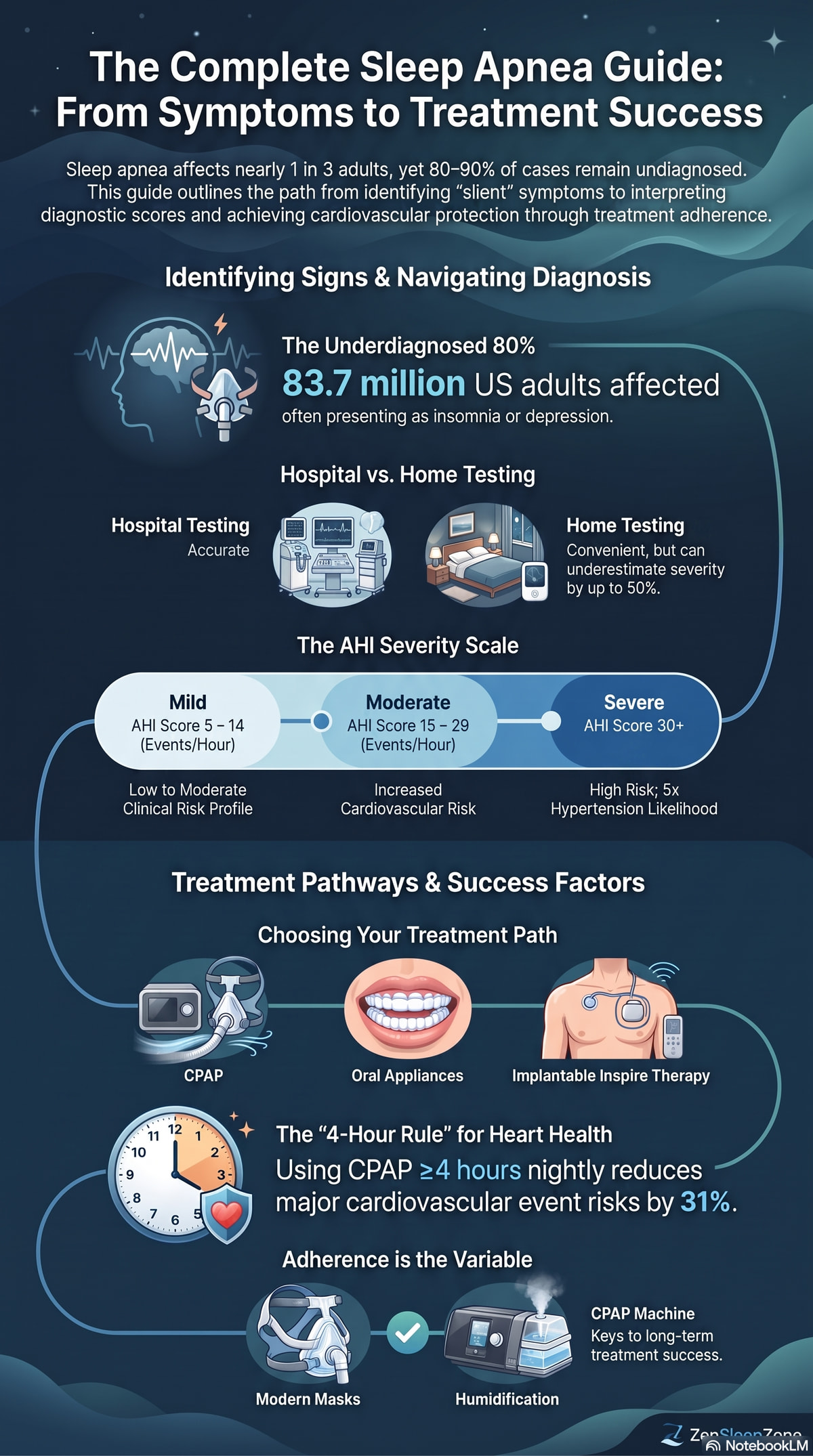
Sleep apnea guide searches often start with a simple fear: “Could this explain why I am exhausted every morning?” Sleep apnea can involve breathing pauses, snoring, gasping, and fragmented sleep, but symptoms do not tell you the full story. Use the interactive tool below to identify the pattern your answers suggest and see what diagnostic step makes sense next.
This interactive assessment is educational and does not diagnose sleep apnea or determine its severity. A qualified clinician and, when appropriate, a sleep study are needed for diagnosis and treatment decisions.
Quick Answer
A sleep apnea assessment can compare breathing pauses, snoring, gasping, daytime sleepiness, morning symptoms, body-size context, age, health conditions, and previous sleep-study results to identify a pattern that may warrant further evaluation.
Tap each answer card to move through the nine-step assessment. Your final profile shows the pattern across breathing events, nighttime disruption, daytime impact, health context, and evaluation priority. Use that profile as a conversation starter with a clinician, not as a diagnosis.
Nighttime Clue: Loud Snoring
Loud snoring is one of the most familiar sleep apnea symptoms, but it is not enough by itself to diagnose obstructive sleep apnea. The tool asks how often it happens because frequency adds context. Snoring can also occur without apnea, while some people with sleep apnea do not snore loudly.
Breathing Pattern: Witnessed Pauses
A partner who notices breathing pauses can provide information you may never know about yourself. Repeated witnessed pauses are more concerning than ordinary snoring because they suggest disrupted airflow during sleep. The assessment uses this answer to separate a simple snoring pattern from one that deserves closer sleep-breathing evaluation.
Why This Tool Matters
Sleep apnea happens during sleep, so the person experiencing it may not recognise repeated breathing changes, while a partner may notice them first.
That gap can leave people exhausted, confused about their symptoms, or unsure whether ordinary snoring has become something more important.
This assessment turns several nighttime clues into a clearer pattern that can help you decide whether a clinical sleep evaluation is worth discussing.
Nighttime Clue: Gasping or Choking
Waking with gasping, choking, or shortness of breath can indicate that sleep has been repeatedly disturbed by breathing problems. The frequency matters because occasional awakenings have many possible causes. When gasping appears alongside loud snoring or witnessed pauses, the combined pattern is more useful than any single symptom alone.
Daytime Impact: Sleepiness and Fatigue
Excessive daytime sleepiness can be one of the most disruptive consequences of fragmented sleep. This question measures how strongly tiredness affects ordinary activities rather than assuming every tired person has apnea. Persistent sleepiness can have many causes, so the result should help frame a clinical conversation rather than replace one.
Morning Signal: Headache, Dry Mouth, or Unrefreshing Sleep
Morning symptoms can reveal what nighttime sleep is failing to provide. Headaches, dry mouth, and waking unrefreshed may accompany sleep-disordered breathing, although they are not specific to apnea. The tool combines these signals with your other answers so one nonspecific symptom does not dominate the final pattern.
Body Context: Weight and Airway Risk
Body size can influence obstructive sleep apnea risk, but it should never be treated as a yes-or-no test. People who are not overweight can still develop sleep apnea. This question adds body context to the profile without allowing it to override breathing symptoms, which helps avoid a common misconception.
Age: Baseline Risk Context
Sleep apnea can occur at any adult age, while risk patterns change across the lifespan. Age therefore provides context rather than a diagnosis. The assessment includes it because a symptom pattern may deserve a different level of attention depending on age and the presence of other risk factors or health conditions.
Health Context: Cardiovascular and Medical Factors
High blood pressure, cardiovascular disease, stroke history, and other significant medical conditions can make sleep-breathing evaluation more important. This input helps the result account for that wider context. Sleep apnea is not only about snoring; repeated breathing disruption can interact with cardiovascular and metabolic health.
What Happens Next: Previous Sleep-Study Results
A previous sleep study changes the question you need to answer. If you have no study, the priority may be determining whether testing is appropriate. If an AHI has already been reported, the focus shifts toward understanding severity, diagnosis, and treatment. The tool keeps those pathways separate instead of treating everyone as undiagnosed.
Sleep Apnea Questions Answered
Get clear answers to common questions about symptoms, diagnosis, AHI, treatment, and what happens when sleep apnea is left untreated.
Read the answers →Complete Sleep Apnea Guide
Go deeper into sleep apnea subtypes, diagnosis, AHI interpretation, treatment choices, cardiovascular effects, and long-term management.
Read the guide →Why the topic matters: An estimated 83.7 million U.S. adults were affected by obstructive sleep apnea in 2024, while global research has estimated 936 million adults aged 30–69 have mild-to-severe OSA. These figures show why persistent breathing-related sleep symptoms deserve more than guesswork. Browse the wider sleep-disorders library when you want to understand related conditions.
Sources
- Sönmez et al., Respiratory Medicine (2025) — estimated U.S. obstructive sleep apnea prevalence and severity distribution. View source
- Benjafield et al., The Lancet Respiratory Medicine (2019) — global prevalence estimates for obstructive sleep apnea. View source
- American Academy of Sleep Medicine — clinical practice guidance on diagnostic testing for adult sleep apnea. View source
- Labarca et al., JAMA (2023) — individual-patient meta-analysis examining CPAP adherence and cardiovascular outcomes in obstructive sleep apnea. View source
Reviewed for evidence and tool alignment: July 2026.
This tool and article provide general educational information only. They cannot diagnose sleep apnea, determine AHI severity, or recommend an individual treatment. Seek appropriate medical evaluation for persistent symptoms, witnessed breathing pauses, significant daytime sleepiness, or concerning health symptoms.