
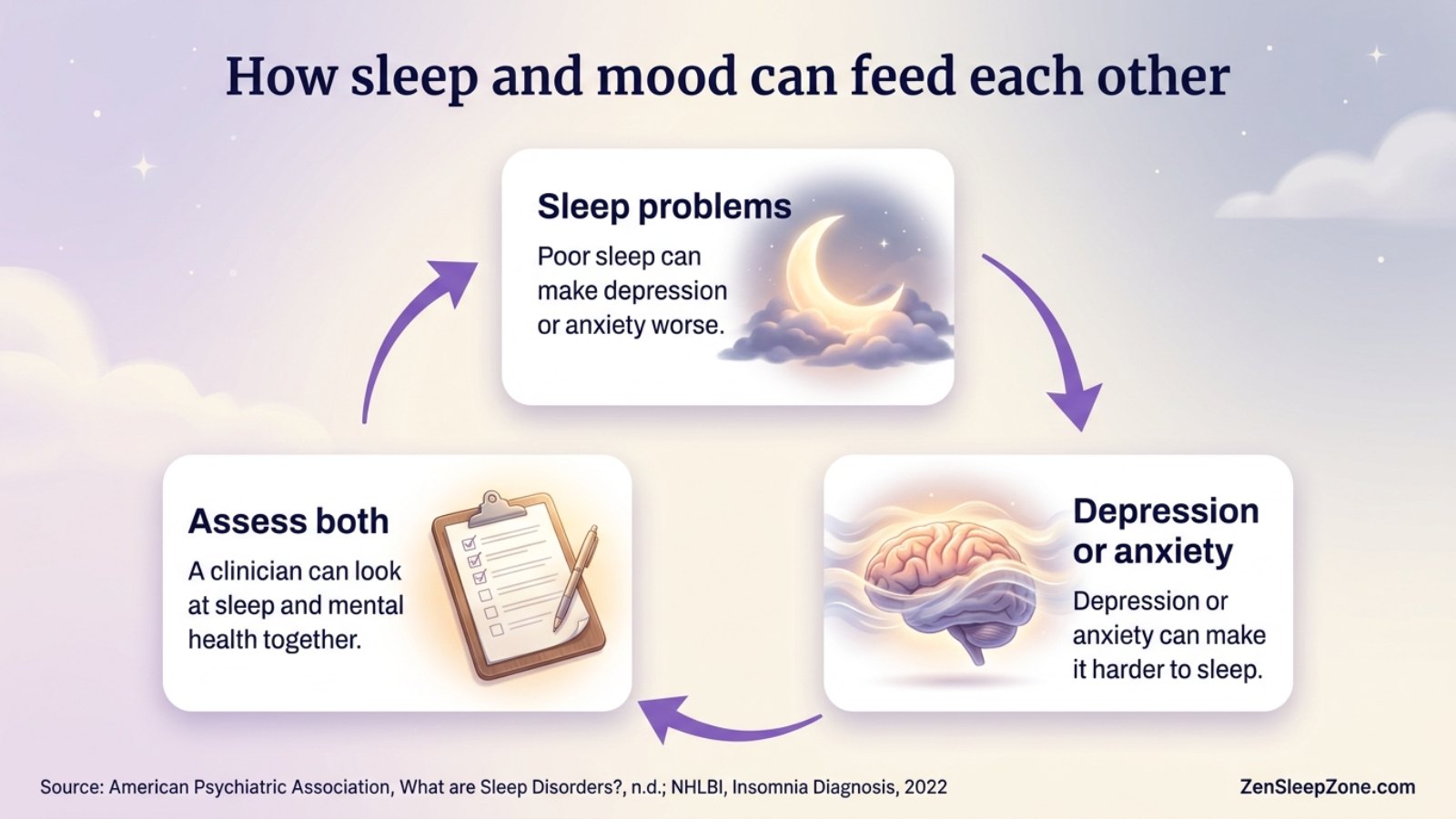
Sleep and mental health can affect each other, including how you feel and function. Sleep problems may worsen anxiety or depression, which can also make sleeping harder. Everyday routines may help, while ongoing problems deserve an assessment of both sleep and mental health. Seek urgent help if you cannot stay safe.
Based on American Psychiatric Association and NHS guidance · Find the sleep pattern that sounds like yours

Many people arrive here worn out and afraid of another bad night. Some feel tired no matter how much they sleep. Others can’t switch off looping thoughts at bedtime.
The American Psychiatric Association describes sleep and mood as a two-way link, and help exists for both sides.
This guide helps you spot your pattern and try one small step. It then compares treatments and shows how to prepare for care. It is part of our mental health guides.
Not sure which part applies to you? The Sleep and Mental Health Compass points you to your starting point in about a minute.
Is this you? Find the line that sounds most like your nights.
- You dread a repeat of the last bad night → one small step for tonight.
- Your thoughts loop before bed → support options worth discussing.
- You feel exhausted even after sleeping → what your pattern might look like.
- You are improving but still have bad nights → how to follow progress and setbacks.
These are points of recognition, not a diagnosis.
This guide explains sleep and mental health for general education. It can’t diagnose you or replace care from a clinician who knows your health.
What does your sleep problem look like?
Sleep problems come in several patterns, and each points to a different next step. Some people can’t fall asleep. Others wake in the night or too early. Some sleep long hours and still feel drained. Naming your pattern is the first useful step.
Pick the line that sounds most like you, then follow the step beside it.
- Trouble falling asleep. Regular trouble falling or staying asleep is called insomnia. If bedtime itself feels frightening, start with the first step for tonight.
- Waking too early. Depression can involve waking too early in the morning. The clock time alone doesn’t show the cause, and a focused guide to waking early with anxiety goes deeper.
- Sleeping too much. Oversleeping can also be part of depression. Note how much you sleep and how you feel, then add it to your appointment notes.
- Tired even after sleeping. Sleep assessment asks how refreshed you feel and how unrested you feel in the day. Hours alone aren’t the whole picture, so check what else could affect your sleep.
- Sleepy in the day. This means feeling likely to fall asleep during the day. Don’t drive when you feel sleepy, and read when to get help.
NHS guidance gives an average of 7 to 9 hours for adults, but needs differ. Treat that range as a rough guide, not a pass-or-fail mark.
Did you know?
Depression can mean sleeping too little or too much. The National Institute of Mental Health lists trouble sleeping, waking too early and oversleeping as symptoms. You can see how often adults report sleep difficulties on the statistics page.
What is a manageable first step tonight?
A manageable first step tonight is one small change that adds no pressure. Keep a familiar bedtime routine and write down one concern you want help with. If coping feels hard, arrange care rather than waiting for a perfect night. Alcohol can lead to poor sleep later in the night.
Your first step tonight
- Keep your usual routine. The NHS suggests going to bed and waking at around the same time each day.
- Write one line. Note the sleep or daytime problem you most want help with.
- Go easy on alcohol. It can lead to poor sleep later in the night.
- Arrange care if coping is hard. Insomnia that makes daily life hard to cope with deserves a clinician’s assessment.
Pick the one that feels easiest. That is enough for tonight. This is general habit advice, not a personal sleep schedule.
Sleep anxiety: when you dread the night itself
Sleep anxiety means fear or stress about falling or staying asleep (Cleveland Clinic). It can turn bedtime into a test you feel you might fail.
Sleep-focused therapy, called CBT-I, includes work on feeling less nervous about not sleeping (NHLBI). Our article on fear and looping thoughts before bed covers this in more depth.
If you are in immediate danger tonight, call your local emergency number. The urgent help routes are listed below.
How do sleep and mental health affect each other?
Sleep and mental health affect each other in both directions. Sleep problems can worsen depression or anxiety, and depression or anxiety can lead to sleep problems. This link doesn’t tell you which came first in your own life. It does mean both deserve attention.
Want the big picture on one page? The sleep and mental health mind map shows how the pieces connect.
How sleep problems can affect mental health
Poor sleep can leave you more anxious or low. That mood can then make the next night harder. This is how sleep problems can affect mental health day to day: as a loop, not a verdict.
Conditions can show up in sleep in different ways. The National Institute of Mental Health lists trouble sleeping, early waking and oversleeping among depression symptoms. It also lists recurring dreams about the event and trouble falling or staying asleep among PTSD symptoms.
These are symptom examples, not a diagnosis. A single nightmare doesn’t establish PTSD. For nightmares linked with PTSD, a sleep medicine position paper recommends imagery rehearsal therapy, which targets the nightmares themselves. You rewrite the nightmare’s story while awake and rehearse the new version (AASM, 2018).
If stress is your main worry, the article on stress and sleep starts there. To see how stress and insomnia feed each other, read how the stress and sleep loop works.
Prefer to listen? This three-minute video from the American Psychiatric Association is a spoken introduction to sleep disorders. It is general background, not proof for the medical points above.
Sleep Disorders / APA — American Psychiatric Association
What else could be affecting your sleep?
Other things can affect your sleep besides stress or low mood. A clinician may ask about your health, your medicines and your use of caffeine or alcohol. They may also check for other sleep problems. Bringing these questions along helps, and you don’t need to self-diagnose.
An assessment looks at new or long-standing health problems, the medicines you take and your caffeine, nicotine, alcohol or drug use (NHLBI, 2022). These are possible contributors, not presumed causes.
A sleep study can look for other problems, such as body-clock disorders, sleep apnea and narcolepsy. Not everyone needs one, and a clinician decides. Our guide to other sleep problems worth assessing explains them. The sleep apnea assessment and support page covers one of them.
Alcohol can lead to poor sleep later in the night. How alcohol affects sleep has its own guide.
If you worry about insomnia medicines, talk with the prescriber about benefits and side effects.
If I sleep badly, it must all be anxiety.
Assessment also considers other sleep problems and medical causes, so anxiety may be only part of the picture.
Depression always means sleeping too much.
Depression can include trouble sleeping, waking too early or oversleeping.
More hours of sleep tell me if I’m improving.
Assessment also asks how refreshed you feel and how unrested you feel in the day.
So bring the whole picture to a clinician, not just your sleep total.
At a glance
- Two-way link — Sleep and mood can affect each other.
- Both directions — Depression can involve too little or too much sleep.
- Different support — Routine advice and CBT-I are different kinds of support.
- Location matters — Care access and payment depend on where you live.
- Safety first — Trouble coping or staying safe changes your next step.
Can improving sleep support mental health?
Improving sleep went along with better mood in trials. When sleep improved, symptoms of depression, anxiety and stress also improved on average. These are group averages, not cure rates, and they can’t predict your result. Treating sleep also doesn’t replace a mental-health plan.
A 2021 review pooled trials that tested how sleep problems can affect mental health. They improved sleep, then measured mood (Scott et al., 2021).
| Symptom | Change (research units) | Comparisons | People |
|---|---|---|---|
| Depression | −0.63 | 61 | 7,868 |
| Anxiety | −0.51 | 35 | 5,819 |
| Stress | −0.42 | 6 | 419 |
The numbers are a research measure of the gap between groups, not percentages of people helped. A minus sign means symptoms went down. Each outcome has its own trials and people, and follow-up time varied.
Stress has the smallest evidence base, so read it with extra care. Don’t rank the three outcomes against each other.
A US survey asks a different question: how many adults report sleep trouble. In 2024, about 3 in 10 adults (30.5%) slept under 7 hours on average (Ng et al., 2026). About 15 in 100 (15.4%) had trouble falling asleep most days. About 18 in 100 (18.1%) had trouble staying asleep.
These answers are self-reported and can overlap. They say nothing about causes and are not diagnoses. They cover US adults only. Every figure, with who it applies to, sits on the statistics page.
The takeaway: better sleep is a worthwhile goal beside mental-health care, not a promise.
Which treatment options are worth discussing?
Treatment options for sleep and mood problems include everyday habits, sleep-focused therapy, mental-health treatment and medicine discussions. Each answers a different question. Habit advice alone is different from CBT-I, and the 2026 combination guidance covers one specific comparison. Your needs and preferences shape the plan.
Start with habits. For chronic insomnia, a 2025 guideline suggests against sleep habit education as a stand-alone treatment. It calls that a weak recommendation with low-confidence evidence (VA/DOD, 2025). Habits can still be a starting point.
The same guideline recommends CBT-I. It calls this a strong recommendation, with moderate confidence in the evidence. Strength and certainty are different things.
If full CBT-I is hard to reach, there are shorter routes to sleep and mental health support. A 2021 guideline also suggests brief behavioral therapy, a shorter course built on the same methods, as a conditional option (AASM, 2021).
In England, NICE recommends Sleepio, a digital self-help program based on CBT-I, in primary care for people who would otherwise be offered sleep habit advice or sleeping pills (NICE, 2022). If you are pregnant or have other health conditions, NICE asks for a medical check first.
A 2026 guideline asks a narrower question. Should treatment start with CBT-I plus an insomnia medicine at the same time? It conditionally favors that over medicine alone. It conditionally suggests against it over CBT-I alone (Buysse et al., 2026).
Both rest on low-certainty evidence, and your preferences may lead to a different choice. The guideline names no medicine or dose.
An older guideline does compare medicines. It weakly suggests some prescription options, such as suvorexant or low-dose doxepin for waking in the night. It weakly suggests against others often used for sleep, including trazodone, diphenhydramine (a common antihistamine sleep aid) and melatonin (AASM, 2017). These are weak recommendations, so a prescriber weighs them against your mood treatment, other medicines and safety.
| Option | Purpose | Evidence or guidance | Access | Main limit |
|---|---|---|---|---|
| Everyday habits | Build a steady routine | NHS advises similar bed and wake times | You can start on your own | Weak recommendation against habits alone for chronic insomnia |
| CBT-I | Sleep-focused talking and behavior therapy | Strong recommendation, moderate confidence | Doctor, nurse or therapist; in person, by phone or online | Programs vary; a provider checks suitability |
| Brief or digital CBT-I | Shorter or self-guided versions of the same methods | Brief therapy: conditional (AASM); Sleepio: recommended by NICE in primary care | Ask your doctor; some services offer an app | Less evidence than full CBT-I with a clinician |
| Depression-focused therapy | Change unhelpful thoughts and behaviors in depression | Depression treatment typically involves therapy, medicine or both | Ask a doctor or mental-health provider | Different from CBT-I; sleep treatment doesn’t replace it |
| Medicine or combination talks | Weigh medicine with or without CBT-I | Conditional recommendations, low certainty | A prescriber | Benefits and side effects belong in that talk |
Two common beliefs deserve a fix. If ordinary sleep tips failed, CBT-I isn’t the same thing. It targets sleep-specific thoughts and behavior. And taking something for sleep doesn’t mean your mental-health care is covered, since that plan has its own options.
Our guide to what CBT-I involves covers the sessions. The page on persistent difficulty sleeping adds assessment detail.
Sleep-focused therapy (CBT-I)
CBT-I is sleep-focused talking and behavior therapy. The 2025 VA/DOD guideline recommends it for chronic insomnia, a strong recommendation with moderate-confidence evidence. It includes work on sleep-related worry and behavior. A qualified provider can tell you whether it fits.
Programs vary in length, so ask your provider what to expect. A finished course isn’t a guarantee of symptom-free sleep.
Two questions to take with you: which comparison does this advice answer, and what is my goal for treatment?
When should you get professional or urgent help?
Get assessed by a clinician when sleep problems make daily life hard to cope with. Get urgent help right away if you can’t keep yourself or someone else safe. Extreme mood changes also deserve an assessment, including needing very little sleep while feeling unusually high or irritable.
| Situation | What to do |
|---|---|
| You can’t keep yourself or someone else safe | In the UK, call 999 or go to A&E now (NHS, 2023). Elsewhere, use your local emergency service. |
| Suicidal crisis or emotional distress | In the US, call or text 988. For life-threatening danger, call 911 or go to an emergency room (NIMH, 2026). |
| Current acute mental-health symptoms | Get assessed first. The VA/DOD guideline says to delay CBT-I or brief behavioral therapy until then. If anyone is in immediate danger, use the rows above. |
| Sleep problems make daily life hard to cope with, or your mood changes feel extreme | See a GP or clinician for an assessment. Ask a mental-health specialist about extreme mood changes. |
| You feel sleepy while driving | Don’t drive while sleepy. |
If one row fits, use that route first.
Needing very little sleep is different from being unable to sleep
A decreased need for sleep can come with a manic episode. The National Institute of Mental Health describes feeling very high, elated or extremely irritable and being more active than usual. Sleep length alone doesn’t diagnose bipolar disorder.
If this sounds like you or someone close, ask a GP or mental-health specialist for an assessment (NHS). If you take bipolar medicine, don’t stop unless a doctor tells you to.
When a sleep program may need changes
Programs such as CBT-I sometimes need adapting or delaying. The 2025 VA/DOD guideline lists these situations. The list is for your clinician to review. It isn’t a way to rule yourself in or out.
- Medically unstable. Delay, with clinician review.
- Active alcohol or drug use disorder. Delay, with clinician review.
- Excessive daytime sleepiness. Adapt or delay, with clinician review.
- Nighttime fall risk or inability to move in and out of bed. Adapt, with clinician review.
- Exposure-based PTSD treatment under way. Delay, and coordinate care.
- Uncontrolled seizure disorder. Delay, with clinician review.
- Bipolar disorder. Adapt, with clinician review.
- Pregnancy or the postpartum period. A clinician reviews before any protocol.
Now you can match your situation to a route. If you’re unsure, start with the care routes for your country.
How can you access care where you live?
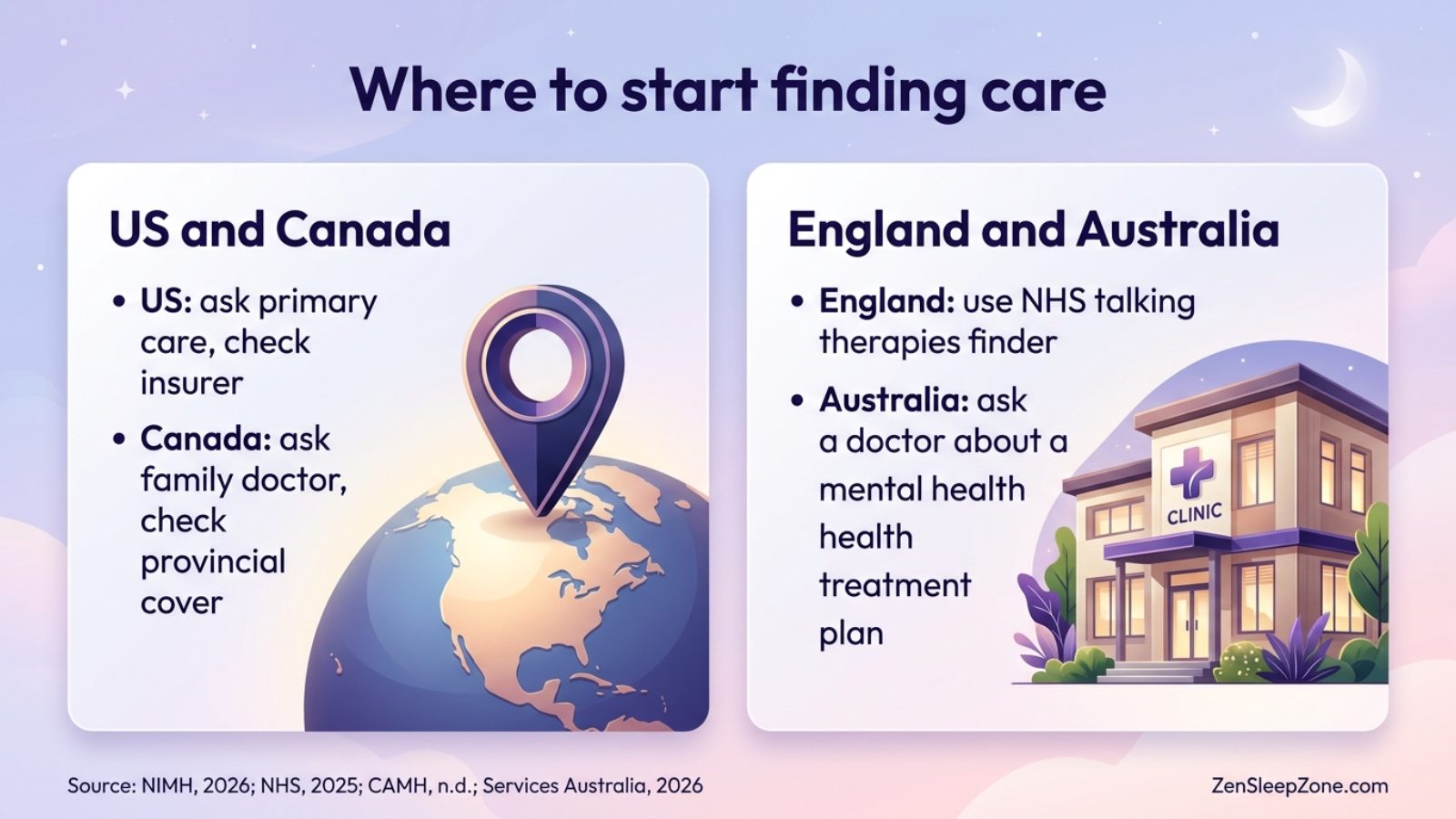
Start with the route for your country. In the US, primary care can screen and refer you, and your insurer can say which local providers are covered. In England, you can self-refer to NHS talking therapies. In Canada, begin with a family doctor. In Australia, a doctor can create a treatment plan.
| Country | Where to start | Cost questions | Limits |
|---|---|---|---|
| US | Primary care can screen and refer (NIMH) | Ask your insurer which local providers are covered | Not a universal payment guarantee |
| England and UK | Adults in England can self-refer through the NHS talking therapies finder | NHS CBT can be free; a UK CBT register lists private providers | Local rules apply. Ask specifically about CBT-I |
| Canada | Ask a family doctor to recommend a therapist | Provincial plans cover psychotherapy from a psychiatrist; some therapists offer a sliding scale | Varies by province and provider; free private therapy isn’t guaranteed |
| Australia | A doctor can create a mental health treatment plan with referral arrangements | Medicare may cover only some of the cost; some video sessions may be claimable (Services Australia, 2026) | Eligibility and clinical need decide; confirm fees first |
CBT-I can be delivered by a doctor, nurse or therapist, in person, by phone or online. General CBT assessment can also happen in person, online or by phone. Access and length vary by program.
Before you book, ask the provider what experience they have with your concerns. Ask whether they accept your insurance and what treatment will cost. Ask explicitly whether they offer sleep-focused treatment.
Have a specific access or medicine question? The sleep and mental health questions page gives short answers with more depth.
What should you bring to your appointment?
Bring notes on your sleep, your daytime difficulties and your medicines. A sleep diary can make the discussion more specific, and rough estimates are fine. Add questions about the provider’s experience, insurance and cost. Needed or urgent care shouldn’t wait for a finished diary.
A sleep diary records when you go to sleep, wake up and nap. It also records how sleepy you feel, your caffeine or alcohol, and exercise. NHLBI suggests keeping one for a week or two before you go, when that helps.
Your clinician may also use short questionnaires. The Insomnia Severity Index asks seven questions about the last two weeks and is scored from 0 to 28; a score of 15 or more counts as clinical insomnia (Penn Medicine). Mood questionnaires are also common in primary care. Filling in the same one again later shows whether your sleep and mental health treatment is helping. A score opens the conversation; it is not a diagnosis.
Here is a hypothetical example. A reader can describe an irregular night but mainly wants help with exhaustion at work. They prepare like this:
- Keep a short diary. They note sleep, naps and how sleepy they feel.
- List medicines and health problems. A clinician may ask about both.
- Write the daytime effect. They describe how tiredness affects work.
- Add questions. They ask which assessment and service fit, and about cost.
You can now walk in with concise notes instead of trying to remember everything.
How can you follow progress and handle setbacks?
Progress means moving toward your own goals, not just counting hours. In therapy, goals are agreed with your provider and reviewed over time. Notice whether you feel more refreshed and how unrested you feel in the day. Slow progress with some bad nights is still worth telling your provider about.
Questions that help you review:
- What would better daily functioning look like for me?
- Do I feel more refreshed than before?
- How unrested do I feel during the day?
- What is still not working?
A rough night after some progress
You may have felt better for a while and then had a rough night. A rough night after some progress is worth noting. Keep using the skills you’ve learned, as the NHS advises after CBT. Then tell your provider what is still hard and review your goals together. Another approach or provider may be considered.
If you already take a treatment, don’t stop it without talking to your provider. For short answers on medicines, supporters and next steps, try the sleep and mental health answers page. You can now describe your progress in your own terms and ask for a review when you need one.
Key takeaways
- Remember — Sleep and mood can feed each other, and help can address both sides.
- Do — Pick one small routine step and write down the sleep and daytime problems you want help with.
- If it continues — Ask a clinician for an assessment when coping is hard, and use urgent help if you can’t stay safe.
Pick the next step that fits your situation
The Sleep and Mental Health Compass matches your situation to a starting point. More in our mental health guides.
Find your starting point →Sleep and mental health questions
How long does CBT-I usually take?
CBT-I is usually described as a 6- to 8-week treatment plan, according to NHLBI patient guidance. Programs differ, so your provider may set a different length. Finishing a course is not a deadline for symptom-free sleep. That range describes the plan, not how fast you will feel better.
Treatment length depends on the program and the provider. Ask how many sessions are planned, what each one covers and how progress will be reviewed. Our guide to how CBT-I sessions work covers them in more detail.
Can I get sleep-focused therapy online?
CBT-I can be delivered online or by telephone as well as in person, by a doctor, nurse or therapist. Whether you can get it depends on the provider, your location and what your plan covers. Self-guided digital programs exist too: in England, NICE recommends the Sleepio program in primary care. Check suitability with a clinician first.
In Australia, telehealth video sessions may be claimable under Medicare, but fees can exceed what Medicare covers. Elsewhere, ask the provider about online options and cost before you book. The care routes for each country show where to start.
How much sleep do adults need?
Adults need an average of 7 to 9 hours of sleep a night, according to NHS guidance. Individual needs differ, so this range is not a pass-or-fail mark. How refreshed you feel and how you function in the day also matter when sleep is assessed.
Hours alone don’t tell the whole story. Someone can sleep within that range and still feel unrested. The section on what your sleep problem looks like can help you find the words.
Can depression cause both insomnia and oversleeping?
Depression can include difficulty sleeping, waking too early in the morning or oversleeping. So yes, both patterns can appear in depression, though sleep symptoms alone don’t determine a diagnosis. NIMH lists these sleep changes among depression symptoms. A clinician can look at the full picture.
Whether you sleep too little or too much, both are worth describing to a clinician. Treating sleep doesn’t replace a depression plan, which typically involves psychotherapy, medication or both. The treatment options worth discussing section shows how these pieces fit together.
How long should I keep a sleep diary before an appointment?
A sleep diary for 1 to 2 weeks before your appointment is what NHLBI suggests, when it is helpful. Rough estimates are fine. Start with whatever you can record, such as bedtime, wake time, naps and how sleepy you feel. Needed or urgent care shouldn’t wait for a finished diary.
If your appointment is soon, bring whatever notes you have. If you can’t keep yourself or someone else safe, use urgent help instead of waiting. The Sleep-and-mood visit planner helps organize notes and questions for your appointment.
Can melatonin solve insomnia linked with mental-health difficulties?
Melatonin is not a proven insomnia treatment: NHLBI says research has not shown it to be effective. That finding is about insomnia, and it does not cover every body-clock problem. Mental-health difficulties have their own treatment options, typically therapy, medicine or both.
Sleep treatment and mental-health treatment are separate tracks. Treating sleep doesn’t replace a plan for anxiety or depression, and the plan should fit your needs, preferences and medical situation. The treatment options section shows how the pieces compare.
Sources
- Buysse et al., Journal of Clinical Sleep Medicine, 2026 (DOI: 10.1007/s44470-025-00038-8). Supports: the conditional recommendations on starting CBT-I plus medicine, compared with medicine alone or CBT-I alone.
- VA/DOD, Clinical Practice Guideline for Chronic Insomnia Disorder and Obstructive Sleep Apnea, 2025. Supports: CBT-I as a strong recommendation, the weak recommendation against sleep habit education alone, and the list of situations needing adaptation or delay.
- Scott et al., Sleep Medicine Reviews, 2021 (DOI: 10.1016/j.smrv.2021.101556). Supports: the effects on depression, anxiety and stress when sleep improved in trials.
- American Psychiatric Association, What are Sleep Disorders?, n.d. Supports: the two-way link between sleep problems and depression or anxiety.
- NHS, Every Mind Matters: Sleep problems, n.d. Supports: regular bed and wake times and the effect of alcohol on sleep.
- NHLBI, Insomnia Treatment, 2022. Supports: what CBT-I includes, who delivers it, the 6- to 8-week plan, melatonin research and talking to a prescriber about medicines.
- NHLBI, Insomnia Diagnosis, 2022. Supports: what an assessment considers, sleep studies, how refreshed you feel and sleep diaries.
- NIMH, Depression, n.d. Supports: sleep symptoms in depression, depression treatment options and treatment planning.
- NIMH, Bipolar Disorder, n.d. Supports: decreased need for sleep with a manic episode.
- NIMH, Post-Traumatic Stress Disorder, n.d. Supports: recurring dreams and sleep difficulty in PTSD.
- NHS, Insomnia, 2024. Supports: the 7 to 9 hour average, seeking help when coping is hard and not driving when sleepy.
- NHS, Bipolar disorder, 2024. Supports: seeing a GP about extreme mood changes and not stopping bipolar medicine without a doctor’s advice.
- NIMH, Help for Mental Illnesses, 2026. Supports: US crisis routes, primary care screening, insurer and provider questions, and not stopping treatment without talking to your provider.
- NHS, Where to get urgent help for mental health, 2023. Supports: UK urgent help when safety is at risk.
- NHS, Cognitive behavioural therapy (CBT), 2025. Supports: free NHS CBT, the UK CBT register, assessment formats and keeping up learned skills.
- Services Australia, Mental health care and Medicare, 2026. Supports: treatment plans, referral arrangements, Medicare costs and video sessions.
- Ng et al., NCHS Data Brief 559, 2026 (2024 NHIS). Supports: US adult figures for short sleep and trouble falling or staying asleep.
- NHS, Find NHS talking therapies for anxiety and depression, 2025. Supports: self-referral for adults in England.
- CAMH, Psychotherapy, n.d. Supports: Canadian routes, provincial coverage, sliding scales and reviewing therapy goals.
- Cleveland Clinic, Sleep Anxiety, 2024. Supports: the meaning of sleep anxiety.
- AASM, Behavioral and psychological treatments for chronic insomnia disorder in adults, Journal of Clinical Sleep Medicine, 2021. Supports: brief behavioral therapy as a conditional option.
- NICE, Sleepio to treat insomnia and insomnia symptoms (MTG70), 2022. Supports: Sleepio as a digital CBT-I option in primary care and the medical check first.
- AASM, Position paper for the treatment of nightmare disorder in adults, Journal of Clinical Sleep Medicine, 2018. Supports: imagery rehearsal therapy for PTSD-associated nightmares.
- AASM, Clinical practice guideline for the pharmacologic treatment of chronic insomnia in adults, Journal of Clinical Sleep Medicine, 2017. Supports: weak recommendations for and against specific sleep medicines.
- Penn Medicine Behavioral Sleep Medicine, Insomnia Severity Index (ISI), n.d. Supports: the seven questions, the 0 to 28 score and the clinical range.
Sources checked · Next review
How we made this guide: researched from the sources above, drafted with AI assistance and edited by Aamir Bashir, Founder & Editor. Read our editorial policy.