
The short answer
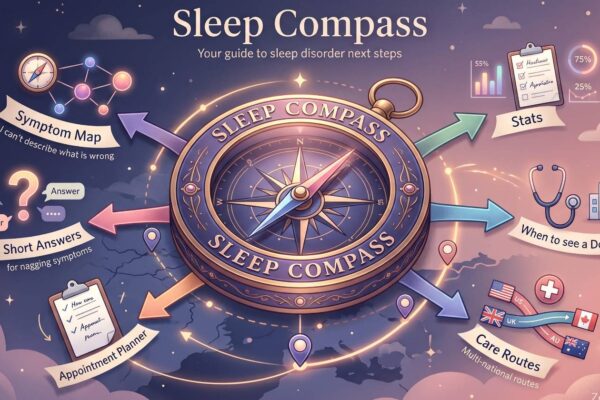
Where to start with sleep and mental health depends on what you need right now. One question sorts it: name the pattern, get one question answered, read the numbers, build appointment notes, see the whole picture or find a service. Pick what you need below and go straight to the page that fits.

Where to Start With Sleep and Mental Health: Pick What You Need
Pick the need that fits right now. One tap opens the page that answers it.
If you can’t keep yourself or someone else safe, or you feel in crisis: call your local emergency number now. In the US, call or text 988. In the UK, call 999 or go to A&E.
Every starting point
If you’re exhausted and unsure what pattern matters
Name your sleep pattern and its daytime cost
Different types of sleep problem need different next steps. Naming yours, from early waking to oversleeping, makes the next conversation specific.
What your sleep problem looks likeThe patterns to compare, what each one looks like in your day, and where it can lead.If you have one treatment or medicine question
Get one clear answer to one question
Some worries need one answer, not a whole guide. These short answers cover CBT-I, medicines, trauma and what is safe to try on your own.
Short answers to one questionPlain answers on CBT-I, medicines, trauma and what is safe to try on your own. Which treatment options to discussRoutine habits, CBT-I and medicine compared, with the strength of each recommendation.If you want the research and its limits
See the numbers, and what they can’t prove
Trials that improved sleep also eased depression and anxiety on average, a 2021 review of randomized trials found. Each outcome here keeps its own sample.
The evidence, figure by figureEach outcome with its own comparisons and people, plus how common sleep problems are. What the research showsHow sleep improvements relate to mood, without turning a group result into a forecast.If you need notes for an appointment
Walk into your appointment with notes ready
A short diary and a few written questions make a visit more specific. NHLBI suggests keeping a sleep diary for 1 to 2 weeks before an appointment.
Your visit plannerAn editable note of your sleep pattern, daytime effect, medicines and questions to ask. What to bring to an appointmentA worked example of notes, medicines and questions that make the visit specific.If you want the whole picture at a glance
See how sleep and mood fit together
Sleep and mental health run in both directions, and one map shows where your own question sits.
The whole picture on one mapBranches for sleep, mood, daytime functioning, contributors and treatment, with the links drawn. How sleep and mental health connectThe two-way explanation in plain words, without assuming which one came first.If you need a service you can reach
Find the care route for your country
Care and payment work differently in the US, England, Canada and Australia. Start with the route for where you live and ask about cost first.
Care routes by countryHow to start in the US, England, Canada and Australia, and what to ask about cost.Quick questions
Where should I start with my sleep and mood concerns?
Start with the need that is loudest today. If you cannot name the pattern, begin there. If you want an answer about treatment, the numbers, appointment notes or a local service, pick that card instead. If you cannot stay safe, use urgent help first.
The full list of signs that need urgent or professional help sits in one place. Check when to get help.
How can I understand the whole picture without reading everything now?
Five things cover most of it: your sleep pattern, your mood and thoughts, how the day feels, possible contributors and the care routes. You do not need every detail to start. Choose the one that matches today, then come back for the rest when it matters.
The mind map draws all five together. See the whole picture.
Do I need to read the whole guide before I pick a page?
No. Where to start with sleep and mental health is a routing question, not a test. Each card opens the one page that answers your need, and you can skip the rest for now. The full article is there when you want the longer explanation.
The article holds the longer version of every route here. Read the full guide.
Sources
Sleep problems can make depression or anxiety worse, and depression or anxiety can make sleeping harder. This does not show which came first for one person.
CBT-I is recommended for chronic insomnia with moderate confidence in the evidence. Sleep hygiene education alone is not recommended as a stand-alone treatment.
Trials that improved sleep also found better depression, anxiety and stress symptoms on average. Those are group results, not a forecast for one person.
A sleep assessment asks how refreshed you feel, which medicines you take and whether caffeine or alcohol plays a part. A sleep diary can help prepare for it.
In 2024, 15.4% of US adults had trouble falling asleep most days or every day, and 18.1% had trouble staying asleep. These are self-reported figures, not insomnia diagnoses.
This Compass points you to the right page; it can’t diagnose you or replace care from a clinician who knows your health. Sources checked . Researched from the sources above, drafted with AI assistance and edited by Aamir Bashir, Founder & Editor (editorial policy).