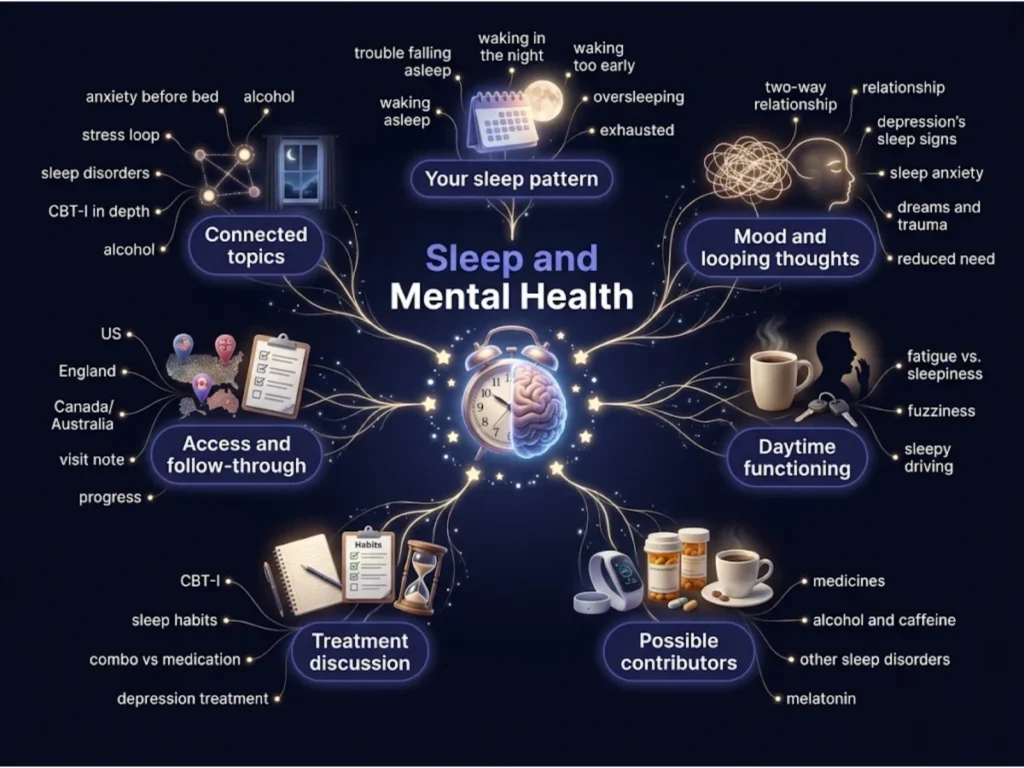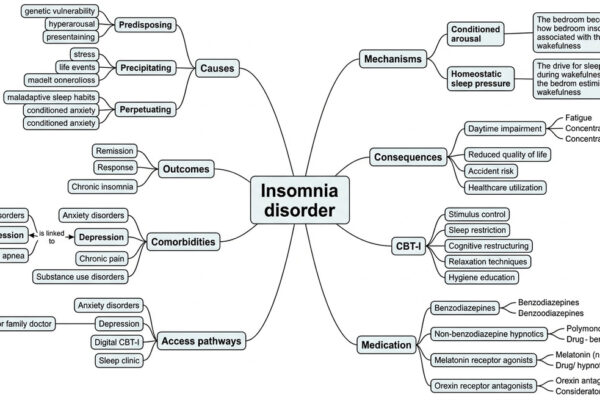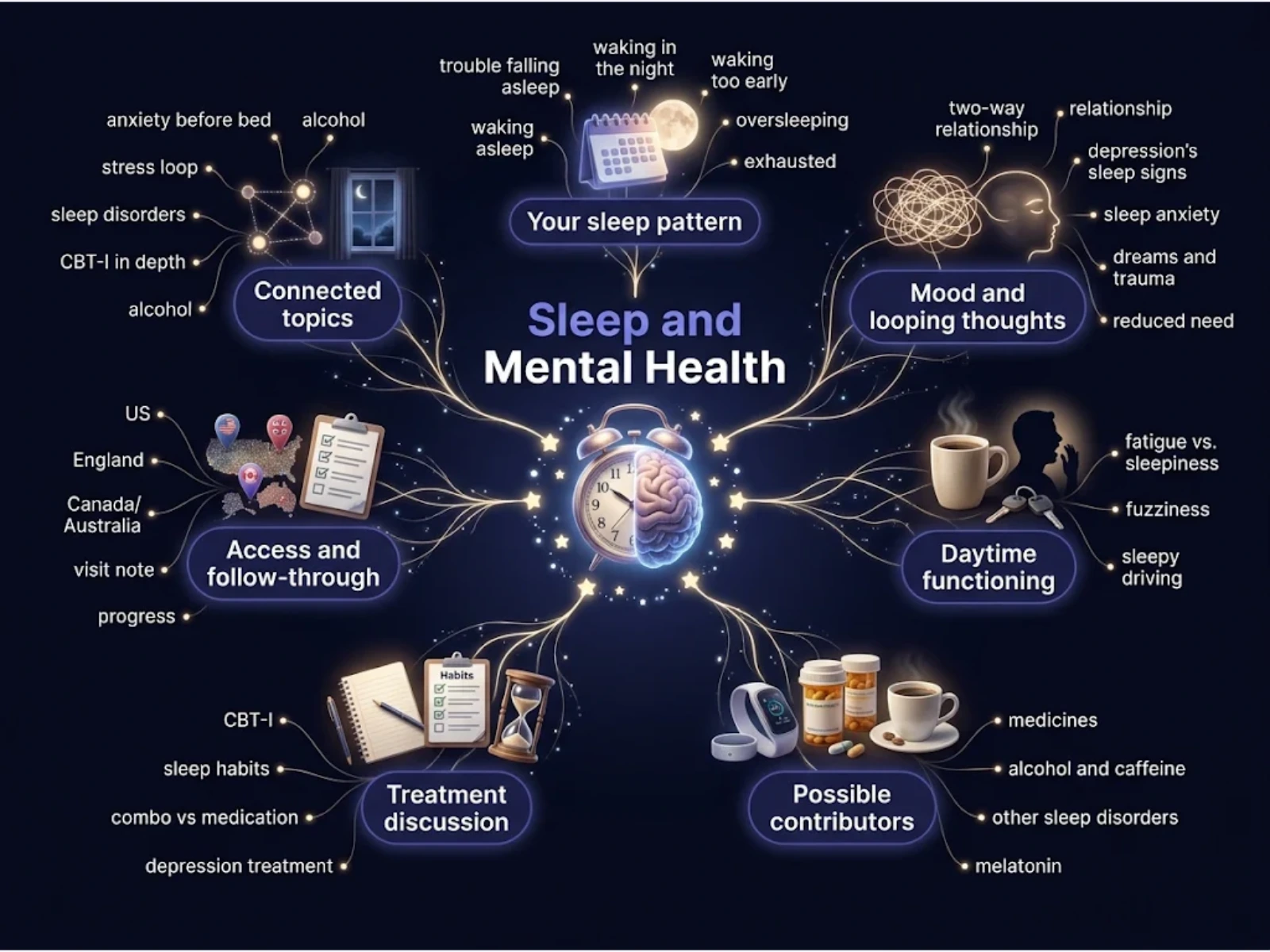

Sleep and mental health affect each other in ways that are easier to see on one map. This page lays out your sleep pattern, mood, daytime functioning, possible contributors, treatment options and where to get help. Open an area, answer “Ask yourself”, try one small step, and add what fits to your plan.
Sleep and mental health mind map: how it all connects
Sleep and mental health
01Your sleep patternThe problem
Most sleep problems start as a pattern you can describe: trouble falling asleep, waking in the night, waking too early or sleeping too long. The same hours mean different things in each pattern. Naming what your nights actually look like is the first step before deciding what to try or ask about.
Key insight: Depression can involve difficulty sleeping, early waking or oversleeping. The pattern is a clue, not a diagnosis.
Ask yourself: Which of these fits my last two weeks best: trouble falling asleep, waking in the night, waking early, or sleeping too long?
Trouble falling asleep
Falling asleep can be hard for many reasons, including worry about the night ahead. US survey data show 15.4% of adults had trouble falling asleep most or every day in the past month. That tells you the pattern is common. It does not name your cause.
Try this: Tonight, write the time you turned off the light and your best guess at when you fell asleep. Keep it for one week. Stop if tracking adds more pressure.
Why a number helps less than a pattern
US survey figures count self-reports, not diagnoses. Your own diary shows what your pattern does week to week, which is more useful in a conversation.
- keeps going because of bedtime worry
Waking in the night
Waking during the night is a different pattern from trouble falling asleep. US data put trouble staying asleep at 18.1% of adults on most or every day in the past month. The same hours can leave you rested or exhausted, depending on what happens after the wake-up.
Try this: Keep the room dim and skip the clock when you wake. Give yourself ten minutes before deciding to get up. Stop if worrying about waking makes it harder to sleep.
Why the clock makes it worse
Watching the minutes pass can add pressure that keeps you awake. Turning the clock away gives your body less to react to.
- is made worse by late alcohol
Waking too early
Waking earlier than you want, with no chance of drifting back, can sit alongside low mood. Depression can include early waking, difficulty falling asleep or oversleeping. The clock time does not establish a cause. The broader pattern does.
Try this: If you wake very early, note the time for three mornings without trying to change it. Share the pattern with a clinician if low mood is also present.
What “early” means
Early waking usually means waking well before your alarm and not falling back asleep. The pattern, not the number on the clock, is what assessment looks at.
- sits with depression
Oversleeping and reduced need
Sleeping much longer than usual can accompany depression. Needing very little sleep, with unusually high or irritable mood and more activity, is a different pattern that warrants assessment. Treat the two as separate signs, not one big “too much sleep” problem.
Try this: If your sleep need has dropped sharply and your mood or energy feels unusually high or irritable, tell a GP or mental-health specialist. Do not wait to see if it settles.
Why the two patterns differ
One is sleeping more. The other is sleeping far less with a mood shift. A clinician assesses them differently because the meaning and follow-up differ.
- looks like a different pattern
Exhausted after sleeping
Feeling exhausted after a full night is common and not automatically a sign of a sleep disorder. Assessment asks how refreshed you feel when you wake and how unrested you feel during the day. Hours alone do not tell the whole story.
Try this: For three mornings, rate how refreshed you feel from 1 to 10 within an hour of waking. Bring the ratings to any appointment. Stop if rating adds worry.
One rating, no diagnosis
Your ratings are a conversation starter. They do not replace a clinician’s assessment of your sleep, mood or health.
- shows up as daytime fatigue
Read more: What does your sleep problem look like?
02Mood and looping thoughtsWhy it happens
Sleep and mood feed each other. Sleep problems can worsen depression or anxiety, and those problems can make sleeping harder. Once you can see the loop, the goal stops being “fix the sleep first” and becomes assess both sides together.
Key insight: Sleep problems can worsen depression or anxiety, and those problems can also disrupt sleep. The loop does not tell you which came first.
Ask yourself: Do my hardest thoughts show up mostly at night, or through the whole day as well?
Two-way relationship
Sleep and mood are not a one-way street. Depression or anxiety can disrupt sleep, and poor sleep can worsen mood the next day. That is why a good plan looks at both sides at once instead of treating one as the cause of the other.
Try this: Pick one night this week and write one sentence about your mood that evening and one about your sleep that night. Look for a pattern after a few days.
Why “which came first” rarely helps
Even when one problem started the loop, both ends now feed it. Treatment usually targets both sides rather than waiting for the first cause to be found.
- shows up as early waking
Depression’s sleep signs
Depression can involve difficulty falling asleep, waking very early, or sleeping much longer than usual. Any of these can show up alone or together. They are examples, not a diagnosis, and they are worth bringing to a clinician in your own words.
Try this: Write the two-week pattern of your sleep changes, plus one sentence about your mood across those weeks. Bring the note to a GP or clinician.
Why you don’t need to self-diagnose
Patterns overlap across conditions. A clinician uses the history, timing and impact, not a single symptom, to work out what is happening.
- can include oversleeping
Sleep anxiety and bedtime dread
Fear or stress about falling or staying asleep has a name: sleep anxiety. It can make bedtime feel like a test you might fail, and that pressure can make falling asleep harder. Sleep-focused therapy (CBT-I) includes work on feeling less nervous about not sleeping.
Try this: Before bed, write one sentence about tomorrow’s worry and set it aside. Give yourself permission to feel nervous without fighting it. Stop if this increases distress.
What CBT-I does here
CBT-I is not just sleep hygiene. It targets the specific thoughts and behaviors that keep bedtime feeling risky, with a trained provider.
- is treated by CBT-I
Dreams and trauma
Post-traumatic stress disorder (PTSD) can involve recurring dreams about the event and difficulty falling or staying asleep. These symptoms need context. A single nightmare does not establish PTSD. Trauma-focused assessment is its own conversation.
Try this: If dreams about a difficult event keep waking you, note how often they happen this week. Ask a clinician about trauma-informed assessment rather than self-diagnosing.
Why trauma deserves its own assessment
PTSD treatment often involves specific trauma-focused therapy. Sleep advice alone does not replace that assessment.
- interrupts staying asleep
Reduced need vs. can’t sleep
Needing very little sleep, with unusually high or irritable mood and more activity, looks different from simply struggling to fall asleep. Extreme mood changes are a reason to see a GP or mental-health specialist. Duration alone does not diagnose bipolar disorder.
Try this: If your sleep need has dropped sharply and your mood or energy feels unusually high or irritable, see a GP or mental-health specialist soon. Do not wait to see if it settles.
What a clinician looks at
The pattern of the mood shift, its duration and how it affects sleep and daily life, not just hours slept.
- differs from oversleeping
Read more: How do sleep and mental health affect each other?
03Daytime functioningWhy it happens
Sleep shows up in the day: fatigue, foggy thinking, memory slips or sleepiness at the wheel. Daytime life is also part of assessment, not only the hours you log at night. Naming what the day looks like makes a care conversation more specific.
Key insight: How refreshed you feel when you wake and how unrested you feel during the day are part of sleep assessment, not extras.
Ask yourself: What in my day has changed most: energy, focus, mood, patience or safety behind the wheel?
Fatigue vs. sleepiness
Feeling exhausted and feeling sleepy are not the same. Fatigue is low energy; sleepiness is being likely to fall asleep in the day. Assessment asks about both, because each points to different questions and next steps.
Try this: For three days, note one time you felt low on energy and one time you could barely stay awake. Bring both lists to a clinician.
Why the difference matters
Sleepiness raises safety questions, especially on the road. Fatigue more often links to mood and health, so the discussion branches early.
- follows unrefreshing nights
Fuzziness and memory
Broken nights can leave the day foggy, with memory slips that worry you more than they should. Many people describe a fuzzy brain and a noticeably affected memory during the day. The pattern is common and worth naming in a care conversation.
Try this: For one week, keep a small note of one memory slip a day. Stop if tracking becomes a source of worry.
Not a sign of decline on its own
Daytime fogginess from lost sleep is usually reversible. Persistent or worsening changes deserve a check-up.
- overlaps with low mood
Sleepy behind the wheel
Feeling sleepy while driving is a safety signal, not just a comfort issue. Do not drive when you feel sleepy, even for a short trip. This is not a “try a small step” topic. It is a “change the plan now” topic.
Try this: If you feel sleepy before a drive, stop and rest or ask someone else to drive. Do not start a trip while sleepy.
Why this is a hard stop
Sleepy driving is a safety risk independent of mood or cause. The next step is to change the plan today, not to wait for a diagnosis.
- can point to a sleep disorder
Read more: At a glance: the whole picture
04Possible contributorsYour options
Sleep is affected by more than mood: medicines, health problems, caffeine, alcohol and other sleep disorders all play a part. Assessment asks about each, not to blame you, but to rule possible causes of sleep problems in or out before treatment choices are made.
Key insight: Assessment considers medicines, health problems and caffeine or alcohol use. These are possible contributors, not presumed causes.
Ask yourself: What medicines, drinks or health issues have changed in the months since my sleep shifted?
Medicines and health problems
Some medicines and health conditions can change sleep. A prescriber can review what you take, including timing, and discuss insomnia medicine benefits and side effects. Do not stop a medicine on your own. Changes go through the prescriber.
Try this: Write down every medicine, supplement and dose you take, with the times. Bring the list to your next appointment. Do not change any dose yourself.
What to ask your prescriber
Ask whether the timing, dose or an alternative could affect sleep. Keep this as a discussion, not a self-directed change.
- ask about a specific medicine
- goes into your visit note
Alcohol and caffeine
Alcohol can lead to poor sleep later in the night, even if it makes falling asleep easier at first. Caffeine can also affect sleep, and the effect lasts longer than many people expect. Assessment asks about both because cutting back is often a small, testable step.
Try this: For one week, note the time of your last caffeine and any alcohol, and how you slept. One week is enough to see a pattern; you don’t need to change anything first.
Why “nightcap” backfires
Alcohol can shorten the time to sleep but often fragments the second half of the night.
- wakes you later in the night
Other sleep disorders
A sleep study can look for other sleep problems, including sleep apnea, body-clock disorders and narcolepsy. Testing depends on your clinical assessment; it is not needed for every sleep complaint. Ask whether an assessment fits your pattern.
Try this: If snoring, gasping or heavy daytime sleepiness stand out, mention them at your appointment. Ask whether a sleep study is worth considering.
What a sleep study looks for
Breathing pauses, unusual sleep timing and other patterns that standard sleep advice does not address.
- can cause daytime sleepiness
Melatonin and quick fixes
Research has not established melatonin as an effective insomnia treatment. That does not mean it is dangerous. It means the evidence is not there for the insomnia claim. Discuss any supplement with a clinician, especially alongside other medicines.
Try this: Before buying a supplement for sleep, write the specific problem you hope it solves. Bring that note to a clinician if the problem is ongoing.
What the evidence does and doesn’t say
The claim that melatonin treats insomnia is not supported by established research. Other circadian uses are a separate question for a clinician.
- sleep is not the whole plan
Read more: What else could be affecting your sleep?
05Treatment discussionYour options
Sleep habits, sleep-focused CBT-I, depression-focused treatment and medication are different kinds of support. Current guidelines make specific, conditional recommendations about CBT-I and medication for chronic insomnia. The right plan depends on the pattern, your preferences and your health.
Key insight: CBT-I is strongly recommended for chronic insomnia, while sleep-habit education alone is a weak option by itself.
Ask yourself: If a clinician asked what I most want to change about my sleep, could I answer in one sentence?
CBT-I
Sleep-focused CBT-I is a structured talking and behavior treatment for insomnia. It includes work on feeling less nervous about not sleeping, along with other components. NHLBI describes a 6- to 8-week treatment plan. Programs vary, and a course is not a deadline.
Try this: Ask your clinician whether a CBT-I program is available locally, by phone or online. If yes, ask what it covers and how long it runs.
What CBT-I is not
It is not the same as general sleep-habit advice. It targets sleep-related thoughts and behavior with a trained provider.
- targets bedtime worry
- see the trial numbers
Sleep habits alone
Everyday sleep habits are a reasonable starting point, but habit education by itself is a weak option for chronic insomnia. If habits have not helped after a few weeks, ask about a sleep-focused treatment rather than repeating the same advice.
Try this: If you have tried sleep-habit advice for two weeks with no change, write down what you tried and ask a clinician about a sleep-focused treatment.
Why habits alone may not be enough
Habit education is not the same as treating sleep-related worry or the specific behaviors that keep insomnia going.
- leads to a CBT-I question
CBT-I plus medication vs medication alone
A 2026 guideline conditionally favors starting CBT-I plus insomnia medication over medication alone. The certainty of evidence is low, and the recommendation is conditional. It does not name a medication, dose or plan. Those come from your prescriber.
Try this: If medication has been suggested, ask your prescriber whether adding CBT-I is an option and what would make it a better or worse fit for you.
Why “conditional” matters
Conditional means the guideline expects some people to reasonably prefer a different path. It is a starting point for the conversation, not a rule.
- compare with CBT-I alone
CBT-I plus medication vs CBT-I alone
The same guideline conditionally suggests against starting CBT-I plus medication over CBT-I alone for chronic insomnia. This is not a stopping instruction. If you are already on a plan, changes go through the prescriber. Preferences may point either way.
Try this: Ask your clinician how the two paths might differ for you and what a review point would look like. Bring specific worries to that conversation.
Why the guideline is split
The two recommendations compare different pairs. Which one applies depends on what is being compared and your starting point.
- compare with medication alone
Depression-focused treatment
Depression treatment typically involves psychotherapy, medication or both, chosen with a clinician. Treating sleep does not replace an individualized mental-health plan, and vice versa. A shared plan usually addresses both sides together.
Try this: Write one sentence about your mood and one about your sleep for a week. Bring both to a mental-health appointment as a starting point.
Two plans, one person
Sleep-focused and depression-focused care can run side by side. Ask each clinician how the two plans fit together.
- matches depression’s pattern
06Access and follow-throughWhat to do
Where you live shapes how you reach care. The route and the payment question differ in the US, England, Canada and Australia. Once you are in care, follow-through means tracking goals, raising setbacks and asking for a review when something is not helping.
Key insight: Access is a local, practical question; the country route and the payment question come first.
Ask yourself: What is the first real phone number or website I could contact this week if I decided to seek help?
US route
In the US, primary care can screen for mental-health concerns and refer you on. Ask your insurer which local providers are covered before booking. Coverage and wait times vary; the insurer’s list is the starting point, not a guarantee.
Try this: Open your insurer’s provider search and save two local names this week. Call one to ask about sleep-focused experience and cost.
Questions to ask the insurer
Ask about sleep-focused therapy, in-network providers, session limits and any out-of-pocket cost.
- not sure which route fits
England and UK route
In England, you can refer yourself to NHS talking therapies for anxiety and depression. NHS CBT can be free; for private providers, the NHS links the UK CBT register. Ask specifically whether CBT-I is available in your area.
Try this: Open the NHS talking therapies finder and check whether self-referral is open where you live. Note the form or phone line you would use.
Self-referral is not UK-wide
The self-referral source is England-specific. In other parts of the UK, ask your GP about local routes.
- feeds your visit note
Canada and Australia routes
In Canada, a family doctor can recommend a therapist, and psychotherapy from a psychiatrist is covered by provincial plans; some therapists offer a sliding scale. In Australia, a doctor can create a mental-health treatment plan, and Medicare may cover only part of the cost. Ask about coverage and out-of-pocket fees before booking.
Try this: Ask your family doctor or GP for one therapist recommendation and one question about provincial or Medicare coverage at your next visit.
Sliding scale, plainly
A sliding scale means the fee changes with your income. Ask the provider directly, before the first session, what the range is.
- feeds your visit note
Preparing a visit note
A short note makes an appointment more useful: your sleep pattern, daytime impact, medicines and questions about experience, cost and access. A sleep diary for 1 to 2 weeks can help; do not delay needed or urgent care to finish one.
Try this: Write three lines before your appointment: my worst sleep problem, my worst daytime effect, and one question I want answered.
What a diary captures
Times you go to bed and wake, naps, daytime sleepiness, caffeine or alcohol and exercise. Estimates are fine.
- build the visit note
Reviewing progress
Progress is measured against goals you agreed with your provider, not just hours slept. If treatment is not helping, tell your provider about the remaining difficulties and review the goals. Treatment changes go through that conversation.
Try this: At the end of this month, compare your current week with the first week you noted. Bring one thing that changed and one that hasn’t.
Setbacks are not failure
A bad night after improvement is expected. The question is whether the trend is moving, not whether every night is good.
- review against CBT-I goals
Read more: How can you access care where you live?
07Connected topicsKeep it working
The map ends where the deeper pages begin. Each topic below answers one question this map only points at: bedtime anxiety, the stress loop, other sleep disorders, CBT-I in depth and alcohol. Follow the one that matches what you want next.
Key insight: One map cannot replace a focused page; each connected topic here goes deeper on a single question.
Ask yourself: Which single question would I most want answered next if I only had five minutes?
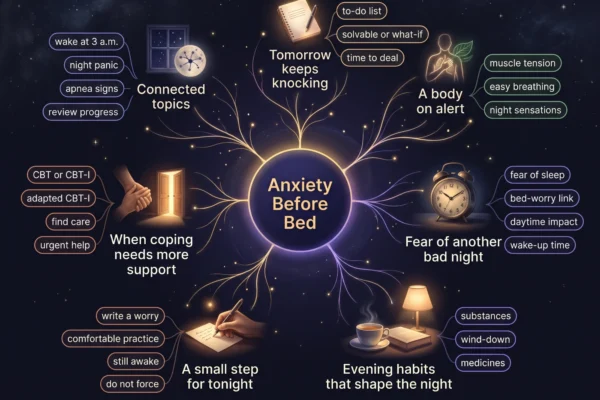
Anxiety before bed
If the hardest part of your night is the hour before bed, with looping thoughts and a racing mind, the anxiety-before-bed article walks through focused ways to wind down without adding pressure.
- read the bedtime-anxiety page
What it covers
Wind-down routines, worry postponement and when to ask for help.
Stress and sleep loop
If stress is the main thread — a busy week that leaves you wired at midnight — the stress-and-sleep-loop article follows the cycle in detail and points to where you can break it.
- read the stress-loop page
What it covers
How the loop starts, what keeps it going and which step to try first.
Sleep disorders guide
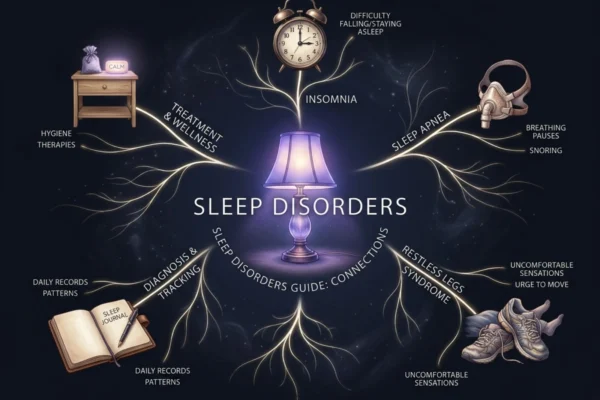
If snoring, gasping or heavy daytime sleepiness stand out, the sleep-disorders guide explains what assessment looks for — sleep apnea, body-clock problems and other conditions worth raising with a clinician.
- read the sleep-disorders guide
What it covers
Common sleep disorders, how testing works and when to ask for a referral.
CBT-I in depth
If treatment is the next question, the CBT-I article walks through the components, what a course looks like and how to ask a provider whether it fits your situation.
- read the CBT-I page
What it covers
The treatment components, typical length, who it suits and how to ask about it.
Alcohol and sleep
If alcohol is part of your evening, the alcohol-and-sleep article explains why it can help you fall asleep and then fragment the night, plus what to ask a clinician.
- read the alcohol-and-sleep page
What it covers
How alcohol affects the second half of the night and what to raise at an appointment.
Read more: Sleep and mental health questions
Sleep and mental health: the connections that matter most
The map in words, for readers who would rather scan a list than tap a node. Each line pairs two sub-topics and states what the evidence supports. Association is not cause, and a shared pattern is not a diagnosis. Use these lines to bring the picture to a clinician in your own words.
- Sleep problems ↔ depression or anxiety — they can worsen each other, but this does not tell you which came first (American Psychiatric Association, n.d.). Bring both sides to the same assessment.
- Depression → difficulty sleeping, early waking or oversleeping — depression can show up as any of these. The pattern is a clue, not a diagnosis.
- Sleep anxiety → CBT-I — CBT-I includes work on feeling less nervous about not sleeping (NHLBI, 2022). That is why it can be a fit when bedtime has become the hard part.
- Alcohol → poor sleep later in the night — alcohol can make falling asleep easier and the second half of the night worse (NHS, n.d.). This is not a safe treatment for insomnia.
- Goals agreed in therapy → progress review — progress is measured against goals you agreed with your provider, not just hours slept. A bad night after improvement is expected; the question is whether the trend is moving.
You can see the whole picture — here’s where to start
If you’re not sure which piece matters most, the Compass routes you by what you’re feeling. The Article explains each branch in full; Answers handles specific questions. More in Mental Health & Sleep.
Find my starting point →Sources
- Buysse et al., Journal of Clinical Sleep Medicine, 2026 (DOI: 10.1007/s44470-025-00038-8). Supports: the two 2026 combination-treatment comparisons in the treatment branch and the “conditional” framing.
- VA/DOD, Clinical Practice Guideline for Chronic Insomnia Disorder and Obstructive Sleep Apnea, 2025. Supports: CBT-I as the recommended treatment and sleep-habit education alone as a weak option.
- Scott et al., Sleep Medicine Reviews, 2021 (DOI: 10.1016/j.smrv.2021.101556). Supports: the trial results behind the “sleep and mood” two-way picture in the Key connections list.
- American Psychiatric Association, What are Sleep Disorders?, n.d.. Supports: the two-way relationship between sleep and depression or anxiety.
- NHS, Every Mind Matters: Sleep problems, n.d.. Supports: routine bedtime habits, the alcohol finding and the “hard to cope” care line.
- NHLBI, Insomnia Treatment, 2022. Supports: CBT-I components, delivery by phone or online, and the guidance on melatonin and insomnia medicines.
- NHLBI, Insomnia Diagnosis, 2022. Supports: sleep diary content, the 1–2 week suggestion, and the daytime-refreshedness assessment question.
- NIMH, Depression, n.d.. Supports: depression’s sleep signs, treatment options and shared decision-making.
- NIMH, Bipolar Disorder, n.d.. Supports: the reduced-need-for-sleep pattern and why it differs from ordinary sleeplessness.
- NIMH, Post-Traumatic Stress Disorder, n.d.. Supports: recurring dreams and sleep difficulty in PTSD.
- NHS, Insomnia, 2024. Supports: the “hard to cope” assessment line, the sleepiness-and-driving warning and the 7–9 hour range.
- NHS, Bipolar disorder, 2024. Supports: extreme mood changes as a reason to see a GP or specialist, and the “do not stop” medicine line.
- NIMH, Help for Mental Illnesses, 2026. Supports: the US primary-care and insurance route, and the “talk to your provider” treatment-change line.
- NHS, Where to get urgent help for mental health, 2023. Supports: the UK 999/A&E line when you cannot keep yourself or someone else safe.
- NHS, Cognitive behavioural therapy (CBT), 2025. Supports: free NHS CBT, the UK CBT register, and continuing learned skills.
- CAMH, Psychotherapy, n.d.. Supports: the Canada route, provincial coverage and the sliding-scale option.
- Services Australia, Mental health care and Medicare, 2026. Supports: the Australia route, the mental-health treatment plan and the Medicare/telehealth cost questions.
- Ng et al., NCHS Data Brief 559, 2026 (2024 NHIS). Supports: the 30.5%, 15.4% and 18.1% figures used in the sleep-pattern branch.
- NHS, Find NHS talking therapies for anxiety and depression, 2025. Supports: the England self-referral route.
- Cleveland Clinic, Sleep Anxiety, 2024. Supports: the plain definition of sleep anxiety.
Sources checked · Next review
How we made this map: built from the sources above, drafted with AI assistance and edited by Aamir Bashir, Founder & Editor. Read our editorial policy.
This page is for information, not medical advice. See a doctor if sleep problems make daily life hard to cope with, or use urgent help if you cannot stay safe.