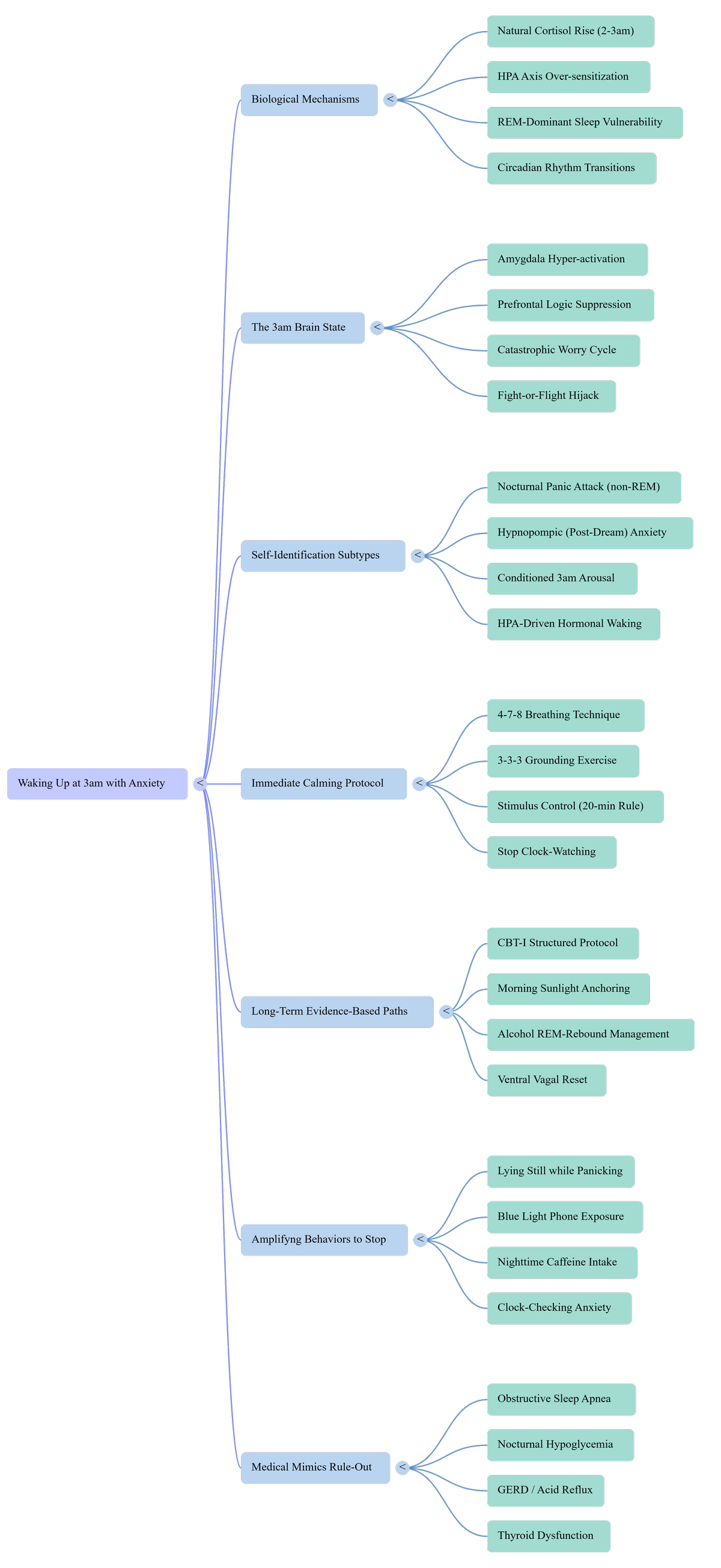

Waking up at 3am with anxiety feels like your body has sounded a false alarm in the dark. Your heart pounds, your mind races, and sleep feels impossible. This interactive mind map breaks down exactly why this happens — from cortisol spikes to brain state shifts — and gives you evidence-based protocols to calm down and return to sleep tonight.
What does the wake up at 3am with anxiety mind map cover?
Wake up at 3am with anxiety is a sleep disruption driven by cortisol spikes, HPA axis over-sensitization, and REM-dominant sleep vulnerability. The mind map covers seven areas: biological mechanisms, the 3am brain state, self-identification subtypes, immediate calming protocols, long-term evidence-based paths, amplifying behaviors to stop, and medical mimics to rule out.
Cortisol naturally rises between 2-3am as part of the circadian rhythm, but chronic stress amplifies this spike and triggers the amygdala’s fight-or-flight response during REM-dominant sleep cycles. Evidence-based interventions including CBT-I, 4-7-8 breathing, and stimulus control protocols can retrain the nervous system and restore sleep maintenance within weeks.
Explore Every Level of the Wake Up at 3am with Anxiety Map
More than one-third of adults wake in the middle of the night at least three times per week. Each area below opens deeper — revealing the exact mechanism behind your 3am awakening and the specific technique that addresses it.
Biological mechanisms drive the 3am anxiety awakening through a convergence of hormonal and neurological factors. Cortisol naturally rises between 2-3am as part of the circadian rhythm, but chronic stress amplifies this spike through HPA axis over-sensitization. REM-dominant sleep vulnerability during this window means the brain is more reactive to stress signals, while circadian rhythm transitions create a natural arousal point that anxiety hijacks (Frontiers in Neuroendocrinology, 2022).
Cortisol begins rising between 2-3am in all humans — anxiety doesn’t create the wake-up, it amplifies a natural biological transition (Frontiers in Neuroendocrinology, 2022).
Natural cortisol rise between 2-3am is a normal circadian event that prepares the body for morning waking. In people with chronic stress or anxiety, this rise becomes earlier and steeper, triggering premature arousal from sleep. Understanding this mechanism removes the fear that something is uniquely wrong with your body (Frontiers in Neuroendocrinology, 2022).
HPA axis over-sensitization occurs when chronic stress keeps the hypothalamic-pituitary-adrenal system in a heightened state of alert. This means even minor stressors trigger disproportionate cortisol release during sleep. The over-sensitized HPA axis is a core driver of recurring 3am awakenings in people with anxiety disorders (Cleveland Clinic, 2025).
REM-dominant sleep vulnerability explains why 3am awakenings feel so intense. During REM sleep, the prefrontal cortex (logical thinking) is suppressed while the amygdala (emotional processing) is hyperactive. Waking from REM during the 3am cortisol spike means you wake directly into an emotionally charged, logically impaired state (Sleep Foundation, 2025).
Circadian rhythm transitions create natural arousal points throughout the night, with the strongest transition occurring around 3am as the body shifts from deep sleep to lighter sleep stages. Anxiety amplifies these transitions by adding stress hormones to an already vulnerable neurological window, turning a normal shift into a full awakening (Cleveland Clinic, 2025).
The 3am brain state is a unique neurological condition where the amygdala becomes hyper-activated while the prefrontal cortex remains suppressed. This creates a catastrophic worry cycle where irrational fears feel absolutely real. The fight-or-flight hijack at 3am is not a character flaw — it is a predictable neurological pattern that responds to specific interventions (Mayo Clinic, 2024).
At 3am, the prefrontal cortex (logical reasoning) is neurologically suppressed while the amygdala (fear center) is hyperactive — making catastrophic thoughts feel true when they are not (Mayo Clinic, 2024).
Amygdala hyper-activation at 3am occurs because the brain’s fear center becomes disproportionately active during REM-dominant sleep cycles. This hyper-activation triggers the physical symptoms of anxiety — racing heart, sweating, shortness of breath — even when no real threat exists. Nocturnal panic attacks are a direct result of this amygdala overactivity (Cleveland Clinic, 2026).
Prefrontal logic suppression during 3am awakenings means the brain region responsible for rational thinking and emotional regulation is neurologically offline. This suppression explains why worries feel catastrophic and unsolvable at 3am but seem manageable by morning. The prefrontal cortex doesn’t fully reactivate until 20-30 minutes after waking (Mayo Clinic, 2024).
Catastrophic worry cycle at 3am is a self-reinforcing loop where anxiety about not sleeping creates more anxiety, which prevents sleep. The brain interprets wakefulness as a threat, releasing more cortisol and adrenaline. Breaking this cycle requires interrupting the thought pattern rather than fighting the wakefulness itself (Sleep Foundation, 2025).
Fight-or-flight hijack at 3am occurs when the sympathetic nervous system activates the body’s survival response during sleep. Heart rate increases, muscles tense, and breathing becomes shallow — all preparing the body to face a threat that doesn’t exist. This hijack is treatable through vagal nerve activation and breathing techniques (Cleveland Clinic, 2026).
Self-identification subtypes help distinguish between different causes of 3am anxiety awakenings. Nocturnal panic attacks occur during non-REM sleep with sudden fear and physical symptoms. Hypnopompic anxiety follows disturbing dreams. Conditioned 3am arousal develops when the brain learns to wake at the same time nightly. HPA-driven hormonal waking is triggered by cortisol spikes independent of psychological factors (DSM-5, 2020).
Identifying your specific subtype — whether nocturnal panic, hypnopompic anxiety, conditioned arousal, or HPA-driven waking — determines which intervention will be most effective for your pattern (DSM-5, 2020).
Nocturnal panic attacks occur during non-REM sleep stages, causing sudden awakening with intense fear, racing heart, sweating, and shortness of breath. Unlike daytime panic attacks, nocturnal episodes have no clear psychological trigger and often feel more intense. CBT and medication are the primary evidence-based treatments (Mayo Clinic, 2024).
Hypnopompic post-dream anxiety occurs when disturbing dreams or nightmares trigger anxiety upon waking. The emotional residue from the dream persists even after the dream content is forgotten. This subtype responds well to imagery rehearsal therapy and stress reduction techniques before bedtime (Sleep Foundation, 2025).
Conditioned 3am arousal develops when the brain learns to associate a specific time with wakefulness and anxiety. After several nights of waking at 3am, the body’s internal clock begins triggering arousal at that time automatically. This conditioned response requires stimulus control and sleep restriction therapy to reset (DSM-5, 2020).
HPA-driven hormonal waking occurs when cortisol and adrenaline spikes trigger awakening independent of psychological factors. This subtype is common in people with chronic stress, adrenal dysfunction, or those taking certain medications. Blood tests can identify hormonal imbalances, and treatment focuses on regulating the HPA axis through lifestyle and medical interventions (Cleveland Clinic, 2025).
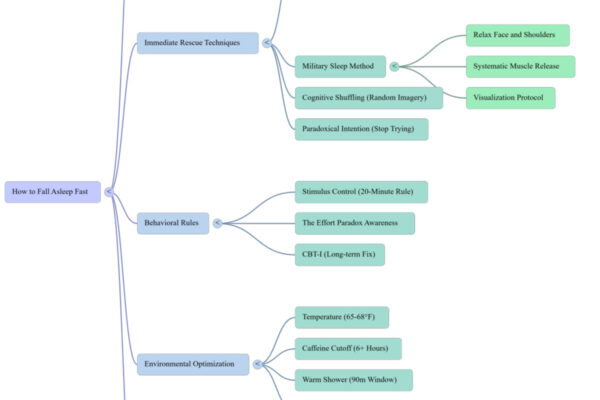
Immediate calming protocols provide actionable techniques to use the next time you wake at 3am with anxiety. The 4-7-8 breathing technique activates the parasympathetic nervous system within minutes. The 3-3-3 grounding exercise redirects attention from internal anxiety to external reality. Stimulus control — leaving bed after 20 minutes — prevents the brain from associating bed with wakefulness. Stopping clock-watching removes the primary anxiety amplifier (Sleep Foundation, 2025).
Leaving bed after 20 minutes of wakefulness is the single most effective immediate intervention — it prevents the brain from conditioning bed as a place of anxiety rather than sleep (Sleep Foundation, 2025).
The 4-7-8 breathing technique activates the parasympathetic nervous system by extending the exhale longer than the inhale. Inhale for 4 seconds, hold for 7 seconds, exhale for 8 seconds. Repeat 4-6 cycles. This technique reduces heart rate and cortisol levels within 3-5 minutes, making it ideal for 3am anxiety episodes (Cleveland Clinic, 2026).
The 3-3-3 grounding exercise redirects attention from internal anxiety to external reality by engaging the senses. Name 3 things you see, 3 sounds you hear, and move 3 body parts. This technique interrupts the catastrophic worry cycle by forcing the prefrontal cortex to reengage with the present moment (Sleep Foundation, 2025).
Stimulus control through the 20-minute rule prevents the brain from associating bed with wakefulness and anxiety. If unable to sleep after 20 minutes, leave the bedroom and engage in a quiet, non-stimulating activity until sleepy. Return to bed only when drowsy. This technique is a core component of CBT-I (DSM-5, 2020).
Stop clock-watching at 3am removes the primary anxiety amplifier that converts wakefulness into panic. Checking the time triggers calculations about remaining sleep, which activates the stress response and makes sleep impossible. Turn the clock away or cover it — knowing the time at 3am provides no benefit and only increases anxiety (Sleep Foundation, 2025).
Long-term evidence-based paths address the root causes of 3am anxiety awakenings through sustained interventions. CBT-I structured protocol retrains sleep associations and regulates the sleep drive. Morning sunlight anchoring resets the circadian rhythm and reduces nighttime cortisol. Alcohol REM-rebound management prevents the secondary awakening caused by alcohol metabolism. Ventral vagal reset strengthens the parasympathetic nervous system’s ability to maintain calm throughout the night (Sleep Foundation, 2025).
CBT-I shows 70-80% effectiveness rates for sleep maintenance insomnia — making it the gold standard treatment for recurring 3am anxiety awakenings (Sleep Foundation, 2025).
CBT-I structured protocol is the gold standard treatment for sleep maintenance insomnia and 3am anxiety awakenings. The protocol combines sleep restriction, stimulus control, cognitive restructuring, and relaxation training over 6-8 weeks. CBT-I shows 70-80% effectiveness rates and provides lasting results without medication dependency (Sleep Foundation, 2025).
Morning sunlight anchoring resets the circadian rhythm by exposing the eyes to natural light within 30 minutes of waking. This exposure suppresses melatonin production and sets a 14-16 hour timer for melatonin release at night. Consistent morning sunlight reduces nighttime cortisol spikes and stabilizes sleep architecture over 2-4 weeks (Cleveland Clinic, 2025).
Alcohol REM-rebound management addresses the secondary awakening that occurs 3-4 hours after drinking as alcohol metabolizes. Alcohol initially suppresses REM sleep, but as it clears from the system, REM rebounds with increased intensity, causing vivid dreams and anxiety awakenings. Eliminating alcohol within 3 hours of bedtime prevents this rebound effect (Cleveland Clinic, 2025).
Ventral vagal reset strengthens the parasympathetic nervous system’s ability to maintain calm throughout the night. Techniques include humming, cold exposure, slow breathing, and social connection. Regular vagal toning reduces baseline anxiety levels and improves the body’s capacity to return to sleep after nighttime awakenings. Practice daily for 4-6 weeks for lasting results (Cleveland Clinic, 2026).
Amplifying behaviors to stop are common reactions to 3am anxiety that actually make the problem worse. Lying still while panicking trains the brain to associate bed with fear. Blue light phone exposure suppresses melatonin and stimulates the brain. Nighttime caffeine intake extends cortisol elevation for 6-8 hours. Clock-checking anxiety creates a feedback loop where monitoring sleep prevents sleep (Cleveland Clinic, 2025).
Checking your phone at 3am exposes your brain to blue light that suppresses melatonin for up to 2 hours — making return to sleep nearly impossible (Cleveland Clinic, 2025).
Lying still while panicking trains the brain to associate the bed with fear and wakefulness rather than sleep. This conditioned response makes future awakenings more likely and more intense. The solution is stimulus control — leaving bed after 20 minutes and returning only when sleepy — which breaks the fear-bed association (DSM-5, 2020).
Blue light phone exposure at 3am suppresses melatonin production for up to 2 hours and stimulates brain activity through engaging content. The combination of light exposure and cognitive stimulation makes return to sleep nearly impossible. Keep phones out of the bedroom or use a traditional alarm clock instead (Cleveland Clinic, 2025).
Nighttime caffeine intake extends cortisol elevation and blocks adenosine receptors for 6-8 hours after consumption. Even afternoon coffee can disrupt sleep maintenance and contribute to 3am awakenings. Caffeine sensitivity increases with age and anxiety — eliminating caffeine after 2pm is recommended for people experiencing nighttime anxiety (Cleveland Clinic, 2025).
Clock-checking anxiety creates a feedback loop where monitoring the time activates the stress response and makes sleep impossible. Each time check triggers calculations about remaining sleep, which increases anxiety and cortisol. Turn clocks away or cover them — knowing it’s 3am provides no benefit and only amplifies the awakening (Sleep Foundation, 2025).
Medical mimics rule-out identifies physical conditions that can cause 3am awakenings with anxiety-like symptoms. Obstructive sleep apnea causes oxygen drops that trigger adrenaline release and awakening. Nocturnal hypoglycemia causes blood sugar crashes that activate the stress response. GERD and acid reflux worsen when lying flat, causing chest discomfort that mimics panic. Thyroid dysfunction elevates metabolism and heart rate, disrupting sleep maintenance (Cleveland Clinic, 2026).
If 3am awakenings are accompanied by snoring, gasping, or daytime fatigue, obstructive sleep apnea should be ruled out through a sleep study before treating as anxiety (Cleveland Clinic, 2026).
Obstructive sleep apnea causes repeated breathing pauses during sleep that drop oxygen levels and trigger adrenaline release, causing sudden awakenings with racing heart and anxiety. Symptoms include snoring, gasping, and daytime fatigue. A sleep study is required for diagnosis, and treatment with CPAP often resolves the nighttime anxiety symptoms (Cleveland Clinic, 2026).
Nocturnal hypoglycemia occurs when blood sugar drops too low during sleep, triggering adrenaline and cortisol release to raise glucose levels. This hormonal response causes awakening with sweating, racing heart, and anxiety. People with diabetes or those who skip dinner are at highest risk. A small protein snack before bed can prevent episodes (Cleveland Clinic, 2025).
GERD and acid reflux worsen when lying flat because stomach acid flows back into the esophagus, causing chest discomfort that mimics panic attacks. Symptoms include burning sensation, coughing, and sour taste. Elevating the head of the bed and avoiding meals within 3 hours of bedtime reduces nighttime reflux episodes (Cleveland Clinic, 2025).
Thyroid dysfunction, particularly hyperthyroidism, elevates metabolism and heart rate, making it difficult to maintain sleep throughout the night. Symptoms include weight loss, heat intolerance, and persistent anxiety. Blood tests measuring TSH, T3, and T4 can identify thyroid issues. Treatment of the underlying thyroid condition typically resolves the sleep disruption (Cleveland Clinic, 2026).
Going deeper? The full wake up at 3am with anxiety guide covers every protocol with step-by-step instructions.
Chronic stress → HPA axis over-sensitization → amplified cortisol spike at 3am
Cortisol + amygdala activation → fight-or-flight → wakefulness with panic
CBT-I + calming protocols → nervous system regulation → restored sleep maintenance
Transform Your 3am Anxiety Into Restful Sleep Tonight
The full guide walks you through every protocol introduced in this map — from the exact 4-7-8 breathing sequence to the complete CBT-I implementation plan. You’ll learn how to identify your specific subtype, eliminate amplifying behaviors, and build a personalized nighttime protocol that retrains your nervous system. Read the complete full wake up at 3am with anxiety protocol guide.
Read the Full Guide →Sources & References
This content is for informational purposes only and does not constitute medical advice. Always consult a qualified healthcare professional for personal health decisions. Content reviewed by the ZenSleepZone Research Team.