
REM vs Deep Sleep: Why You Need Both for Total Recovery
If you wake up feeling physically drained, you might lack deep sleep. If you wake up foggy and irritable, your REM might be suffering. Here is the science behind the two most critical stages of rest.
In the age of smart rings and sleep trackers, we are bombarded with data about our nights. But seeing a graph showing “low REM” or “high Deep Sleep” doesn’t help unless you understand what those stages actually do.
Understanding sleep science reveals that sleep isn’t just a passive state of rest; it is an active, complex neurological process. The battle of REM vs deep sleep isn’t about which is better—it’s about understanding how they partner to keep you alive and functioning.
For a visual breakdown of the entire night, check out our sleep cycle infographic.
The Basics: Defining the Stages
Before diving into the differences, it helps to know where these fit into the full sleep cycle. Sleep is generally divided into NREM (Non-Rapid Eye Movement) and REM (Rapid Eye Movement).
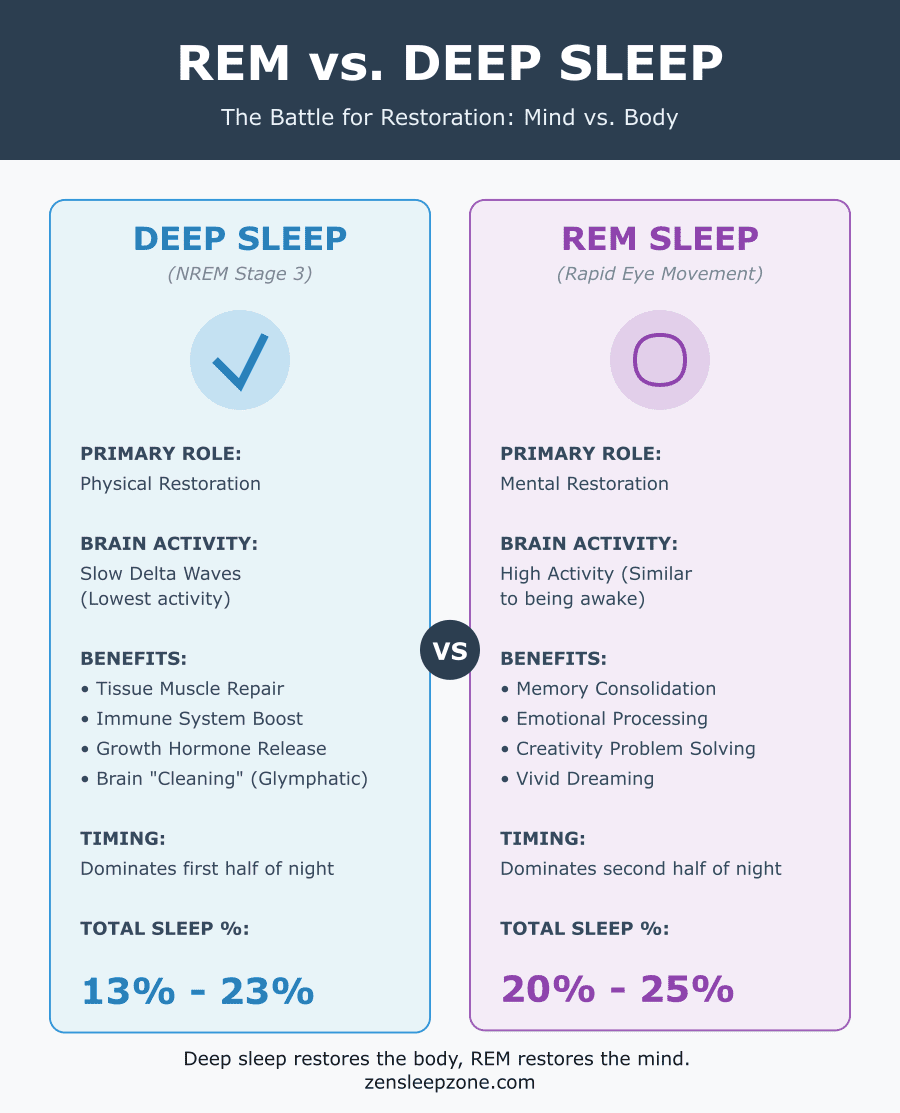
- Deep Sleep (NREM Stage 3): Also known as “slow-wave sleep,” this is the deepest state of relaxation your body enters. It is physically restorative.
- REM Sleep: A paradoxical state where the brain is highly active, almost as if awake, but the body is paralyzed. It is mentally restorative.
Deep Sleep: The Body’s Mechanic
Deep sleep is the “physician” of the night. During this stage, your brain waves slow down to delta waves—the slowest frequency. Your heart rate and breathing drop to their lowest points.
Key Functions of Deep Sleep:
- Physical Repair: Tissues regenerate and cells repair themselves.
- Growth Hormone: The pituitary gland releases human growth hormone (HGH), essential for muscle development.
- Brain Detox: The glymphatic system flushes out toxins, including beta-amyloid, which is linked to Alzheimer’s.
- Immune Health: Cytokines (proteins that fight infection) are produced.
If you are interested in the hormonal side of this stage, read our deep dive on cortisol and deep sleep to see how stress hormones can block this vital recovery phase.
REM Sleep: The Mind’s Therapist
REM sleep is the “therapist” of the night. It usually happens about 90 minutes after you fall asleep. This is the stage where vivid dreaming occurs.
Key Functions of REM Sleep:
- Emotional Processing: The brain processes emotional experiences, taking the “sting” out of traumatic memories.
- Memory Consolidation: It converts short-term memories into long-term storage.
- Learning: It solidifies new skills, from playing guitar to solving math problems.
- Brain Development: Crucial for infants, but remains vital for neuroplasticity in adults.
Comparison: REM vs Deep Sleep at a Glance
For a quick reference, here is how the two stages stack up against each other.
| Feature | Deep Sleep (NREM 3) | REM Sleep |
|---|---|---|
| Primary Focus | Physical Body Restoration | Mental & Emotional Restoration |
| Brain Activity | Slow Delta Waves (Low Activity) | Mixed Frequency (High Activity) |
| Timing | Dominates first half of the night | Dominates second half of the night |
| Dreaming | Rare (or logical/boring if any) | Vivid, emotional, illogical |
| Heart Rate | Slowest of the night | Variable (can speed up) |
| Ideal Percentage | 13% – 23% | 20% – 25% |
Timing and Architecture
One of the biggest misconceptions is that these stages happen evenly. They don’t. This uneven distribution is dictated by your circadian rhythm and stages.
The “Front-Loading” Effect:
- Early Night: Your body prioritizes Deep Sleep. If you go to bed late, you may cut into your deep sleep time because your biological clock knows it’s almost morning.
- Late Night/Morning: Your sleep cycles shift to favor REM. This is why you often wake up remembering a dream—you were likely in a long REM period right before the alarm went off.
What Disrupts These Stages?
Knowing the difference is half the battle; protecting them is the other. Various factors can selectively destroy one stage over the other.
Deep Sleep Killers:
- Aging: Naturally decreases as we get older.
- Stress: High cortisol prevents the body from relaxing into delta waves. Read more on stress impact on sleep stages.
- Caffeine: Even afternoon coffee can reduce deep sleep by 20%.
Curious if stress is ruining your recovery? Try our stress and sleep assessment quiz.
REM Sleep Killers:
- Alcohol: The biggest enemy of REM. It sedates you (helping Deep Sleep initially) but blocks REM in the second half of the night due to the “rebound effect.”
- Sleep Apnea: Frequent awakenings often interrupt REM cycles.
- Alarms: Cutting your sleep short usually slices off the longest REM period of the night.
For a visual aid on how hormones affect this, view our cortisol stages visual.
How to Optimize Both
You cannot force your brain into a specific stage, but you can create the right environment for it.
- Stick to a Schedule: Consistent wake times regulate the ratio of REM to Deep Sleep.
- Cool It Down: Deep sleep requires a drop in core body temperature. Keep your room around 65°F (18°C).
- Cut the Nightcap: Avoid alcohol 3 hours before bed to protect your REM.
- Manage Cortisol: If you feel “tired but wired,” your stress hormones are likely too high. Take our cortisol sleep quiz to find out.
Conclusion
When comparing REM vs deep sleep, there is no winner. Deep sleep ensures you have the physical energy to face the day, while REM ensures you have the mental clarity and emotional stability to handle it.
To truly master your recovery, you need to look beyond total hours asleep and focus on the quality of your sleep architecture.
Ready to transform your sleep quality?
Read the Full Comprehensive Guide

