
How to Stop Panic Attacks at Night: A Complete Diagnostic Guide
Panic attacks at night, or nocturnal panic attacks, are sudden waves of intense fear that wake you from sleep, reaching a peak within minutes. Unlike night terrors, you are usually fully alert and can remember the event clearly. They are triggered by a surge in the autonomic nervous system, often caused by a cortisol spike or an adrenaline surge during light sleep stages. Distinguishing these from medical emergencies like a heart attack is critical for both peace of mind and proper treatment.
Waking up in the middle of the night with your heart pounding against your ribs is one of the most jarring experiences a person can have. If you are reading this, you’ve likely felt that sudden jolt—the “doom” that follows a deep dive into the mental health triggers that disrupt our rest. Understanding why these events occur is the first step toward reclaiming your bedroom as a sanctuary.

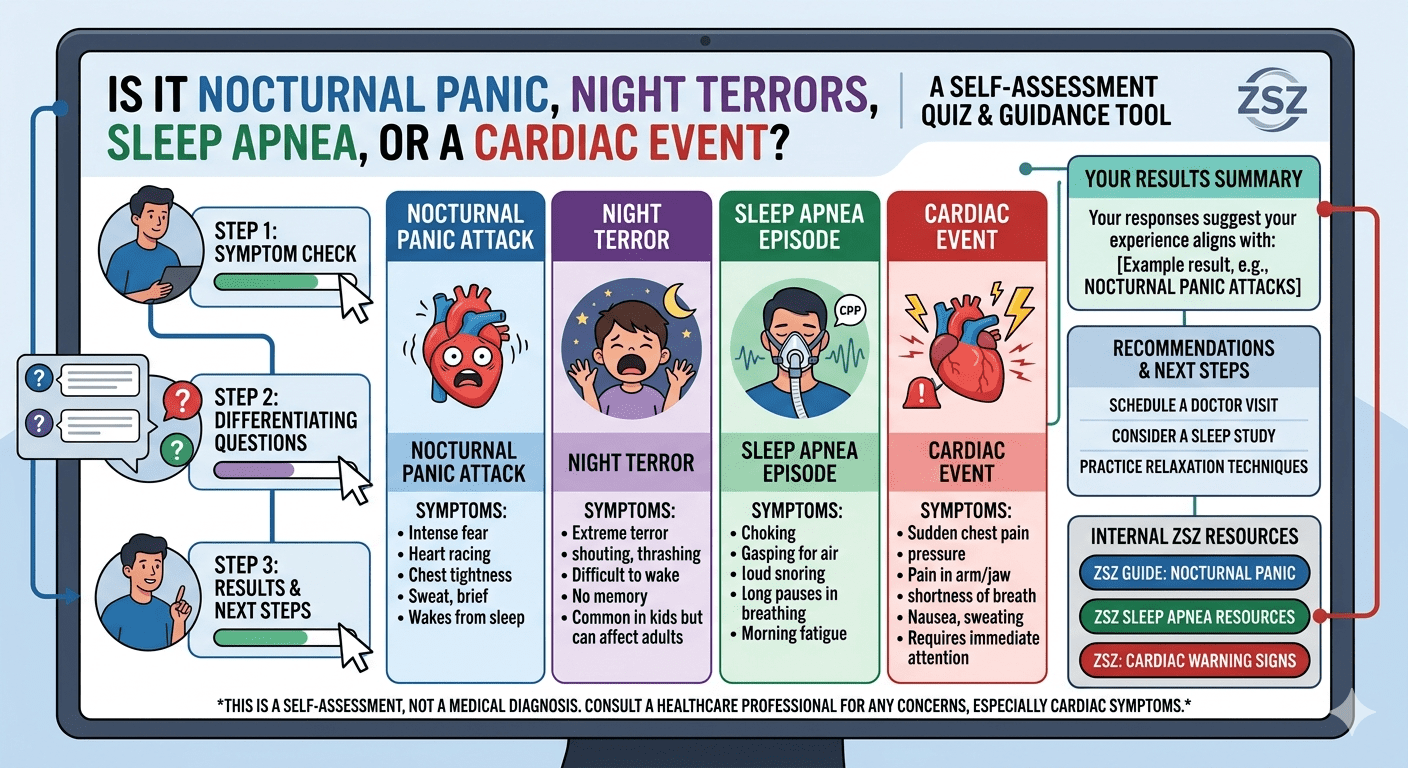
Our interactive assessment helps distinguish panic attacks at night from other sleep-disrupting events.
Step 1: The Biology of the Nocturnal Panic Attack
Why does the body decide to “fight or flight” when there is no threat present? Science suggests that a nocturnal panic attack isn’t actually “random.” It often occurs during the transition between Stage 2 and Stage 3 sleep. During this phase, your HPA axis (hypothalamic-pituitary-adrenal axis) may become hyper-responsive.
If your baseline stress levels are high, even a minor change in heart rate or breathing can trigger interoceptive conditioning. Your brain misinterprets a normal physiological shift as a life-threatening event, leading to a massive cortisol spike. This is closely linked to the sleep and mental health guide principles we discuss regarding neuroplasticity and sleep hygiene.
Step 2: Differentiating Between Panic, Terrors, and Apnea
One of the most common questions we receive is: “Is it a panic attack or am I just not breathing?” As shown in our infographic, the symptoms overlap, but the “flavor” of the event differs:
- Panic Attacks at Night: Intense fear, sweating, waking up with racing heart, and full memory of the event.
- Night Terrors: Occur in deep sleep; the person may scream or thrash but usually has no memory of the event in the morning.
- Obstructive Sleep Apnea: Characterized by gasping, choking, or a “snort” that wakes you up. You may feel tired the next day despite “sleeping.” Symptoms of obstructive sleep apnea often require a clinical sleep study for confirmation.
Step 3: Panic Attack vs Heart Attack at Night
This is the most critical distinction. A nocturnal anxiety attack can mimic a cardiac event through chest tightness and hyperventilation. However, a cardiac event often includes pain that radiates to the jaw, neck, or left arm, along with a feeling of heavy pressure rather than just “tightness.”
If you are waking up in a panic frequently, it is essential to monitor your autonomic nervous system response. If the symptoms dissipate within 20 minutes and follow a period of chronic anxiety before bed, panic is the more likely culprit—though medical clearance is always recommended.
The Role of Somniphobia and the Worry Cycle
When you experience panic during sleep once, you begin to fear the next occurrence. This creates somniphobia (fear of sleep). You might start staying up late to avoid the “threshold” of sleep, which actually increases sleep fragmentation and makes a cortisol spike more likely the following night.
Solutions: How to Calm Down After a Panic Attack at Night
Breaking the cycle requires a multi-pronged approach involving both immediate grounding and long-term behavioral changes.
- The 5-4-3-2-1 Method: Engage your senses immediately upon waking to pull your brain out of the “threat” center and back into the room.
- CBT-I Protocols: Cognitive Behavioral Therapy for Insomnia is the gold standard. Implementing clinical CBT-I protocols can help re-train your brain to view the bed as a place of safety.
- Parasympathetic Activation: Use “Box Breathing” (4 seconds in, 4 hold, 4 out, 4 hold) to manually force your body into a rest-and-digest state.
Take Control of Your Nightly Rest
Don’t let nocturnal anxiety dictate your life. Explore our comprehensive library of evidence-based strategies to soothe your nervous system and achieve the deep, restorative sleep you deserve.
Explore the Mental Health HubConclusion
Understanding the mechanics of panic attacks at night is the most powerful tool in your arsenal. When you can label the sensation as a “misfired alarm” rather than a “sinking ship,” you take the power away from the panic.
If you have more questions about specific triggers, visit our panic attack at night Q&A to see what other sleepers in our community are experiencing. Remember: you are not alone, and your body is not your enemy—it’s just trying to protect you in the only way it knows how.


