
These REM vs deep sleep questions cover what each stage is, what tracker numbers mean, and when to seek help. They are written for adults reading a wearable result or trying to understand their sleep. The full explanation, table and next-step guide live in our REM vs Deep Sleep article.
Not sure where to start? The REM vs Deep Sleep Sleep Compass asks three questions and points you to your first step.
These answers explain REM and deep sleep for general education. They can’t diagnose you or replace care from a clinician who knows your health.
REM vs deep sleep: what each stage is
The basics: what these two stage names mean, how they feel, and when they show up in your night.
What is the difference between REM and deep sleep?
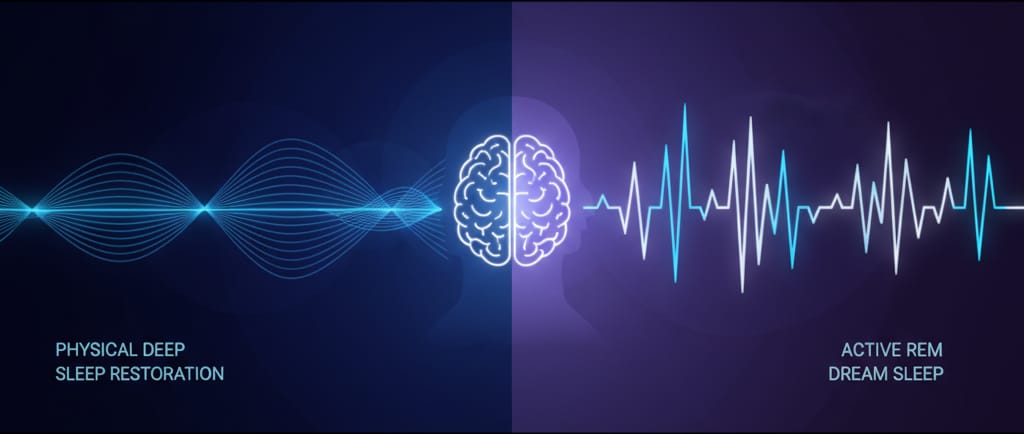
Deep sleep is stage N3, a non-REM stage with slow brain waves and reduced heart rate. REM sleep comes after the non-REM stages. It has active brain activity, rapid eye movements and markedly reduced muscle movement. Both appear in the same night of sleep.
The NHLBI describes N3 as having “large slow brain waves.” It notes N3 is also difficult to wake from. The NICHD describes REM as having rapid eye movements and an active brain, paired with temporary muscle stillness. Both stages share the same night and both contribute to learning and memory. The full side-by-side comparison, including a table, is in the REM vs deep sleep comparison.
Does N2 count as deep sleep?
No. Deep sleep is N3 only. Non-REM sleep has three stages — N1, N2 and N3. N1 is very light sleep; N2 is a middle stage; N3 is the deepest. REM is a separate category altogether, not part of non-REM at all.
The NHLBI identifies N3 as the “deep sleep” stage. N1 and N2 are lighter non-REM stages. They come before N3. Calling all non-REM sleep “deep sleep” is a common mix-up. It can make tracker numbers harder to read correctly.
Is deep sleep harder to wake from?
Yes — deep sleep is the stage that is most difficult to wake someone from. The NHLBI notes that N3 involves slow brain waves and is hard to rouse. Waking abruptly from deep sleep can leave you feeling briefly disoriented. This does not justify using a fixed sleep-cycle formula to time your alarm.
The brief fogginess after waking from deep sleep — called sleep inertia — passes on its own. It is not a sign that something is wrong. No proven consumer-app method reliably identifies deep sleep in real time. Claims about waking you before deep sleep ends need to be read alongside wearable-accuracy research.
When do REM and deep sleep happen during the night?
Deep sleep tends to be more prominent in the first part of the night, while REM sleep becomes more prominent later. This is a tendency, not a strict clock schedule. Both stages appear in recurring cycles. The exact pattern varies from person to person and from night to night.
The NHLBI states that people spend “more time in this stage early in the night” for deep sleep. It also notes “more REM sleep later.” A visual schematic of this tendency is more useful than a rigid cycle calculator. The broader pattern of all four sleep stages is in the sleep stages and cycles article.
What this means for you: If you cut sleep short in the morning, you lose more REM than deep sleep. If you go to bed very late, you may miss some of the deep sleep that clusters early. Protecting total sleep duration protects both.
What each stage does
This section covers what research says about the roles of REM and N3. It also covers where the evidence is still incomplete.
Is REM or deep sleep more important?
Neither stage can be declared more important than the other. Both REM and non-REM sleep contribute to learning and memory, according to the NICHD. Research on how each stage works is still active. The evidence does not set a personal stage target.
Lutz et al., writing in Physiological Reviews (2024), found that REM’s role in memory consolidation is “presently much less clear” than that of non-REM slow oscillations. That does not make REM less valuable. It means the mechanisms are less settled. Framing this as a competition misreads what the science says. More on the research is in the stage roles section.
Can you dream outside REM sleep?
Yes. Dreaming can also occur in non-REM sleep, per the NICHD. Most people associate dreams with REM, and vivid, narrative dreams are more commonly reported there. But dreaming alone does not tell you which stage you were in.
Feeling as though you were “thinking instead of sleeping” does not prove you missed REM or deep sleep. Stage identification requires more than subjective experience. If that feeling persists alongside daytime tiredness, describe it to a clinician. Do not interpret it as a stage deficit on your own.
Does deep sleep change with age?
Pooled studies find that slow-wave sleep decreases with age in healthy adults. Ohayon et al. reported this in Sleep (2004). That meta-analysis found that the percentage of slow-wave sleep and REM sleep both decreased with age across healthy cohorts. This is a group-level finding, not a personal nightly quota.
Knowing this helps put tracker readings in context. A lower N3 reading in an older adult does not automatically signal a disorder. The Ohayon et al. meta-analysis used pooled historical data. Age-related variation and wearable limits both apply when you read your own number. The REM vs deep sleep statistics page explains what these published figures actually describe.
Which sleep stage matters most for memory?
Research particularly implicates non-REM slow oscillations and sleep spindles in long-term memory consolidation. Lutz et al., in Physiological Reviews, highlight these non-REM rhythms. REM also plays a role. Its exact mechanisms are less settled. This is mechanistic research. It does not translate into a nightly stage quota.
Denis and Cairney (2024) wrote in Current Sleep Medicine Reports that timing between sleep spindles and slow oscillations during non-REM sleep “plays a central role” in memory. These are lab findings from EEG (brain-wave recording) studies. They are not consumer-wearable outputs. A wearable’s N3 estimate is not the same measurement. The connections between stages are mapped in the REM vs deep sleep mind map.
What happens across all the sleep stages in a full cycle?
A full sleep cycle moves through N1, N2, N3 and REM, then repeats. This page compares REM with N3 specifically. The complete picture of all four stages is in a dedicated article. That includes how cycles change across the night and what a hypnogram (a stage chart) looks like.
The sleep stages and cycles article covers N1 and N2 as well as N3 and REM. It also explains how cycle length shifts across the night. You will find what happens when cycles are cut short there too.
REM vs deep sleep questions about tracker numbers
How wearables produce stage estimates, what those numbers can and cannot tell you, and how to read specific amounts without turning them into targets.
How does a watch work out REM and deep sleep without measuring brain waves?
Wrist wearables infer sleep stages from movement and optical pulse signals, not from brain activity. Schyvens et al. tested this in SLEEP Advances (2025). Their study describes accelerometers and optical sensors monitoring “different movement and physiological patterns.” Polysomnography, by contrast, records brain signals, eye movements and muscle tone directly.
This difference explains why stage labels from a watch are estimates, not clinical findings. The two methods are not equivalent. Mayo Clinic notes that clinical polysomnography “records your brain waves” alongside other physiological signals. Consumer devices have no access to those signals. What this means for your number is covered in the tracker limits section.
What this means for you: When your watch labels 47 minutes as “deep sleep,” that label is the device’s best guess from wrist signals. It is a useful prompt, not a lab measurement.
Can a smartwatch replace a clinical sleep study?
No. Stage estimates from a consumer wrist device are not equivalent to clinical polysomnography. Schyvens et al. (2025) tested six devices against polysomnography. They found “considerable variability in performance” across the six devices. The study concluded that “wearables do not replace PSG for clinical diagnosis.”
De Zambotti et al. noted two known limitations in Sleep (2024). These are “the misclassification of wakefulness during the sleep period” and unclear translation across different populations. Mayo Clinic states that clinical polysomnography monitors sleep stages and cycles with brain wave recording. Use your device as a general sleep prompt, not as a diagnostic tool. Mayo Clinic explains what a clinical sleep study involves.
Can a tracker’s percentage-error figure tell me how many minutes my stage estimate is off?
No. Study error metrics summarize measurement performance for a specific device, sample and night — not your personal reading. A figure from a validation study cannot be converted into a personal plus-or-minus minute range. That would require a supported individual prediction model. Consumer devices do not provide one.
The 2025 Schyvens et al. study reported epoch-classification rates for specific devices under lab conditions. That tells you how a device performed in that study. It does not tell you whether your Thursday night reading was off by a fixed number of minutes. The estimate carries uncertainty. How much uncertainty varies.
Why does my sleep app say I was asleep when I remember being awake?
Quiet wakefulness can be misclassified as sleep by consumer devices. De Zambotti et al. (Sleep, 2024) name “the misclassification of wakefulness during the sleep period” as a known limitation. Lying still without moving produces signals similar to sleep. Wrist-based devices cannot always tell the difference.
This is a measurement issue, not proof that you slept well or missed a stage. If your app regularly ignores stretches when you felt awake, mention that to a clinician. This matters especially alongside daytime tiredness. The tracker limits section explains what wearable estimates can and cannot establish.
How many minutes of deep sleep should you get?
There is no validated required number of minutes. An NHLBI guide describes deep sleep as roughly one-fifth of total sleep. That is a broad historical description, not a personal nightly target. For someone sleeping seven hours, one-fifth is roughly 84 minutes. That figure is an illustration, not a prescription.
Stage proportions shift with age, per Ohayon et al. (Sleep, 2004). Wearable estimates carry their own uncertainty too. Chasing a specific minute count is unlikely to improve how you feel. The AASM and Sleep Research Society consensus recommends seven or more hours per night for adults — that is total sleep, not a stage target. The context behind these figures is on the REM vs deep sleep statistics page.
Is 45 minutes of deep sleep OK?
A single 45-minute deep-sleep estimate cannot determine whether your sleep is adequate on its own. The NHLBI’s one-fifth figure is a broad historical description, not a minimum threshold. Forty-five minutes may reflect a measurement limitation, your age, or how long you slept. Context matters.
Wearable estimates for N3 vary in accuracy. The 2025 Schyvens et al. study found that device performance for identifying deep-sleep epochs differed considerably across six devices. A 45-minute reading paired with refreshed, alert days is a different situation from one where daytime sleepiness affects your life. The latter warrants a clinical assessment, independent of the percentage.
Is 4.5 hours of deep sleep too much?
The NHLBI’s historical one-fifth description is not an upper safety limit. Four and a half hours cannot be classified as harmful from that average alone. No validated individual upper threshold for N3 appears in these sources. Wearable estimates are also uncertain. A reported 4.5 hours may partly reflect misclassification of other stages.
If that reading follows recovery from illness, significant sleep debt or a much longer-than-usual night, context explains it. A consistent pattern alongside unusual symptoms is different. A clinician can look at the full picture in that case. A single stage estimate does not substitute for that assessment.
Is 2 hours of REM sleep good or bad?
Two hours alone cannot determine whether your sleep is good or bad. The NHLBI guide describes REM as roughly one-fifth of total sleep. That is a historical illustration, not a personal requirement. Two hours of REM in a seven-hour night sits near that broad description. The figure was not designed as a pass/fail threshold.
Age, total sleep duration and wearable accuracy all shape any given reading. The AASM and Sleep Research Society consensus is that adults need seven or more hours of total sleep per night. That is a total sleep figure, not a specific REM minute count. How you feel during the day is a more useful gauge than matching a percentage to a published average.
Is 3 hours of REM sleep enough for me?
No published source establishes a required personal REM amount. Three hours cannot confirm adequate or inadequate sleep for an individual. The NHLBI’s one-fifth figure is a descriptive historical estimate. It is not a minimum or maximum for any one person.
Stage proportions vary with age, total sleep duration and how accurately the device classifies stages. Three hours of REM in a longer-than-average night looks different from three hours in a short one. Wearable estimates carry measurement uncertainty. Daytime function — whether you feel alert and able to do what matters — is the more reliable guide.
Is 4 hours of deep sleep enough for adults?
Four hours of deep sleep cannot establish adequacy or inadequacy for an individual adult. The NHLBI’s historical one-fifth estimate is not a recommended minimum. No validated lower threshold for N3 appears in the clinical sources here. Total sleep duration guidance — seven or more hours per night — comes from a separate consensus.
Wearable deep-sleep estimates also carry uncertainty. The 2025 Schyvens et al. validation study found that N3 classification accuracy varied considerably across six devices. Four hours of estimated N3 may partly reflect misclassification of other stages. Assess how you feel and function during the day rather than treating the number as a grade. The stage amounts section explains what the published figures were designed to convey.
Tired, habits and next steps
This section covers tiredness despite a good score, habits that can help, and signs that call for a clinician.
Why am I tired despite a good sleep score?
A good score does not guarantee refreshed sleep. Feeling tired differs from repeatedly falling asleep during the day, per the NHS. A tracker percentage does not identify the cause of either. Scores reflect an estimate, not a full picture of sleep quality or any underlying condition.
If tiredness means occasional grogginess, consistent sleep timing and a regular routine may help. If it means often falling asleep during the day, that meets the NHS threshold for seeking a primary-care assessment. The same applies if sleepiness affects your work, driving or daily life. Your tracker reading does not change that threshold. Details on both situations are in the tired despite a good score section.
If that’s you: If you often fall asleep during the day, or sleepiness is limiting your life, arrange a primary-care appointment. Describe the frequency and impact — not just the tracker number.
Does feeling mentally active during sleep mean I never reached deep sleep?
No. Subjective experience does not identify sleep stages. The NICHD confirms that dreaming can occur in non-REM sleep. This includes stages other than REM. Feeling as though you were “thinking rather than sleeping” is a reported experience, not a stage diagnosis.
Clinical polysomnography records brain waves, eye movements and muscle signals to identify stages. A personal recollection cannot replicate that. If this experience happens alongside persistent tiredness or daytime sleepiness, mention both to a clinician. Do not use the feeling alone to conclude a stage was missing.
Do low wearable stage readings prove brain damage?
No. A low consumer stage estimate is not evidence of brain damage. Consumer wearables infer stage categories from wrist movement and optical signals. They do not record brain activity. They cannot make a clinical finding of any neurological condition.
Klier et al. (2026) identified “methodological limitations in accurately capturing key sleep parameters, particularly sleep stages” in consumer devices. That appeared in Frontiers in Sports and Active Living. Stage percentages have classification uncertainty. Symptoms and clinical history — assessed by a clinician — are what matter, not a displayed percentage. If you are worried about a specific symptom, a primary-care appointment is the right starting point.
What habits can you dream outside rem sleep support healthier sleep?
Three habits have clear general support: going to bed and waking at the same time every day, keeping your bedroom quiet, cool and dark, and being mindful of caffeine. The NHLBI recommends all three as part of healthy sleep habits. None is proven to increase a specific stage by a measurable amount.
These habits support overall sleep opportunity and consistency. They do not target REM or N3 separately. The AASM and Sleep Research Society consensus recommends seven or more hours of sleep per night for adults. That total sleep duration is where the clearest evidence sits. Practical detail on each habit is in the support your sleep section. For caffeine timing specifically, the coffee timing for sleep article goes further.
Can good habits cure daytime sleepiness?
Habits may help. Persistent excessive daytime sleepiness may not be cured by lifestyle changes alone. The NHS states that improved sleep habits “may not cure” excessive daytime sleepiness. When sleepiness frequently causes you to fall asleep, or affects your daily life, assessment and cause-specific care are needed.
Improving sleep timing and environment is a reasonable first step. It should not delay an appointment when daytime sleepiness is already affecting your life. The NHS advises seeking help when “sleepiness is affecting your life.” That threshold matters whether your tracker shows good or poor stage totals. NHS guidance on excessive daytime sleepiness explains what to expect from an assessment.
When should I see a doctor about my sleep?
See a doctor when you often fall asleep during the day, sleepiness is affecting your life, or someone has noticed breathing pauses, gasping or choking during your sleep. The NHS lists these as reasons to arrange a primary-care assessment. Do not let a good tracker score delay that step.
Severe, current difficulty breathing — including being unable to get words out — needs emergency help immediately. Do not drive yourself. That is a separate, urgent situation from daytime sleepiness. For the UK, call 999 or go to A&E, per NHS guidance. For the US, Canada and Australia, call your local emergency number. The full three-situation guide is in the next steps section.
Before your appointment: Note how often you fall asleep during the day and whether it affects driving or work. Mention any observed breathing symptoms. Ask your doctor whether a sleep diary would help.
Could breathing pauses during sleep mean sleep apnea?
Witnessed breathing pauses, gasping or choking during sleep are reasons to seek a primary-care assessment. These symptoms can be associated with sleep apnea. Do not attribute them solely to a stage percentage. Do not dismiss them because a tracker shows a good score.
The NHS lists “breathing stops and starts” and “gasping, snorting or choking noises” as reasons to see a GP. A GP may refer you to a specialist sleep clinic. In the US, the VA/DOD guideline (2025) recommends assessing clinically suspected obstructive sleep apnea with polysomnography or home sleep apnea testing. A clinician decides the appropriate route. This page does not diagnose or treat sleep apnea. The sleep apnea guide covers the condition in full. NHS sleep apnoea guidance explains what assessment can involve.
Where should I start if I am worried about my REM or deep sleep?
Start by separating the concern into two parts: what the number says, and how you actually function during the day. If the worry is a tracker reading alone, begin with measurement limits. If daytime sleepiness or witnessed breathing symptoms are also present, move directly to an assessment route.
The REM vs Deep Sleep Sleep Compass asks three short questions. It asks what brings you here, whether you often fall asleep during the day, and whether breathing symptoms have been noticed. It then routes you to the right starting point. It takes under a minute and gives you a specific first step, not a general reading list.
What should I bring to a sleep appointment?
Describe your daytime sleepiness clearly: how often it happens, what activities it affects, and whether anyone has noticed breathing pauses, gasping or choking at night. Ask whether a sleep diary would help before or between appointments. The NHS notes that a GP may request one.
A sleep diary records timing — when you went to bed, when you fell asleep, and any wake-ups. It does not capture verified stage data. Bring your tracker summary as background information, not as a clinical finding. A clinician will weigh your symptoms, history and any objective tests together. The Compass includes a short “what to bring” step: see the REM vs Deep Sleep Sleep Compass.
See REM and deep sleep side by side — without a health grade
The interactive Visual tool lets you compare stage features and check measurement limits with reveal cards. You can also get sourced explanations — no stage quotas or scores. More in the Sleep Science pillar.
Explore the Visual tool →Sources
- Watson et al., Journal of Clinical Sleep Medicine, 2015 (doi:10.5664/jcsm.4758) (2015). Supports: q-how-much-deep-sleep, q-2-hours-rem, q-3-hours-rem, q-4-hours-deep, q-habits-help.
- National Heart, Lung, and Blood Institute, 2022 (2022). Supports: q-rem-vs-n3, q-n2-not-deep, q-hard-to-wake, q-when-each-happens.
- National Heart, Lung, and Blood Institute, Your Guide to Healthy Sleep, 2011 (2011). Supports: q-how-much-deep-sleep, q-45-min-deep, q-4pt5-hours-deep, q-2-hours-rem, q-3-hours-rem, q-4-hours-deep.
- Eunice Kennedy Shriver National Institute of Child Health and Human Development, 2019 (2019). Supports: q-rem-vs-n3, q-dreaming-outside-rem, q-mental-active-deep, q-which-matters.
- Ohayon et al., Sleep, 2004 (doi:10.1093/sleep/27.7.1255) (2004). Supports: q-deep-sleep-age, q-how-much-deep-sleep, q-2-hours-rem.
- de Zambotti et al., Sleep, 2024 (doi:10.1093/sleep/zsad325) (2024). Supports: q-watch-no-brain-waves, q-watch-replace-study, q-app-vs-memory.
- Klier et al., Frontiers in Sports and Active Living, 2026 (doi:10.3389/fspor.2026.1872518) (2026). Supports: q-low-stage-brain.
- NHS, Excessive daytime sleepiness (hypersomnia), 2023 (2023). Supports: q-tired-good-score, q-habits-cure-sleepy, q-when-see-doctor.
- NHS, Sleep apnoea, undated (accessed October 10, 2026). Supports: q-breathing-apnea, q-when-see-doctor.
- National Heart, Lung, and Blood Institute, Healthy Sleep Habits, 2022 (2022). Supports: q-habits-help.
- Mayo Clinic Staff, Polysomnography (sleep study), 2025 (2025). Supports: q-watch-replace-study, q-all-stages-route.
- NHS, Shortness of breath, 2024 (2024). Supports: q-when-see-doctor.
- Department of Veterans Affairs and Department of Defense, VA/DOD Clinical Practice Guideline for the Management of Chronic Insomnia Disorder and Obstructive Sleep Apnea, 2025 (2025). Supports: q-breathing-apnea.
- Schyvens et al., SLEEP Advances, 2025 (doi:10.1093/sleepadvances/zpaf021) (2025). Supports: q-watch-no-brain-waves, q-watch-replace-study, q-error-stat-minutes, q-45-min-deep, q-4-hours-deep.
- Lutz et al., Physiological Reviews, volume 106 (doi:10.1152/physrev.00054.2024). Supports: q-which-matters, q-non-rem-memory.
- Denis and Cairney, Current Sleep Medicine Reports, 2024 (doi:10.1007/s40675-024-00291-y) (2024). Supports: q-non-rem-memory.
Sources checked · Next review
How we made this page: questions gathered from real searches, answers researched from the sources above, drafted with AI assistance and edited by Aamir Bashir, Founder & Editor. Read our editorial policy.