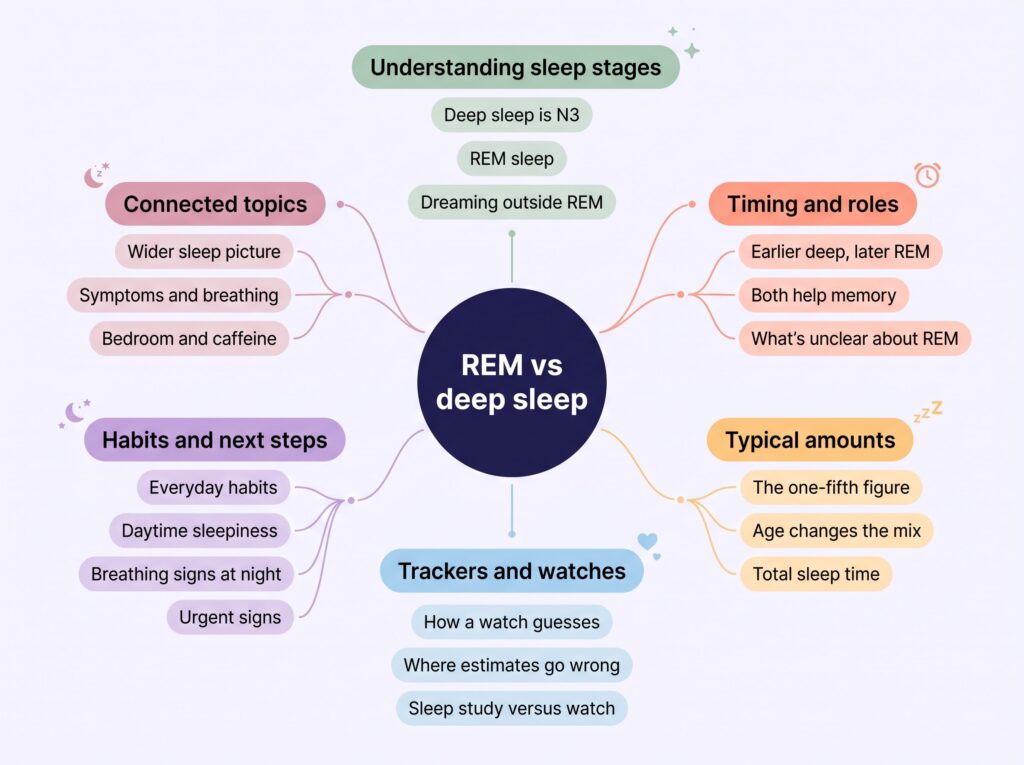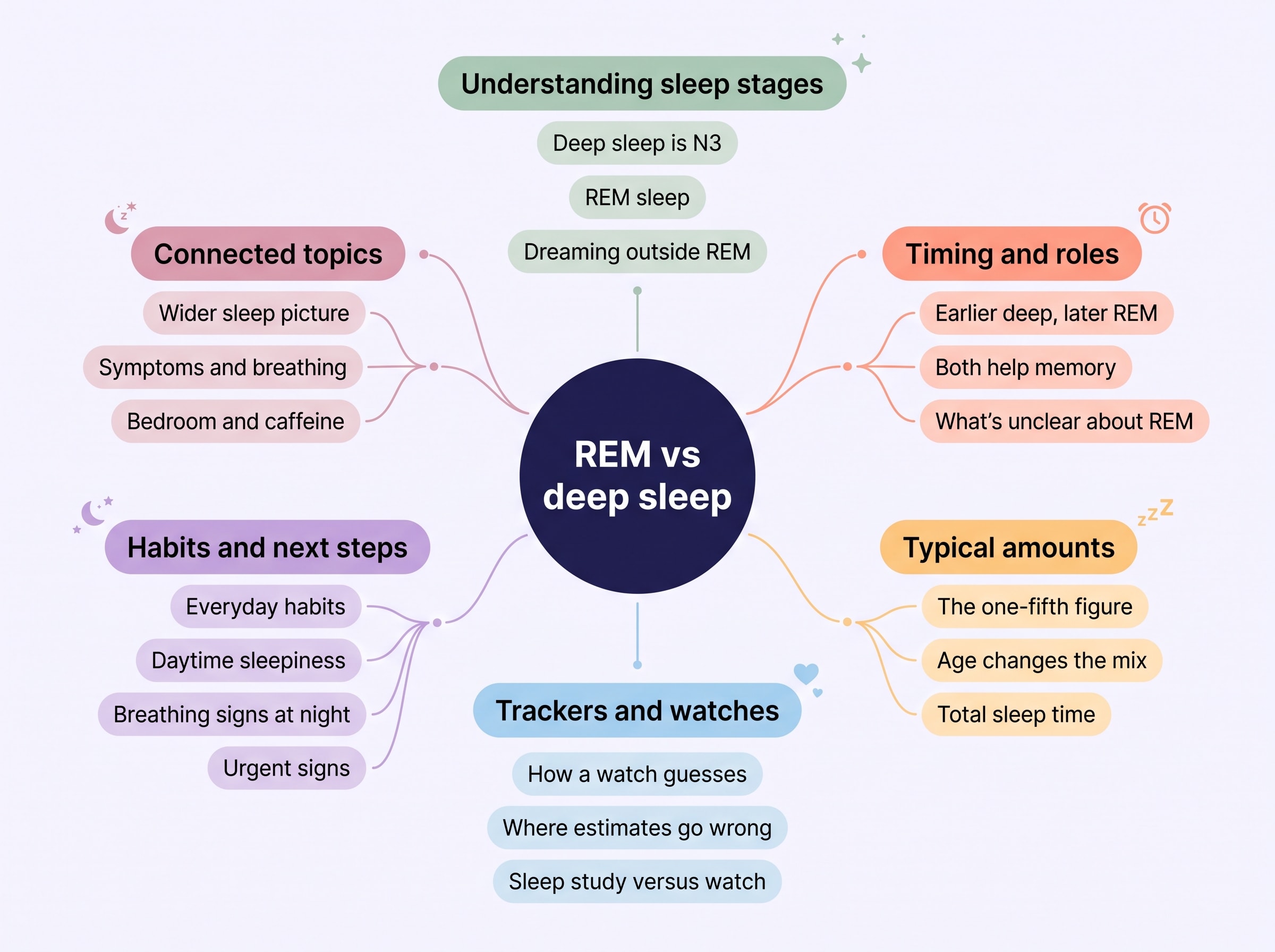

This REM vs deep sleep mind map shows how the two stages, tracker numbers and your next steps fit together. Open any area to see the big picture. Answer the “Ask yourself” questions to find your place. Try one small thing. Then add what fits to your plan.
REM vs deep sleep mind map: how it all connects
REM vs deep sleep
01Understanding sleep stagesThe problem
Understanding sleep stages starts with one split. Deep sleep is a non-REM stage called N3. REM sleep is a different stage, with quick eye movements and an active brain. In a REM vs deep sleep mix-up, the stage numbers can confuse. N1 and N2 are non-REM stages too, but they aren’t deep sleep.
Key insight: Deep sleep means N3 only. Calling all non-REM sleep “deep” mixes up three different stages.
Ask yourself: Which label confuses you most: N1, N2, N3 or REM? Could you explain N3 in one sentence?
Deep sleep is N3
Deep sleep is stage N3 of non-REM sleep. Its brain waves are large and slow, and it’s hard to wake someone from it. Some people call this slow-wave sleep. That makes N3 the stage people mean by deep sleep.
Try this: Say it aloud: “Deep sleep is N3, one of three non-REM stages.” If you can, you have the main label right. Stop there.
Does N2 count?
No. N1 and N2 are other non-REM stages. Only N3 is deep sleep. Keeping the three non-REM stages separate stops most label mix-ups.
- is more common early in the night →
- Compare the two stages in a reveal-card checklist
REM sleep
In REM sleep, your brain is active and your eyes dart back and forth. Your muscles normally become limp. REM is its own stage, separate from all three non-REM stages. Rapid eye movement is where the name comes from.
Try this: Sort three clues into REM or N3: quick eye movements, limp muscles, slow brain waves. Check your sorting against the text above, then stop.
Quick eye movements
Rapid eye movement means what it says: the eyes dart back and forth. Pair that clue with an active brain and limp muscles to spot REM.
Limp muscles
In REM your muscles normally become limp. That is a normal feature of the stage. It is one clue to how REM differs from deep sleep, whose brain waves are large and slow.
Dreaming outside REM
Dreams can happen in non-REM sleep too. So a vivid dream or a busy mind doesn’t prove you were in REM. Dreaming alone can’t tell you which stage you were in. What this means for you: don’t treat your dreams as stage evidence.
“I was thinking, not dreaming”
Some people wake feeling they were thinking rather than dreaming. That experience can’t identify a stage. If tiredness keeps affecting your days, raise it with a clinician instead of guessing.
- dreaming doesn’t prove REM →
Read more: REM vs deep sleep: what is the difference?
02Timing and rolesWhy it happens
Deep sleep tends to be more common early in the night, and REM sleep more common later. That’s a tendency, not a fixed schedule. Both kinds of sleep help you learn and form memories. Research points more firmly to non-REM rhythms for memory, while REM’s memory roles are less settled.
Key insight: Neither stage wins. Both help memory, and the evidence for how each one works differs in strength.
Ask yourself: Do you think of REM as “for the mind” and deep sleep as “for the body”? Does that split still hold up?
Earlier deep, later REM
Deep sleep tends to be more common early in the night. REM sleep tends to be more common later. Treat that as a broad pattern, not a clock you can set an alarm by. Real nights vary.
Try this: Look at a stage chart from one of your nights. Ask only whether deep sleep sits early and REM later. Don’t judge the minutes. Stop after one look.
Why a diagram is a sketch
A stage diagram shows a typical shape, not your recording. Real nights differ, so use any chart as an illustration of the tendency rather than a schedule you should match.
- later sleep means more REM →
Both help memory
Both REM and non-REM sleep help you learn and form memories. Non-REM includes N1, N2 and N3, so this doesn’t mean every stage does the same job. In short, both matter.
Try this: Next time you hear “REM is for the mind, deep sleep is for the body,” ask what each half leaves out. Then drop the split. Stop there.
Non-REM rhythms and memory
Research on long-term memory points to slow oscillations, sleep spindles and replay in the hippocampus during non-REM sleep. That is a lab finding. It doesn’t show that more watch-estimated deep sleep improves your memory.
- REM’s memory role is less settled →
What’s unclear about REM
A major memory review says REM sleep’s roles in memory are less settled than non-REM processes. That means less is known, not that REM is unimportant. Be careful with any claim that gives REM one neat job.
What “less settled” means
It compares how well the mechanisms are understood. It doesn’t say REM does nothing for memory, and it doesn’t rank one stage above the other.
Spindles and slow waves
A review links the timing between sleep spindles and slow oscillations in non-REM sleep to memory consolidation. It’s a mechanism finding, not a stage quota or a treatment instruction.
Read more: Is REM or deep sleep more important?
03Typical amountsYour options
An older NHLBI guide describes deep sleep and REM as roughly one-fifth of sleep each. Those are broad descriptions, not nightly targets. Stage mix also changes with age. Sleep duration advice is separate. A joint consensus statement advises adults aged 18 to 60 to get 7 or more hours of total sleep per night.
Key insight: A published average describes sleep. It doesn’t set a personal quota. Seven hours is about total sleep, not about any one stage.
Ask yourself: Do you treat a published average as a pass mark? What would change if you saw it as a rough picture?
The one-fifth figure
A 2011 NHLBI guide gives about one-fifth for deep sleep and about one-fifth for REM. The guide doesn’t report its underlying data. Read it as a rough illustration, not a minimum, a maximum or a pair of equal targets.
Try this: Write down one number you’ve seen, such as “45 minutes of deep sleep.” Beside it write: “an estimate, not a pass mark.” Then stop comparing.
Is 4.5 hours too much?
The one-fifth figure isn’t an upper safety limit. Four and a half hours of deep sleep can’t be called harmful from that average alone, and watch estimates are uncertain.
- is read through tracker limits →
- What each quantity means and where it stops
Age changes the mix
In pooled studies of healthy people, the share of slow-wave sleep and REM sleep fell with age. The time until REM first appears fell too. This is an age pattern, not a rule for your night. What this means for you: an average for one age group isn’t a target for you.
Healthy groups, older scoring
The pooled studies covered healthy people and used older scoring methods. They show an association with age. They can’t tell you what your own stage numbers should be.
- shifts what “typical” looks like →
Total sleep time
The 7-hour advice is about total sleep, not stages. A joint consensus statement says adults aged 18 to 60 should regularly get 7 or more hours per night. It gives no number for REM or deep sleep.
Try this: Write down roughly how many hours you slept on three nights this week. Compare that with 7 or more hours, not with any stage figure. Then stop.
Duration versus stages
Seven hours counts all sleep together. Stage shares describe how that sleep divides up. Neither number turns into a personal REM or deep-sleep quota.
Why ages 18 to 60
The advice was written for adults aged 18 to 60. It’s a recommendation about total sleep, drawn from literature assessed through 2015. It isn’t a stage guideline.
04Trackers and watchesYour options
Wrist wearables infer sleep stages from movement and pulse signals. A clinical sleep study records brain waves, eye movements and muscle tone. So a watch’s stage chart is an estimate, not a lab finding. It can also misread quiet wakefulness as sleep.
Key insight: A 2025 study of six wrist devices found large differences between devices. It also concluded that wearables don’t replace a sleep study for diagnosis.
Ask yourself: Does your app ever say you slept when you remember lying awake? Do you treat its stage totals as lab results?
How a watch guesses
A wrist device doesn’t read brain waves. It tracks movement and pulse patterns, then estimates the stage. Methods differ between devices, so results differ too.
Try this: Open your app’s help section and look for which signals it uses, such as movement or pulse. Note them, then stop.
The light sensor
Many wrist devices use a light sensor that picks up pulse changes (photoplethysmography). They pair it with a movement sensor. Neither one records brain waves.
- differs from a sleep study’s recording →
Where estimates go wrong
Wearables can misclassify wakefulness during the sleep period. They may not perform equally well in every group of people. So a low deep-sleep reading, or a zero, can’t show that you had no N3.
Try this: Next time the app disagrees with your memory of the night, write one line: “estimate, not a finding.” Then notice how you feel by afternoon.
Single-study results
In one lab study, how often devices matched deep-sleep or REM labels varied by stage and by device. Those figures describe one study, not your watch, and they aren’t minutes of error.
- daytime sleepiness leads to a check-up →
- Questions about tracker numbers
Sleep study versus watch
A clinical sleep study (polysomnography) records your brain waves and other body signals. A clinician decides when it’s suitable. A watch’s totals aren’t equivalent findings, so a smartwatch can’t stand in for it.
Try this: If you’re curious about a sleep study, jot down two or three questions for a clinician. Don’t offer your watch’s chart as a substitute.
What a sleep study records
Polysomnography records brain waves, and research describes it as also capturing eye movements and muscle tone. In a US sleep clinic it monitors your stages and cycles.
Limits aren’t uselessness
Limits don’t make a tracker useless. They mean its stage chart is an estimate. Use it as a prompt to notice how you feel, not as a verdict.
Read more: How accurate are sleep trackers for REM and deep sleep?
05Habits and next stepsWhat to do
Steady habits support overall sleep, though none promises more of any one stage. Think regular timing, a quiet, cool, dark bedroom, and care with caffeine. If you often fall asleep in the day, or someone sees breathing problems at night, talk to a clinician. Severe breathing trouble, or sleepiness at the wheel, needs action now.
Key insight: Sleepiness that affects your life is reason enough to ask for an assessment. That holds whatever your tracker score says.
Ask yourself: Do you often fall asleep during the day, beyond just feeling tired? Has anyone seen you stop breathing, gasp or choke in your sleep?
Everyday habits
Go to bed and wake up at the same time every day. Keep the bedroom quiet, cool and dark. Caffeine can interfere with sleep. These support overall sleep habits, and none is promised to raise a particular stage.
Try this: Choose one: a steady wake-up time, a quieter bedroom, or less caffeine. Try it for a week, then stop and see how you feel.
No stage promise
These habits come from general sleep advice. They haven’t been shown here to raise REM or deep sleep. Judge them by how you feel in the daytime.
Nicotine too
NHLBI healthy-habits guidance names nicotine along with caffeine as things that can interfere with sleep. It gives no universal cutoff time and no promise about any one stage.
Daytime sleepiness
Being sleepy during the day is different from simply feeling tired. If you often fall asleep, or sleepiness is affecting your life, arrange an assessment with primary care. A UK GP may ask for a sleep diary and may refer you to a sleep specialist.
Try this: Start a simple sleep diary: bedtime, wake time and how sleepy you felt in the day. Bring it if a clinician asks. It records timing, not stages.
Habits may not be enough
Better habits may help, but they may not fully clear up excessive daytime sleepiness. If sleepiness keeps affecting your life, don’t wait on habits alone.
- Find my starting point
Breathing signs at night
If someone sees your breathing stop and start, or hears gasping, snorting or choking, arrange an assessment in primary care. These signs can point to sleep apnoea. In the UK a GP may refer you to a specialist sleep clinic for tests.
Try this: If a partner or relative has noticed these signs, ask them to describe what they saw. Write it down for your clinician, then stop.
What the US guideline says
For adults with suspected obstructive sleep apnea, a US government guideline recommends diagnosis with polysomnography or home sleep apnea testing. A clinician picks the route. It isn’t advice to order a test because of a watch score.
- points to a check-up for breathing →
Urgent signs
If severe breathing trouble means you can’t get words out, get emergency help now. In the UK, call 999 or go to A&E. Don’t drive yourself there. If you feel sleepy while driving, pull over in a safe place. A good sleep score doesn’t change that.
Severe breathing trouble
Being unable to speak because of breathlessness is an emergency. The emergency route given here is the UK one. Don’t use this map to decide whether you can wait.
Sleepy at the wheel
Sleepiness behind the wheel is an immediate accident risk. The advice is to stop in a safe place. A reassuring sleep score isn’t a reason to keep driving.
Read more: What should I do next, and when should I seek help?
06Connected topicsKeep it working
This map compares two stages. Other guides go further. Use them to keep your sleep in perspective. Some cover the full stage cycle and your body clock. Others cover symptoms and breathing at night. More cover bedroom and caffeine habits. Each opens a full guide, so you can follow whichever idea matters to you.
Key insight: Follow your overall habits and daytime function over time. A single night’s stage chart is only an estimate.
Ask yourself: Which question is still left: stages across the night, your body clock, symptoms, breathing or habits?
Wider sleep picture
This map compares only REM and N3. The stages-and-cycles guide covers all the stages across a full night. The circadian rhythm guide explains timing and your body clock. A sleep spindles guide covers brain activity seen in N2.
Why spindles?
Sleep spindles are brain activity seen in N2. A review links their timing with slow oscillations to memory consolidation. The spindle guide goes deeper.
- All stages and cycles
- Sleep timing and the body clock
- The brain activity seen in N2
Symptoms and breathing
If tiredness keeps affecting your days, the sleep disorders guide gives the wider context. If the worry is breathing pauses, the sleep apnea guide explains the condition. Neither replaces a conversation with a clinician.
What to take along
Describe your daytime sleepiness and anything seen at night. Ask whether a sleep diary would help. A diary records timing, not verified sleep stages.
- Persistent sleep symptoms
- Breathing pauses during sleep
Bedroom and caffeine
The sleep environment guide covers a suitable sleep space. The coffee timing guide goes deeper on caffeine. Both support overall sleep habits, and neither promises a change in REM or deep sleep.
General, not stage-specific
These topics come from general sleep guidance. They support good habits. They haven’t been shown here to raise any one stage.
- A suitable sleep environment
- Caffeine and sleep
REM vs deep sleep: the connections that matter most
This REM vs deep sleep mind map in words: understanding sleep stages means following the links, not memorizing numbers. Each link below shows how one idea feeds another. Each one is worded exactly as strongly as its source allows. Read it if you’d rather read than tap.
- Earlier night → deep sleep, later night → REM — Deep sleep tends to be more common early in the night, and REM later. Use that as a broad picture, not a schedule.
- Non-REM rhythms → memory research — Slow oscillations, spindles and replay in the hippocampus during non-REM sleep are linked to memory consolidation. That’s lab science. It doesn’t mean more watch-estimated deep sleep will sharpen your memory.
- REM → less certainty about memory roles — A major review calls REM’s memory functions less settled than non-REM processes. That’s a gap in knowledge, not a sign that REM doesn’t matter.
- Stage estimate → measurement caveats — Wearables can misclassify wakefulness. A 2026 review also flags limits in measuring sleep stages. Read a stage chart as an estimate.
- Daytime sleepiness → assessment — NHS guidance on daytime sleepiness covers when to arrange a primary-care assessment. That includes often falling asleep, or sleepiness affecting your life. A good sleep score doesn’t change it.
- Breathing pauses, gasping or choking → assessment — Witnessed breathing pauses are a reason to seek assessment. For adults with suspected obstructive sleep apnea, a US government guideline recommends polysomnography or home sleep apnea testing. It rates this strong, with low confidence in the evidence. A clinician picks the route.
You can see the whole picture. Here’s where to start.
Still unsure where you fit? The Compass finds your starting point in a few taps. The full explanation lives in the Article, and quick Answers settle the short questions. More in Sleep Science.
Find my starting point →Sources
- Watson et al., Journal of Clinical Sleep Medicine, 2015 (doi:10.5664/jcsm.4758). Supports: Typical amounts (total sleep time).
- National Heart, Lung, and Blood Institute, 2022. Supports: Understanding sleep stages; Timing and roles.
- National Heart, Lung, and Blood Institute, Your Guide to Healthy Sleep, 2011. Supports: Understanding sleep stages (deep sleep); Typical amounts.
- Eunice Kennedy Shriver National Institute of Child Health and Human Development, 2019. Supports: REM sleep; dreaming outside REM; both stages and memory.
- Ohayon et al., Sleep, 2004 (doi:10.1093/sleep/27.7.1255). Supports: Typical amounts (age changes the mix).
- de Zambotti et al., Sleep, 2024 (doi:10.1093/sleep/zsad325). Supports: Trackers and watches (misclassified wakefulness).
- Klier et al., Frontiers in Sports and Active Living, 2026 (doi:10.3389/fspor.2026.1872518). Supports: Trackers and watches; stage estimate → measurement caveats.
- NHS, Excessive daytime sleepiness (hypersomnia), 2023. Supports: Daytime sleepiness; UK diary and specialist route.
- NHS, Sleep apnoea, undated (accessed October 10, 2026). Supports: Breathing signs at night.
- National Heart, Lung, and Blood Institute, Healthy Sleep Habits, 2022. Supports: Everyday habits.
- Mayo Clinic Staff, Polysomnography (sleep study), 2025. Supports: Sleep study versus watch.
- NHS, Shortness of breath, 2024. Supports: Urgent signs (severe breathing trouble).
- National Highway Traffic Safety Administration, Drowsy Driving, undated (accessed October 10, 2026). Supports: Urgent signs (sleepy while driving).
- Department of Veterans Affairs and Department of Defense, VA/DOD Clinical Practice Guideline for the Management of Chronic Insomnia Disorder and Obstructive Sleep Apnea, 2025. Supports: Breathing signs at night; breathing pauses → assessment.
- Schyvens et al., SLEEP Advances, 2025 (doi:10.1093/sleepadvances/zpaf021). Supports: Trackers and watches (how a watch guesses; device differences; sleep study versus watch).
- Lutz et al., Physiological Reviews, volume 106 (doi:10.1152/physrev.00054.2024). Supports: Timing and roles (memory; what’s unclear about REM).
- Denis and Cairney, Current Sleep Medicine Reports, 2024 (doi:10.1007/s40675-024-00291-y). Supports: Timing and roles (spindles and slow oscillations).
Sources checked · Next review
How we made this map: built from the sources above, drafted with AI assistance and edited by Aamir Bashir, Founder & Editor. Read our editorial policy.
Information, not medical advice: see a doctor if sleepiness affects your life or someone notices breathing pauses, gasping or choking.