
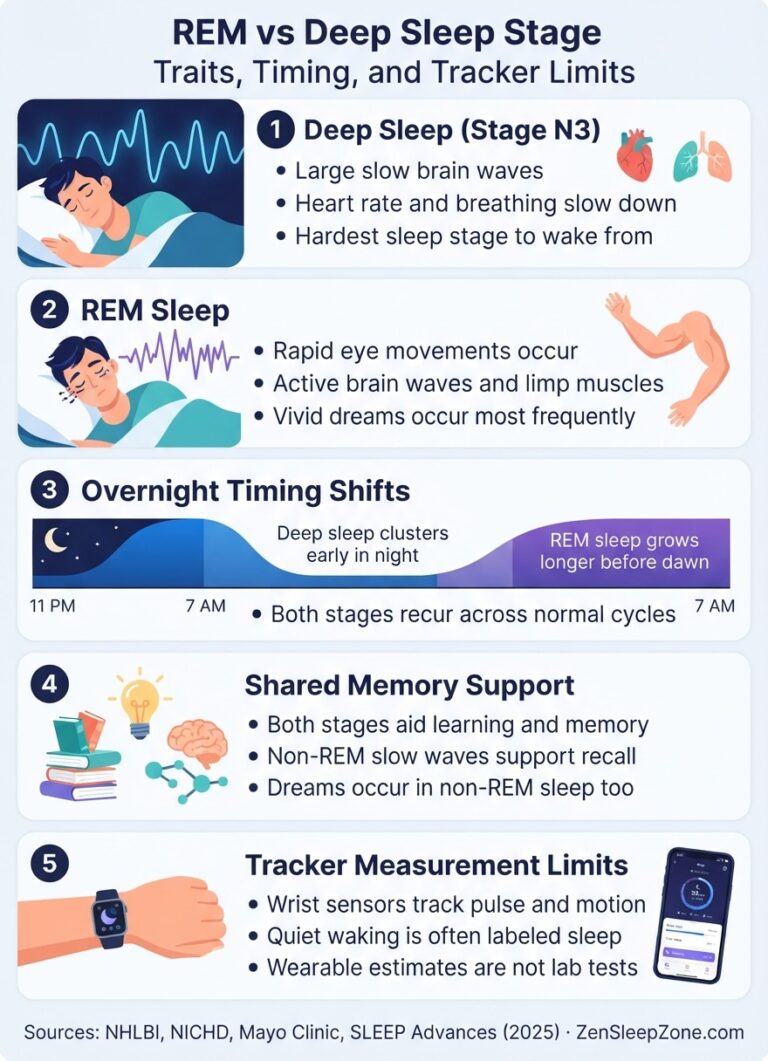
This REM vs deep sleep chart shows how the two stages differ and where each tends to fall across a night. The tool below maps your own bedtime and wake time, then puts your tracker’s stage numbers next to the published averages, so you can read them calmly.
An educational picture and tool, not a diagnosis or medical advice.
How to use the REM vs deep sleep chart
It takes about a minute. You get a picture of your own night and a calm reading of your tracker numbers.
- Enter your usual bedtime and wake time. The chart shows which part of your night has more deep sleep and which has more REM.
- Try waking earlier. Pick 30, 60 or 90 minutes and see which part of the night you would cut.
- Add your tracker numbers if you have them. Total sleep, deep minutes and REM minutes from last night.
- Copy or print your snapshot. Keep it, or take it to an appointment.
No tracker? The night chart works without one. If you often fall asleep during the day, or someone sees you stop breathing in your sleep, talk to a GP or primary care clinician first.
Free chart tool
Your night, stage by stage
See where deep sleep and REM tend to fall in your own night, and read your tracker numbers calmly.
The live tool needs JavaScript. The examples below show each possible result.
Enter a bedtime and a wake time to see your night.
Example: bedtime 23:00, wake 07:00, waking 60 minutes earlier
Your night: 8 h 0 min in bed
Waking 60 minutes earlier trims the end of the night. That is the later part, when REM sleep is more common.
This is time in bed, not time asleep. For adults aged 18 to 60, sleep experts recommend 7 or more hours of sleep a night.
Example: 420 minutes asleep, 60 deep, 95 REM
Your tracker’s estimate, beside the averages
About one-fifth each is a broad average for adults, not a nightly target. Stage shares also change with age.
Your numbers are your device’s estimate. In a 2025 lab study, an Apple Watch Series 8 matched the sleep lab on about half of deep-sleep moments and about 7 in 10 REM moments.
Open next: What a stage estimate can and can’t tell you
Example: deep and REM minutes add up to more than total sleep
Those numbers don’t add up yet
Deep and REM minutes together can’t be more than your total sleep. Check the numbers in your app and try again.
What your result means and what to do next
Rem and deep sleep timing follows a broad pattern, not a clock. Deep sleep is more common early in the night, and REM sleep is more common later. The chart shows that pattern across your own hours. It can’t show your actual stages.
For example, imagine you sleep from 23:00 to 07:00 and try waking at 06:00. The hour you cut comes from the later part of the night. That is when REM sleep is more common.
Tracker shares are estimates. If your deep sleep shows well under one-fifth, read the limits of wrist trackers before you worry. If you often fall asleep in the day, that matters more than any share. Arrange a check-up with a GP or primary care clinician.
Not sure where to begin? The REM vs deep sleep Compass gives a one-minute briefing for your situation.
REM vs deep sleep chart, panel by panel
Two different stages, a shifting night, a shared job, and the limits of a watch.
- Deep sleep (stage N3) 鈥?Large, slow brain waves. It is the hardest stage to wake from.
- REM sleep 鈥?Active brain, quick eye movements. Muscles go limp.
- Across the night 鈥?Earlier: more deep sleep. Later: more REM.
- Both help memory 鈥?Learning needs both phases, REM and non-REM.
- Trackers estimate 鈥?Movement and pulse, not brain waves. A clinical sleep study records brain signals.
The full side-by-side table is in the REM vs deep sleep comparison. How it all connects is on the REM vs deep sleep mind map.
The rules behind this tool
| If you鈥?/th> | The tool shows鈥?/th> | Because鈥?/th> |
|---|---|---|
| Enter a bedtime and a wake time | Your time in bed, and a bar from earlier night (more deep sleep) to later night (more REM) | Your own arithmetic. The pattern: National Heart, Lung, and Blood Institute, 2022 |
| Choose to wake 30鈥?0 minutes earlier | The cut end of the bar, and that it comes from the later night | Your own arithmetic, with the same NHLBI pattern |
| Enter total, deep and REM minutes | Your deep and REM shares, beside a one-fifth marker | Your own arithmetic. The one-fifth average: National Heart, Lung, and Blood Institute, Your Guide to Healthy Sleep, 2011 |
| See the device note | How one watch matched the sleep lab | Schyvens et al., SLEEP Advances, 2025 (doi:10.1093/sleepadvances/zpaf021) |
| Enter deep + REM above total sleep | A “doesn’t add up” message | Your own arithmetic |
The tool never gives a bedtime, a target or a verdict. It can’t see your real stages. If you often fall asleep in the day, or someone sees you stop breathing in your sleep, talk to a clinician first.
See every REM and deep sleep number, with its source
Typical shares, age changes and device-accuracy figures are on the REM vs deep sleep statistics page. More in Sleep Science.
See the numbers 鈫?/a>Sources
- National Heart, Lung, and Blood Institute 鈥?How Sleep Works: Sleep Phases and Stages (2022). Supports: the stage descriptions and the overnight pattern.
- National Heart, Lung, and Blood Institute 鈥?Your Guide to Healthy Sleep (2011). Supports: slow brain waves, hard to wake, the one-fifth averages.
- Eunice Kennedy Shriver National Institute of Child Health and Human Development 鈥?What happens during sleep? (2019). Supports: REM brain activity and eye movements, both phases and memory.
- Schyvens et al. 鈥?A performance validation of six commercial wrist-worn wearable sleep-tracking devices, SLEEP Advances (2025). Supports: how wrist devices estimate stages and how one watch matched the lab.
- Watson et al. 鈥?Recommended Amount of Sleep for a Healthy Adult, Journal of Clinical Sleep Medicine (2015). Supports: 7 or more hours for adults aged 18 to 60.
- NHS 鈥?Excessive daytime sleepiness (hypersomnia) (2023). Supports: when to arrange a check-up.
Sources checked 路 Next review
How we made this page: infographic and tool rules built from the sources above, drafted with AI assistance and edited by Aamir Bashir, Founder & Editor. Read our editorial policy.