
The short answer
How to fall asleep fast when nothing works starts with calming your body and mind instead of forcing sleep: a dark, quiet room, one relaxing exercise, and getting up briefly if you’re still awake and frustrated. What helps most depends on what’s keeping you up tonight. Pick what you need below and go straight to the page that fits.

How to fall asleep fast when nothing works: pick your need
How to fall asleep fast often depends on what’s happening right now, so pick your problem below and we’ll send you straight to the page that helps.
Every starting point
If you can’t stop racing thoughts at bedtime
Calm a racing mind with guided breathing
Worry and stress can make it harder to fall asleep, according to the NHS. A short, paced breathing exercise gives your mind something calmer to follow.
A guided breathing timerPaced breathing you start and stop yourself, with no promised sleep time. The why-you’re-awake sectionExplains how worry and stimulation keep your mind alert at night.If your body feels tired but still wired
Try the relaxation technique that fits you
Breathing, muscle relaxation and guided imagery are reasonable options to try. None can guarantee instant sleep, but each gives tense muscles something else to do.
The relaxation techniques sectionBreathing, muscle relaxation and imagery, with what each can and can’t do.If you’ve tried everything and nothing’s worked
Stop forcing it and reset calmly
Lying awake and trying harder tends to backfire. A short, quiet activity away from bed can lower the pressure until you feel sleepy again.
The still-awake fallback sectionA calm next step for when your first attempt doesn’t work tonight.If you want to know what’s normal
See how long falling asleep usually takes
Sleep-onset time varies by person and night. A reference range isn’t a deadline you need to hit.
The sleep-timing numbersTypical ranges for falling asleep, explained without turning them into a test. The normal-timing sectionWhat counts as a typical night and why a range isn’t a target.If you’re worried this is becoming a real problem
Find out when it’s worth getting checked
Ongoing trouble that affects your days is worth a conversation with a clinician. Habit changes that haven’t helped are one sign worth mentioning.
The when-to-get-help sectionThe signs worth mentioning to a clinician, and what counts as ongoing.Quick questions
Where do I start if nothing has worked?
Start with whatever is bothering you most right now: a racing mind, a tense body, a room that won’t settle, or trouble that keeps repeating. Pick the option above that matches it instead of trying every tip you’ve ever read at once. If none fit exactly, the still-awake fallback works for most frustrated nights.
If a specific worry like melatonin or sleeping pills is nagging at you, the quick answers page covers it directly.
How can I tell if my sleep is actually improving?
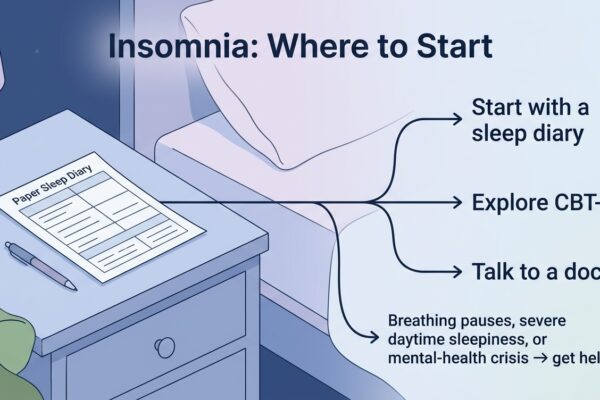
A sleep diary is the simplest way to see real change. Write down when you go to bed, wake up and nap for a week or two, rather than judging each night by how rough it felt. Patterns across several nights matter more than any single bad one.
The sleep-timing numbers page shows what’s typical to compare against.
What to do when you can’t fall asleep
You don’t need to read a full guide to start. Pick whichever option above matches tonight’s problem and go straight to the page built for it. The techniques, fallback and when-to-get-help sections all live in the main article if you want more detail later.
If you’d rather read start to finish, the full guide walks through every stage.
Sources
What backs the calming, room and quiet-activity suggestions on this page.
Why relaxation techniques are offered as reasonable options, not guaranteed fixes.
Why how long it takes to fall asleep varies from person to person.
When ongoing trouble falling asleep is worth a clinician visit.
This Compass points you to the right page; it can’t diagnose you or replace care from a clinician who knows your health. Sources checked . Researched from the sources above, drafted with AI assistance and edited by Aamir Bashir, Founder & Editor (editorial policy).