
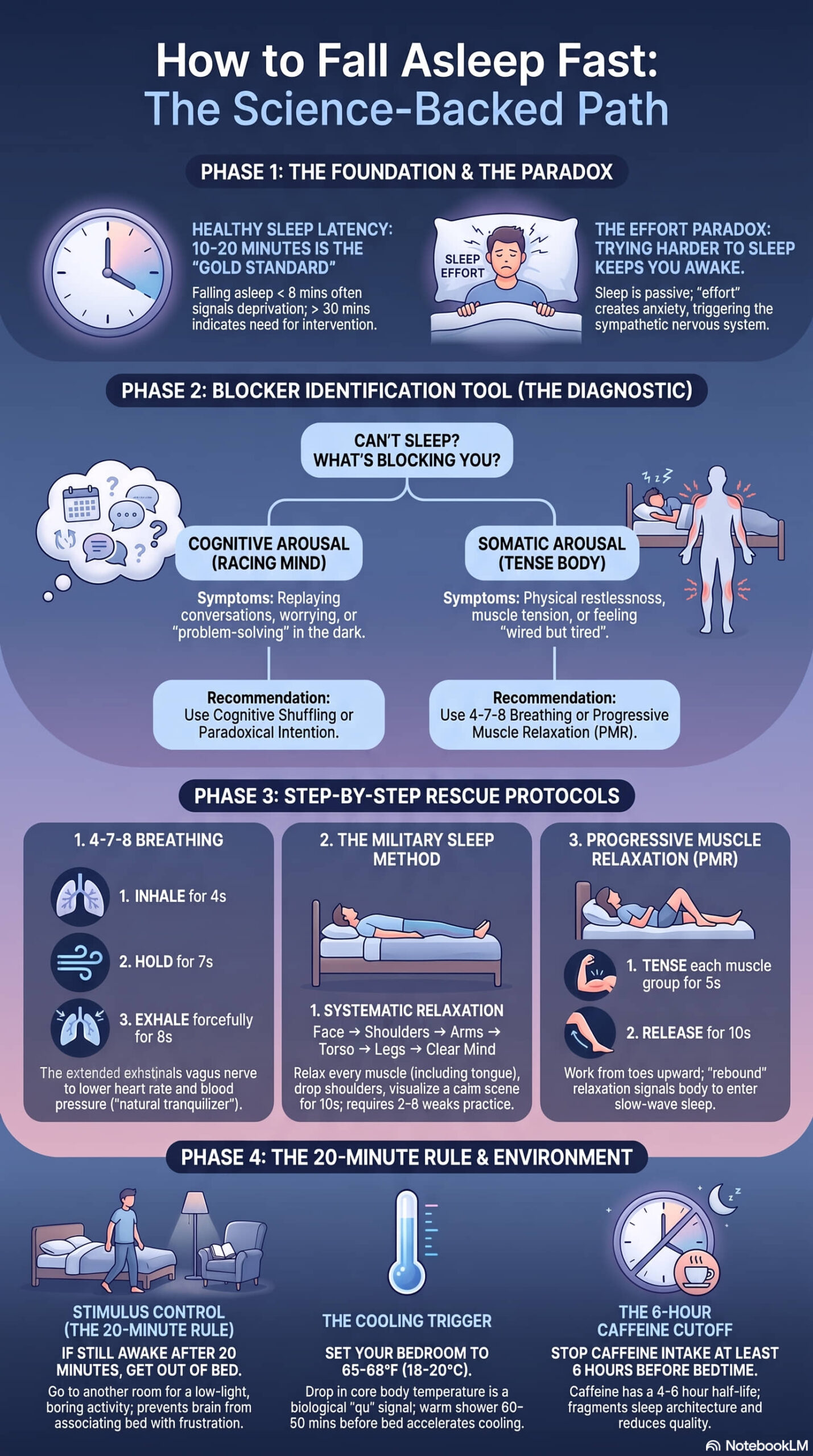
If you lie awake night after night, the answer isn’t just “try harder to sleep” — it’s understanding why your brain won’t shut off. Our Sleep Blocker Identifier helps you pinpoint whether cognitive arousal (racing thoughts), somatic arousal (physical tension), circadian misalignment, or conditioned wakefulness is keeping you up, then matches you to the most effective technique for your specific blocker.
This assessment tool is for informational purposes only and does not constitute medical advice, clinical diagnosis, or treatment recommendations. Consult a qualified healthcare professional for any personal sleep health concerns.After you complete the 8 questions, your result will show one of four primary sleep blockers, along with a personalized technique to try tonight. If your result doesn't resonate, try adjusting your answers — you can retake the assessment as many times as you like. For more on each blocker, visit the How to Fall Asleep Fast Q&A hub.
How This Tool Works, Step by Step
Below we walk through every question the Sleep Blocker Identifier asks, why each one matters for your sleep onset, and how your answers influence your personalized result. Understanding the logic behind each step helps you use the tool more effectively — and gives you a head start on tonight's bedtime routine.
Step 1: Identify What's Most Active — Mind or Body
The first question asks whether your mind, body, or both feel most active when you get into bed. This helps distinguish between cognitive arousal (mental chatter, worry, planning) and somatic arousal (physical tension, restlessness). Many people experience both, which is why "both equally" is an option — it signals that your sleep blocker may be a combination type requiring a hybrid approach.
Step 2: Track Your Last Caffeine Intake
This question asks when you last consumed caffeine — coffee, tea, soda, or energy drinks. Caffeine has a half-life of 4–6 hours (and up to 12 hours depending on metabolism), meaning it can still disrupt sleep quality even if you feel you "sleep fine." Choosing "within the last 6 hours" strongly suggests a circadian or cognitive blocker, since caffeine not only delays sleep onset but also increases mental alertness.
Step 3: Assess Your Bedroom Temperature
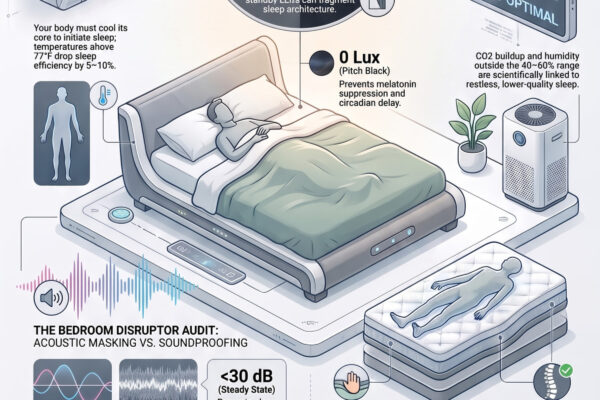
Your bedroom's temperature directly impacts your ability to fall asleep. The optimal range is 65–68°F (18–20°C) — any warmer can prevent the natural drop in core body temperature that triggers sleep onset. If your room feels too warm or too cold, it may contribute to somatic arousal (physical discomfort) or circadian timing issues if temperature fluctuations disrupt your internal clock.
Step 4: Examine Your Reaction When You Can't Sleep
How you respond to wakefulness in bed is one of the most powerful predictors of conditioned arousal. Staying in bed and trying harder to sleep, or watching the clock, reinforces the association between your bed and frustration. Choosing "get out of bed and do something relaxing" is a positive signal — it's the foundation of stimulus control, a core CBT-I technique proven to break the cycle of conditioned insomnia.
Step 5: Gauge Your Physical Tension Level
This step asks how physically tense your body feels, from jaw and shoulder tightness to neck stiffness. High tension points to somatic arousal — a state where your nervous system is stuck in "fight or flight." This is distinct from cognitive arousal, though they often co-occur. If you report high tension, the tool may recommend progressive muscle relaxation (PMR), which takes 2–6 weeks of practice to become a reliable conditioned sleep signal.
Step 6: Describe Your Thought Patterns
Here you choose how to describe your thoughts: racing, worrying, calm but not sleepy, or distracted. Racing thoughts and worry are hallmarks of cognitive arousal — the mental overactivity that keeps your brain alert. This question helps the tool separate cognitive from somatic arousal. If your thoughts are calm but you still can't sleep, it may point toward circadian timing or conditioned arousal instead.
Step 7: Evaluate Your Sleep Schedule Consistency
Your sleep/wake schedule is the strongest lever you have over your circadian rhythm. Selecting "irregular" or "chaotic" strongly suggests a circadian timing blocker. Even variations of just 1–2 hours on weekends can create "social jetlag," making it harder to fall asleep on Sunday and Monday nights. Consistency — within 30 minutes daily — is more powerful than any single sleep aid for circadian alignment.
Step 8: Estimate Your Average Sleep Latency
The final question asks how long it typically takes you to fall asleep. Normal sleep latency is 10–20 minutes; under 10 minutes can signal sleep deprivation, while over 45 minutes indicates significant difficulty. Longer latencies, especially when combined with clock-watching or staying in bed awake, strongly point toward conditioned arousal. This step helps the tool confirm which blocker is most likely, especially when other scores are close.
Step 9: Receive Your Personalized Blocker & Technique
After all 8 questions, the tool calculates which sleep blocker is most prominent: Cognitive Arousal (racing mind), Somatic Arousal (physical tension), Circadian Timing (clock misalignment), or Conditioned Arousal (bed-wake association). You'll see the blocker name, a description, a specific technique to try tonight (e.g., cognitive shuffling, PMR, light exposure, or stimulus control), and a plan B if the primary technique doesn't work. This isn't a diagnosis — but it's a science-backed starting point tailored to your unique pattern.
Circadian misalignment, untreated anxiety, and conditioned bed-wake associations are the primary drivers of chronic sleep onset insomnia.
You lie awake for 30+ minutes, feel frustrated, and may develop anticipatory anxiety about sleeping — reinforcing the cycle night after night.
Cognitive Behavioral Therapy for Insomnia (CBT-I) is the gold standard — it addresses all four blocker types with a 70–80% success rate in clinical trials.
Sources & References
Now You Know Your Blocker — Here's Your Next Move
You now have a personalized technique to try tonight. For deeper guidance on each blocker — including step-by-step protocols, science-backed routines, and troubleshooting — explore our complete sleep optimization library.
Read the Full Guide →