
This tool provides educational estimates based on CBT-I principles and cannot diagnose insomnia or replace a clinical sleep assessment. Always consult a physician before altering sleep schedules.
Quick Answer
CBT-I for insomnia uses sleep efficiency—the percentage of time in bed actually spent asleep—to determine if sleep restriction therapy is appropriate. Efficiency below 85% indicates fragmented sleep that responds best to behavioral protocols rather than medication.
Drag the sliders to match your average nightly sleep diary numbers, and watch your sleep efficiency gauge and personalized time-in-bed window update instantly. Review your result tier to see if you are ready for sleep restriction, then explore our CBT-I questions answered to understand the protocol.
Time in Bed (TIB)
Drag the slider to your average hours spent in bed attempting to sleep. This baseline is critical because sleep restriction therapy compresses this window to match your actual sleep ability. Overestimating this number weakens the homeostatic sleep pressure needed to consolidate your rest, a core concept in our sleep solutions hub.
Total Sleep Time (TST)
Set this to your actual hours of sleep obtained, excluding awake time. This metric directly calculates your sleep efficiency percentage. If your TST is consistently low despite long hours in bed, it signals the fragmented sleep pattern that CBT-I techniques are specifically designed to repair.
Why This Tool Matters
Spending excessive hours in bed trying to force sleep fragments your sleep drive and teaches your brain to associate the mattress with wakefulness.
You wake up exhausted, frustrated, and increasingly anxious about the upcoming night, creating a self-perpetuating loop of sleeplessness.
This calculator determines your exact sleep efficiency threshold, providing a safe, personalized time-in-bed window to rebuild your biological sleep pressure through restriction, the foundation of our insomnia recovery framework.
Time to Fall Asleep (SOL)
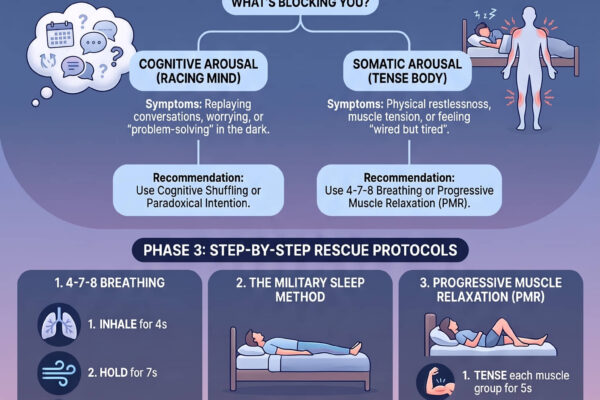
Adjust this slider to reflect your typical sleep onset latency. Taking longer than 30 minutes to drift off often points to conditioned arousal, where your brain associates the mattress with frustration and anxiety before bed. Understanding this delay helps tailor stimulus control rules.
Time Awake at Night (WASO)
Input your average wake after sleep onset. Frequent or prolonged night wakings destroy sleep architecture and leave you exhausted. Tracking this specific metric highlights sleep maintenance insomnia, a core target for behavioral interventions that stabilize your rest, especially if you struggle with waking at 3am with anxiety.
Insomnia Duration
Select how long you have battled chronic insomnia. The duration of your sleep struggle influences the treatment timeline and whether digital programs or guided therapy is the better starting point. Long-term patterns often require structured behavioral sleep medicine to dismantle entrenched habits outlined in our chronic insomnia guide.
Primary Wake Issue
Tap the option that best describes your main frustration, whether that is waking too early or sleeping in. Identifying your specific circadian rhythm misalignment or sleep phase issue helps pinpoint whether your insomnia is driven by a delayed body clock or premature morning awakenings addressed across our behavioral sleep library.
Safety-Critical or Shift Job
Toggle this if your profession requires intense vigilance or irregular hours. Standard sleep restriction carries immediate risks for shift workers or heavy machinery operators. Modifying the protocol under medical supervision ensures you rebuild your sleep drive safely without compromising your daytime alertness or occupational safety.
Currently Using Sleep Medication
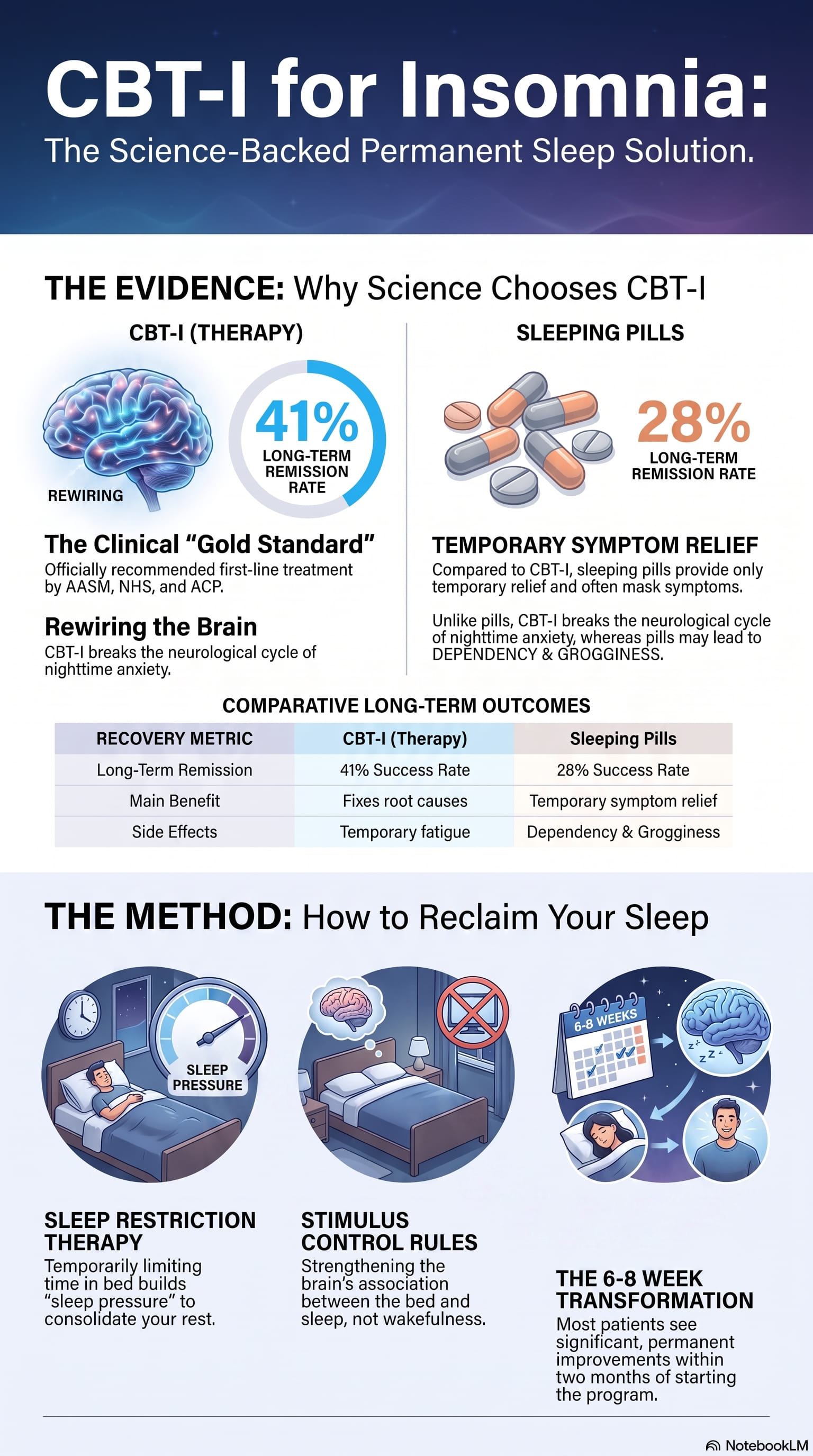
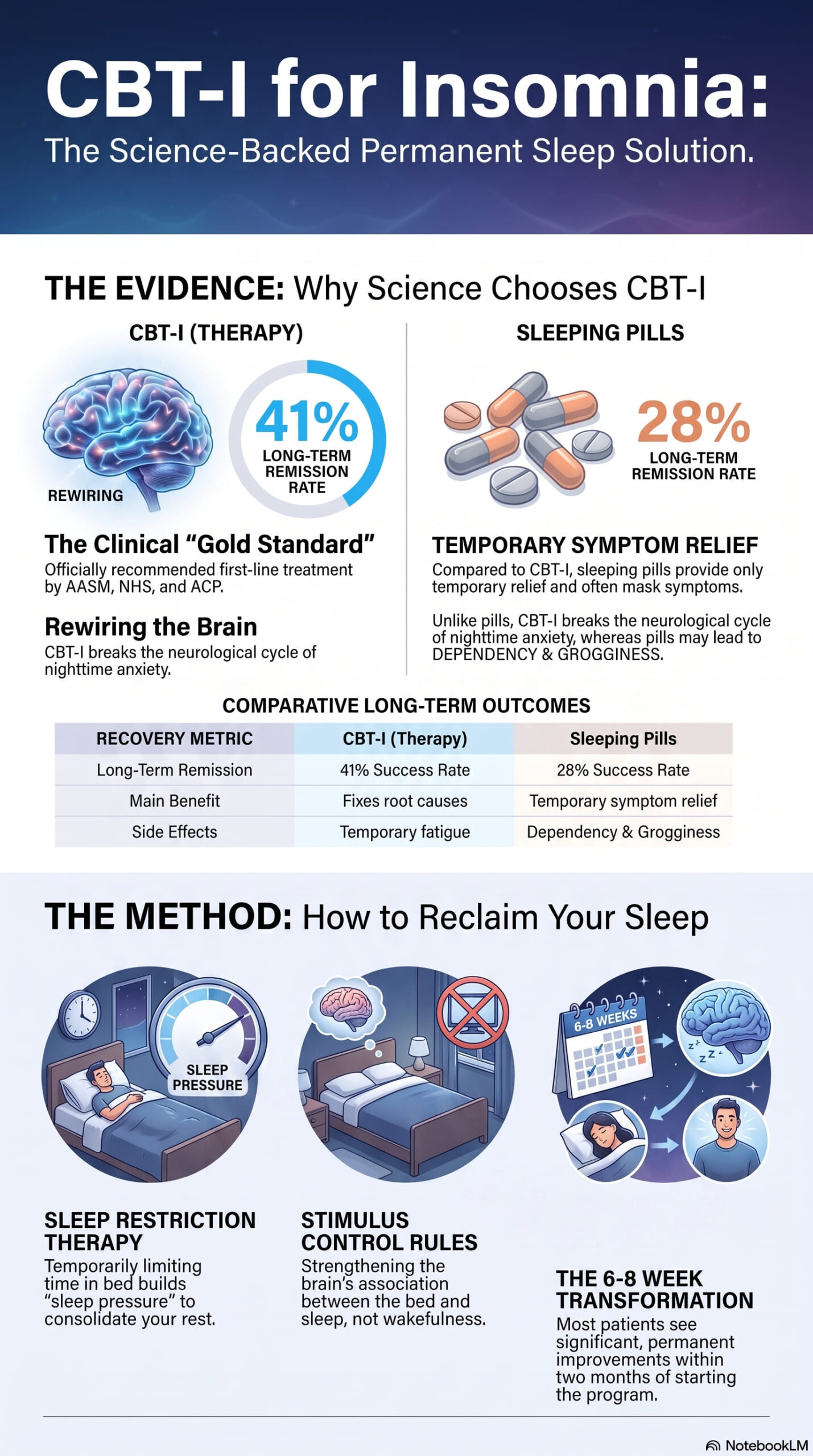
Indicate if you are relying on pharmacotherapy. While sleeping pills offer temporary relief, they do not fix the underlying behavioral drivers of insomnia. CBT-I provides a clinically validated exit strategy from medication dependency, helping you break the stress-insomnia cycle for sustainable, long-term remission.
CBT-I for insomnia questions answered
Get direct, evidence-based answers to the most common questions about starting and sticking with CBT-I protocols.
Read the answers →CBT-I for insomnia guide
Dive deep into the science, components, and step-by-step implementation of cognitive behavioral therapy for chronic insomnia.
Read the guide →Sources
- Furukawa et al., 2025 — CBT-I achieves 41% long-term remission vs. 28% for pharmacotherapy in chronic insomnia.
- ScienceDirect Component NMA, 2024 — Sleep restriction therapy is the most effective single CBT-I component for insomnia severity.
- npj Digital Medicine, 2025 — Fully automated digital CBT-I shows moderate-to-large effects across 29 RCTs.
- Cleveland Clinic, 2026 — Most people see improvement within 6–8 weeks of CBT-I with long-term benefits.
Last reviewed July 2026. ZenSleepZone updates this content regularly as new research becomes available.