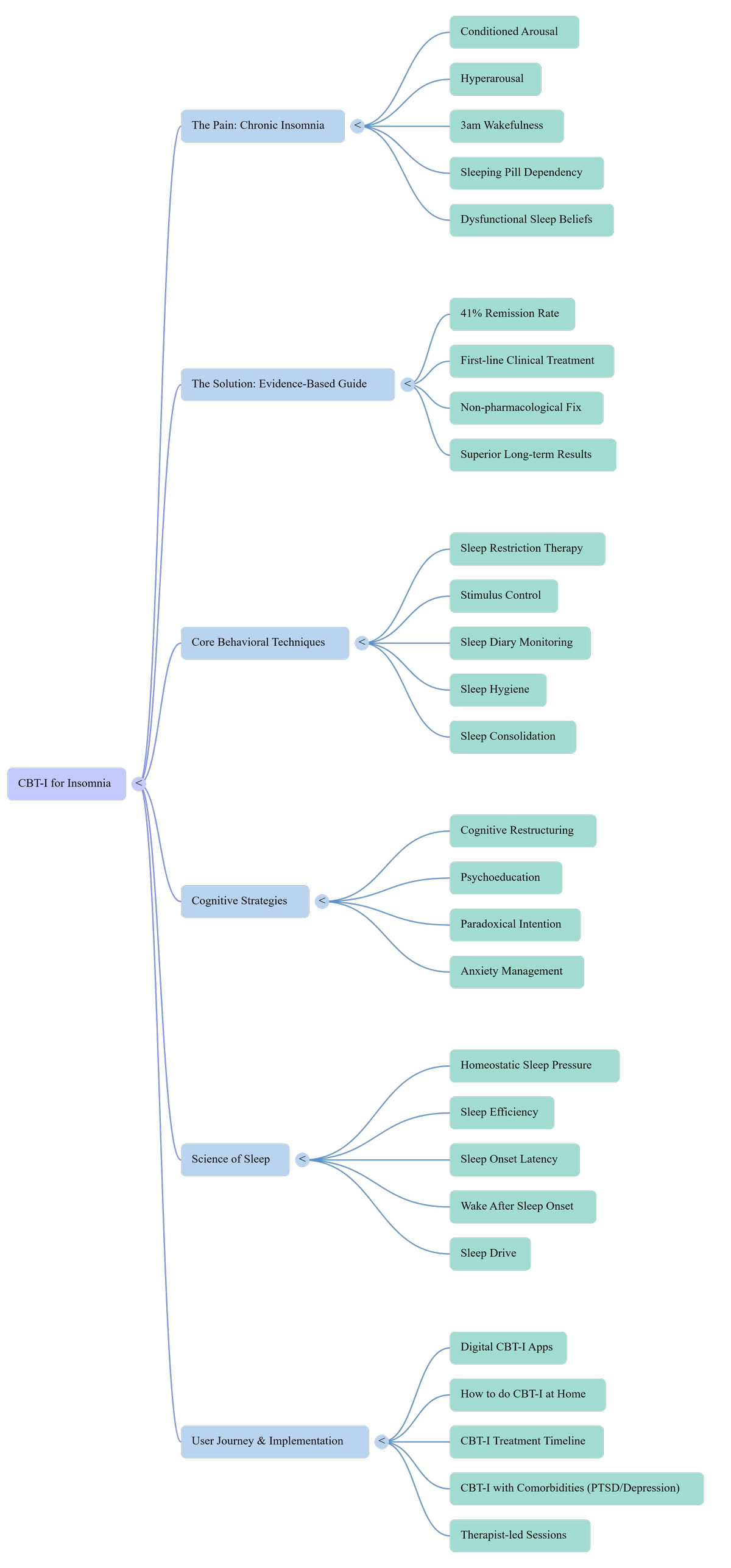

If you have spent months lying awake at 3 AM, relying on sleeping pills that are losing their effect, and wondering if there is a real cure for your chronic insomnia—Cognitive Behavioral Therapy for Insomnia (CBT-I) is the clinically validated answer. This interactive mind map breaks down the 41% remission rate, the exact behavioral techniques, and how to implement the science at home, going far beyond a static image.
What does the CBT-I for insomnia mind map cover?
CBT-I for insomnia is a non-pharmacological, evidence-based treatment for chronic insomnia. This interactive guide explores the pain of conditioned arousal and hyperarousal, the science of homeostatic sleep pressure and sleep drive, core behavioral techniques like sleep restriction and stimulus control, cognitive strategies, and a practical user journey for implementation at home, with a therapist, or via digital apps.
Chronic insomnia persists through conditioned arousal, where the brain associates the bed with wakefulness and anxiety. CBT-I for insomnia breaks this cycle using sleep restriction and cognitive restructuring, achieving a 41% long-term remission rate compared to 28% for pharmacotherapy (Furukawa et al., 2025).
Explore Every Level of the CBT-I for Insomnia Map
This interactive mind map guides you from understanding the core pain of chronic insomnia to implementing the solution. Each area opens deeper—revealing the science, specific techniques, and practical next steps at every level.
Chronic insomnia is more than just difficulty falling asleep; it is a profound cycle of conditioned arousal, hyperarousal, and pill dependency. The 3 AM wakefulness pattern—where you wake up in the middle of the night and cannot return to sleep—is a hallmark of the disorder. This pain is perpetuated by dysfunctional sleep beliefs, such as “I must get 8 hours or I will not function,” which only intensify the anxiety around sleep (Sleep Foundation, 2026).
12% of Americans have been formally diagnosed with chronic insomnia, and conditioned arousal—where the brain treats bed as a place of vigilance—is the core driver that makes the disorder persist (AASM, 2024).
Conditioned arousal describes the process where repeated sleepless nights form a Pavlovian association between the bed and wakefulness. The brain begins to treat the bedroom as a place for vigilance and problem-solving rather than sleep, creating a self-perpetuating cycle of insomnia.
Hyperarousal is a state of elevated physiological and psychological activation that prevents the natural transition to sleep. It involves increased heart rate, elevated cortisol, and a racing mind—keeping the nervous system in a fight-or-flight state that directly blocks sleep onset and maintenance.
Waking at 3 AM is a classic sign of sleep maintenance insomnia, often linked to anxiety and a disrupted circadian cortisol rhythm. This is the most frustrating form of insomnia, as the sleep drive has already been partially satisfied, making it incredibly difficult to fall back asleep.
Reliance on sleeping pills often reinforces the hyperarousal cycle, as the brain learns to depend on external chemical signals rather than natural sleep drive. Pharmacotherapy is rarely a cure and is associated with a lower 28% long-term remission rate compared to CBT-I’s 41% (Furukawa et al., 2025).
Dysfunctional beliefs—like catastrophizing the consequences of a bad night’s sleep—create performance anxiety that actively prevents sleep onset. These cognitive distortions are a primary target of CBT-I’s cognitive restructuring component, which systematically replaces them with balanced, evidence-based thoughts.
Cognitive Behavioral Therapy for Insomnia (CBT-I) is the first-line clinical treatment for chronic insomnia, recommended by the AASM, NHS, and ACP. As a non-pharmacological fix, it targets the underlying cognitive and behavioral causes of sleeplessness rather than just masking symptoms. Superior long-term results are the hallmark of CBT-I, with a 41% remission rate that outpaces the 28% achieved by pharmacotherapy (Furukawa et al., 2025; Sleep Foundation, 2026).
CBT-I is not just sleep hygiene—it is a structured multicomponent program with fundamentally different mechanisms, achieving a 41% long-term remission rate without medication.
CBT-I achieves a clinically significant 41% long-term remission rate for chronic insomnia, compared to just 28% for pharmacotherapy. This high-certainty evidence from a 2025 network meta-analysis demonstrates that behavioral and cognitive interventions produce more durable outcomes than medication (Furukawa et al., 2025).
CBT-I is universally recognized as the first-line clinical treatment for chronic insomnia by major health organizations. This means it is the preferred intervention that should be offered before medication, due to its superior safety profile, long-term efficacy, and ability to treat the root causes of insomnia (Sleep Foundation, 2026).
As a non-pharmacological treatment, CBT-I avoids the side effects, tolerance, and withdrawal risks associated with sleep medications. It re-trains the brain and body to sleep naturally by adjusting behavior patterns and eliminating the conditioned anxiety that perpetuates insomnia.
Unlike medication that often loses effectiveness over time, CBT-I produces durable improvements that persist long after therapy ends. This is because the therapy teaches lifelong skills—such as managing sleep drive, restructuring beliefs, and maintaining sleep consolidation—that protect against relapse.
The core behavioral techniques of CBT-I are actionable protocols designed to rebuild the brain’s association between bed and sleep. Sleep restriction therapy, the most powerful single component, consolidates sleep by limiting time in bed to match actual sleep duration. Stimulus control removes the conditioned arousal link by enforcing the rule: “only sleep in bed.” Sleep diary monitoring, sleep hygiene, and sleep consolidation complete the behavioral toolkit (ScienceDirect, 2024; Sleep Foundation, 2026).
Sleep restriction therapy has the largest effect size of any single CBT-I component (d = −0.45), making it the most potent active ingredient for reducing insomnia severity (ScienceDirect, 2024).
Sleep restriction therapy limits the total time spent in bed to match the actual sleep time, creating a mild sleep deficit that drives sleep pressure. This consolidates sleep and improves sleep efficiency, with an effect size of d = −0.45 for insomnia severity—the strongest among all single components (ScienceDirect, 2024).
Stimulus control is a set of behavioral rules that re-establishes the bed as a strong cue for sleep. The core rule is to only go to bed when sleepy and get out of bed if not asleep within 20 minutes. It is highly effective at breaking conditioned arousal and improving total sleep time (ScienceDirect, 2024).
Sleep diary monitoring is the objective tracking of sleep patterns over time, collecting data on bedtime, sleep onset latency, wake after sleep onset, and total sleep time. This data is essential for calculating sleep efficiency and adjusting the sleep restriction window with clinical precision.
Sleep hygiene involves lifestyle habits that support quality sleep, such as maintaining a consistent schedule, limiting caffeine and alcohol, and creating a cool, dark, quiet bedroom environment. While it is a supporting component of CBT-I, it alone is not a sufficient treatment for chronic insomnia.
Sleep consolidation is the endpoint of behavioral therapy, where the fragmented sleep pattern transforms into continuous, deep, and restorative sleep. Achieving sleep consolidation requires consistent application of sleep restriction and stimulus control, ultimately leading to a single, robust block of nighttime sleep.
Cognitive strategies within CBT-I address the mental narratives that fuel insomnia. Cognitive restructuring systematically challenges dysfunctional sleep beliefs, such as “I must sleep 8 hours” and “I will ruin my day if I don’t sleep.” Psychoeducation teaches the biology of sleep to reduce anxiety, while paradoxical intention reduces performance pressure by instructing the patient to try to stay awake. Anxiety management techniques, including relaxation training, complete the cognitive toolkit.
Paradoxical intention removes the performance anxiety of “trying to sleep,” by instructing the patient to stay awake—this reduces the cognitive arousal that actually prevents sleep onset.
Cognitive restructuring challenges and replaces catastrophic thoughts about sleep, such as “I will fail at my job if I don’t sleep tonight.” It reframes these beliefs with balanced, evidence-based alternatives—reducing the anxiety that serves as a primary driver of conditioned arousal and hyperarousal.
Psychoeducation is the process of teaching the patient the underlying science of sleep, including sleep drive, circadian rhythms, and the mechanics of conditioned arousal. Understanding the biological basis of insomnia reduces the fear and stigma surrounding it, empowering the patient to take control of their treatment.
Paradoxical intention is a therapeutic technique where the patient is instructed to do the exact opposite of their goal: try to stay awake. This removes the performance anxiety around falling asleep, reducing the active effort that often blocks sleep onset and allowing the brain’s natural sleep drive to take over.
Anxiety management encompasses relaxation techniques like deep breathing, progressive muscle relaxation, and mindfulness, which directly reduce physiological hyperarousal. These tools are essential for preparing the body for sleep and are often integrated with other cognitive strategies for maximum effect.
The science of sleep provides the biological foundation for CBT-I’s efficacy. Homeostatic sleep pressure is the natural drive to sleep that builds with every waking hour, while sleep drive regulates the urgency of sleep. Sleep efficiency, measured by the ratio of time asleep to time in bed, is the clinical metric used to guide sleep restriction. Metrics like sleep onset latency and wake after sleep onset (WASO) are the measurable targets that CBT-I systematically improves to restore normal sleep architecture.
Sleep efficiency is the primary clinical metric used to adjust the sleep restriction window; a target of 85% or higher indicates successful sleep consolidation.
Homeostatic sleep pressure is the biological drive to sleep that increases the longer you stay awake. In CBT-I, sleep restriction works by creating a controlled sleep deficit that intensifies this pressure, making it easier to fall asleep quickly and stay asleep through the night.
Sleep efficiency is the clinical metric defined as total sleep time divided by total time in bed, expressed as a percentage. CBT-I targets an efficiency of 85% or higher. This metric is the primary guide for adjusting the sleep restriction window and ensuring that time in bed accurately reflects actual sleep duration.
Sleep onset latency is the amount of time it takes to transition from full wakefulness to sleep. Prolonged latency is a primary symptom of conditioned arousal. Through stimulus control and paradox intention, CBT-I systematically reduces this latency to under 30 minutes.
Wake after sleep onset (WASO) is the total duration of wakefulness that occurs after the initial sleep onset. Chronic insomnia often features high WASO, particularly with 3 AM awakenings. Sleep consolidation is the primary CBT-I technique used to reduce WASO and restore continuous sleep.
Sleep drive is the brain’s biological urgency to sleep, influenced by homeostatic pressure and circadian rhythms. CBT-I harnesses the sleep drive as a natural agent of change, using sleep restriction to amplify it, thereby reducing sleep onset latency and WASO without medication.
Implementation of CBT-I is flexible, with options ranging from digital CBT-I apps (which show moderate-to-large effects across 29 RCTs with 9,475 participants) to full therapist-led sessions. This guide covers how to do CBT-I at home using a structured protocol, a standard CBT-I treatment timeline of 6–8 weeks (Cleveland Clinic, 2026), and adaptations for comorbid conditions like PTSD and depression. Whether you choose apps, self-guidance, or professional support, the core principles remain the same.
Fully automated digital CBT-I delivers moderate-to-large effects across 29 RCTs involving 9,475 participants, making professional-level treatment accessible at home (npj Digital Medicine, 2025).
Digital CBT-I apps are evidence-based, fully automated mobile platforms that deliver the core components of the therapy. A 2025 meta-analysis of 29 RCTs with 9,475 participants confirmed that these apps produce moderate-to-large effects on insomnia severity, making them a highly accessible and effective alternative to in-person therapy (npj Digital Medicine, 2025).
Starting CBT-I at home involves three steps: keeping a two-week sleep diary to calculate your baseline sleep efficiency, establishing a strict sleep window (time in bed equals average sleep time + 30 minutes), and applying the 20-minute stimulus control rule consistently. Adjust the window weekly based on your sleep diary data until you achieve 85% efficiency.
Most patients see clinically meaningful improvements within 6–8 weeks of starting CBT-I. The timeline begins with a 1-2 week baseline assessment using a sleep diary, followed by 4-6 weeks of active intervention where sleep windows are adjusted weekly. Benefits are durable and long-term, not requiring ongoing medication (Cleveland Clinic, 2026).
CBT-I is safe and effective for patients with comorbid PTSD and depression, though the treatment may require integrated care. The core behavioral techniques remain the same, but cognitive restructuring is often expanded to address trauma-related thoughts and depressive rumination, making a therapist-led session preferable in these cases.
Therapist-led sessions provide personalized guidance, deeper cognitive restructuring, and immediate support for complex cases. A certified CBT-I therapist can tailor the sleep restriction window, help with comorbid conditions, and ensure the patient remains on track for the 6-8 week improvement timeline.
Going deeper? The full CBT-I for insomnia step-by-step guide covers every protocol with detailed instructions.
Repeated sleepless nights condition the brain to associate bed with wakefulness and anxiety
Sleep onset and maintenance fail; pill dependency reinforces the hyperarousal cycle
CBT-I’s sleep restriction and stimulus control rules systematically break conditioned arousal
Move from understanding CBT-I for insomnia to implementing your personalized treatment protocol
This interactive map introduced the pain, science, and strategies of CBT-I. The complete guide provides a 6-8 week protocol, detailed sleep diary templates, and exact calculations for your sleep restriction window. Read the complete CBT-I for insomnia treatment guide.
Read the Full Guide →Sources & References
This content is for informational purposes only and does not constitute medical advice. Always consult a qualified healthcare professional for personal health decisions. Content reviewed by the ZenSleepZone Research Team.